
Silvio Pellico was a celebrated Italian playwright, and the Austrian police suspected him of belonging to the Carbonari, a secret revolutionary society1. On Friday, 13 October 1820, at three in the afternoon, he was arrested in Milan and taken to the Santa Margherita prison2. At nine that evening the jailer took his watch and money into safekeeping and politely wished him good night. Pellico asked for something to eat: he had had no dinner that day. The jailer promised to fetch a meal from the inn next door and praised its wine2, but when he heard that his prisoner didn’t drink wine, he looked at him in alarm2: “I’m sorry for you: you’ll find the solitude twice as hard.”3
The cell was on the ground floor and looked out onto the courtyard2: “Prisons on this side, prisons on that, prisons above, prisons opposite.”3 Somewhere prisoners were singing wildly, jailers came and went, and Pellico leaned on the windowsill for some time, listening2. He tried to brace himself with the thought of how quickly time passes, but then he remembered his father and mother, his brothers and sisters, and all his philosophizing was no help2. “My heart melted, and I wept like a child,”3 he writes. It was in that cell that Pellico learned to pray in his own words, which may be just what you are hoping to learn.
So how do you start praying? Simply: talk to God about what is on your heart right now, in whatever words you have. You don’t need polished phrases or a “proper” formula, and written prayers are a good support on the days when your own words won’t come. The people who found their way into prayer like this could hardly be more different: an Italian Catholic prisoner, a Canadian Presbyterian missionary, a French Carmelite nun and a Russian Orthodox bishop who spent his last two decades as a recluse. Here are their stories.
“Am I not in excellent company?”
With the interrogations over, his days were suddenly empty, and solitude turned bitter. Books were not the problem: he had a Bible and a Dante, and the jailer offered him a few novels from his own collection. The problem was his restless mind, which could not settle on a page4. Even Dante didn’t get through to him: the canto he memorized each day was rote work, done while he brooded over his own fate. Now and then a passage of Scripture did reach him. He had loved the Bible all his life, even in the years when he took himself for an unbeliever, and he now treated it with new reverence; yet often his eyes went over the lines while his thoughts wandered, and nothing sank in4. Only little by little did he learn to go deeper into it4.
One day Pellico made a resolution: no thought should cross his mind that was not driven by the wish to accept God’s will. What set him on this path was a line he had come across: prayer must never stop, and real prayer is not a heap of words, the way pagans pray, but plain worship of God in what we say and in what we do4. What he read echoes Jesus’ words in the Sermon on the Mount: “And when you pray, do not babble on like pagans, for they think that by their many words they will be heard. Do not be like them, for your Father knows what you need before you ask Him” (Matthew 6:7–8)5.
Pellico used few set prayers. Not out of contempt, since he believed they were very helpful. He simply knew he could not recite many of them without his mind wandering off until he forgot he was worshipping at all4. Instead, he tried to remember all day long that God was near, and with every passing day his solitude frightened him less4. “Am I not in excellent company?”6 he would tell himself, and he grew calm and even started humming and whistling4.
He prayed for his family fervently, sometimes with tears4, “but the tears themselves were mingled with sweetness.”6 He trusted completely that God would sustain them and him, and, as he wrote later, he was not mistaken4.
A little girl with a toothache
Rosalind Goforth, a Presbyterian missionary, spent nearly half a century in China7. In 1921 she published How I Know God Answers Prayer, the testimony of a lifetime. Telling the story of her life, she begins with her childhood.
From the time she was tiny, whenever something went wrong, Rosalind’s habit was to take it straight to Jesus8. She was six or seven and playing in the garden when a tooth suddenly began to ache badly. Her mother tried to comfort her, but nothing helped8. So, with her face hidden against her mother, the little girl prayed without a sound: “Lord Jesus, if you will take away this toothache right now, now, I will be your little girl for three years.”8
Before the words were even out, the pain had vanished, and she was certain Jesus had taken it. The child took the deal seriously. For years, any time mischief tempted her, fear held her back, because breaking her promise might bring the toothache back8. A child bargaining with God can look naive, but what Goforth herself treasured about that day was something else: it left her with an abiding awareness that God was truly present8.
This is her testimony, not a promise that every pain will vanish after a prayer. But there is something in it for anyone: a small girl started with what hurt right then, and she didn’t go looking for the right words first.
“Like children who cannot read”
Thérèse Martin entered the Carmelite convent in Lisieux at fifteen and died there of tuberculosis at twenty-four. Her notebooks, published after her death as The Story of a Soul, became one of the most widely read spiritual books of the twentieth century, and the Catholic Church declared her a saint.
One Lent a novice came to Thérèse, radiant. She had dreamed that she was trying to talk her sister, a very worldly young woman, into leaving the vanities of the world behind, and now the novice wondered whether God might want her to bring that soul to Him. Should she write to her sister at Easter, tell her about the dream and say that Jesus was calling her to dedicate her life to Him? Thérèse simply said that she could ask permission.9 But Lent still had a long way to run, and the prioress was taken aback by such haste. Her reply: a Carmelite wins souls by praying for them more than by writing to them9. “We must get to work: let’s pray hard,”10 Thérèse told the novice. And their prayer for the sister was answered: “By the end of Lent, one more soul was consecrating herself to Jesus! It was a true miracle of grace, a miracle won by the fervor of a humble novice!”10
“How great, then, is the power of prayer!”10 Thérèse writes. Yet she adds that she would be in a sorry state if God heard only polished prayers taken from a book and written for a particular occasion. No such formula is needed for a prayer to be answered9. There are so many lovely prayers in books, each more beautiful than the last, that she could never recite them all and would never know which to choose. Hunting for them simply gives her a headache, so she doesn’t try, although she gladly recites the Divine Office9, the Church’s daily cycle of psalms and prayers. For her own prayer she has another way: “I do as children do who cannot read. I simply tell God what I want to say to Him, and He always understands me.”10
“For me, prayer is an upward surge of the heart; it is a simple look turned toward heaven; it is a cry of gratitude and love, in the midst of trial as well as in joy.”10 That doesn’t mean she throws written prayers away. On dry days her lifeline is the Our Father or the Hail Mary. When her mind is so parched that not one good thought will surface, she prays one of them as unhurriedly as she can, and she needs nothing more: that prayer by itself fills her with joy and nourishes her soul9. For Thérèse, her own words and the Church’s words are not rivals: when one fails her, the other carries her.
A prayer book is a phrasebook
Theophan the Recluse was a Russian Orthodox bishop. At fifty-one he gave up his diocese and settled at the Vysha Hermitage, and he spent the last twenty-two years of his life there in seclusion, from 1872 until his death in 1894. The mail brought him twenty to forty letters a day, and he answered every one11.
His Letters on Prayer include one to a layman with many social commitments12. The man had recently freed himself from the burden of managing an estate. Theophan pointed to the change he felt within himself as evidence that he had made the right choice12: “the soul has, as it were, been given little wings.”13 The same man confesses, clearly worried: “I no longer pray as well using prayer books.”13 Theophan answers: “That is no loss.”13 He even adds: “You need never take a prayer book in your hands at all.”13 Then he explains with an unexpected comparison: “Prayer books are just like phrasebooks, French ones for example.”13 In other words, ready-made texts are something to lean on while you learn. Once the soul can turn to God by itself, the book can be set aside12.
The same letter has an image that echoes Thérèse’s words: “Children come up to their father or mother and say nothing; they just keep hovering around them, because it is sweet for them to be near them.”13
It matters who this was written to: someone already used to praying from a prayer book. Theophan tells him he may pray without the book whenever prayer is alive in his heart, and in the same breath warns him not to let laziness hide behind it12. Otherwise, he writes, “the enemy will come at once and, as if taking you by the hand, begin pulling you away from prayer.”13 And when his own prayer will not come, Theophan advises starting with printed prayers to stir it up, and knowing a few prayers and psalms by heart12.
Our own advice, not Theophan’s, for anyone who keeps a prayer rule (a fixed set of daily prayers) or prays from a prayer book, whether Orthodox, Catholic or Anglican: add your own words to those prayers rather than putting them in their place. For how to choose a rule that fits your life, see our article on the rule of prayer.
When prayer won’t come
Prayer didn’t always come easily to Pellico either. Nightmares began to torment him. One night he woke with the feeling that he was being strangled. His own handkerchief was wound tightly around his neck and tied in several knots, and he had no memory of doing it14. By day he joked with his fellow prisoners and his jailers, but at sunset he would start to shiver. He never dared ask to be moved to another cell, afraid that he would be laughed at. In the end he was gripped by the dreadful thought that God had abandoned him for good14. For several days he resisted the arguments against Providence, then gave in and began to repeat what he had heard from furious atheists: that religion does nothing but weaken the mind. But God freed him from all this when he least expected it14. Then, one morning, his coffee was followed by violent vomiting and cramps, and he was sure he had been poisoned. Worn out, he dozed off around noon and slept quietly until evening, and when he woke, the calm inside him took him by surprise. Rather than lie down again, he stayed up, reasoning that he could face the usual night terrors better on his feet. They never came14. Overflowing with gratitude, he threw himself on his knees and begged God to forgive him for denying Him those days, and he fell asleep right there, still kneeling, leaning against a chair14.
The hardest part was still ahead. On 21 February 1822 he was brought before the judges15. What he heard was a death sentence, and then the emperor’s rescript changing it: fifteen years of hard imprisonment, to be served in the Spielberg fortress15. “God’s will be done!”16 he answered. He truly meant to take this terrible blow as a Christian, bearing no one a grudge15. But in the eyes of one judge, who had always seemed hostile to him during the trial, Pellico thought he saw a gloating, mocking smile, and the Christian patience they were still praising him for was already, secretly, gone15. Back in his cell, the first thing he did was sit down and write to his father: he wanted his family to hear the terrible news from him rather than from anyone else17. That night he could not sleep for thinking of his elderly parents. Would they survive such a blow?17 He thought, too, of that judge and the gloating, mocking look he believed he had seen in his eyes17. The night was hell: he could not forgive, nor did he want to; hatred tasted sweeter17. He admits it plainly: “In the morning, I did not pray.”18 And he goes on: “I felt wretched that I could not pray; but where pride reigns, one finds no other God than oneself.”18
Pellico doesn’t hide that night or turn it into a tidy moral. But his honesty suggests a useful question: if prayer suddenly won’t come, what am I hiding from God right now? Resentment, anger and pride can be named out loud, and that, too, is praying in your own words.
And if you have no words at all, the apostle Paul offers comfort: “In the same way, the Spirit helps us in our weakness. For we do not know how we ought to pray, but the Spirit Himself intercedes for us with groans too deep for words” (Romans 8:26)19.
How to start praying today
- Start with what is on your heart, or what hurts. One sentence is enough, as it was for little Rosalind.
- Use ordinary words. Thérèse didn’t hunt for beautiful prayers, and she was sure God understood her.
- When words won’t come, lean on written prayers. Read the Lord’s Prayer or a psalm very slowly, then carry on in your own words. Theophan advised this, and Thérèse did it.
- Name whatever is in the way. Resentment and pride took Pellico’s prayer from him; telling God about them is already the start of a conversation.
- Don’t wait for the right place or time. Pellico prayed in a prison cell, Rosalind with her face hidden against her mother.
Support for your own words
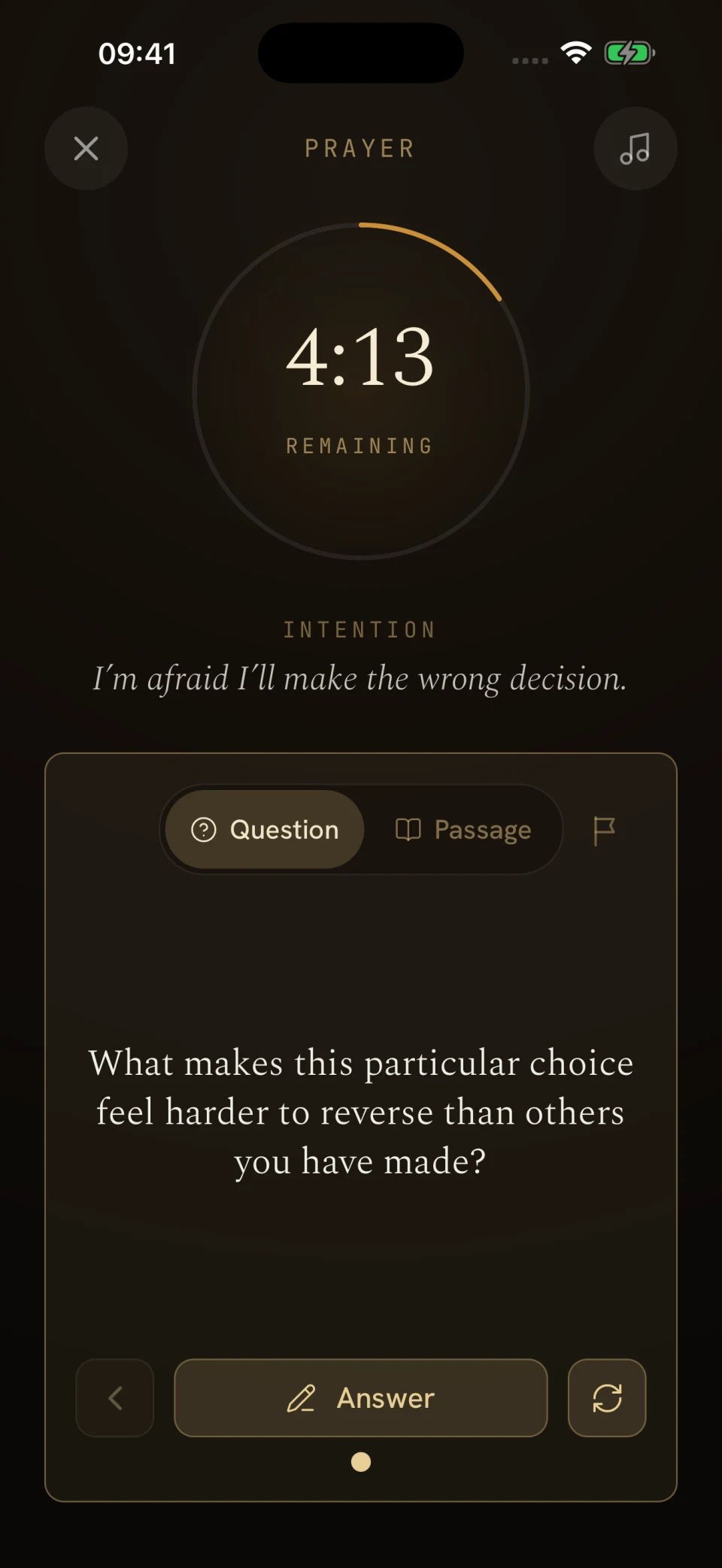
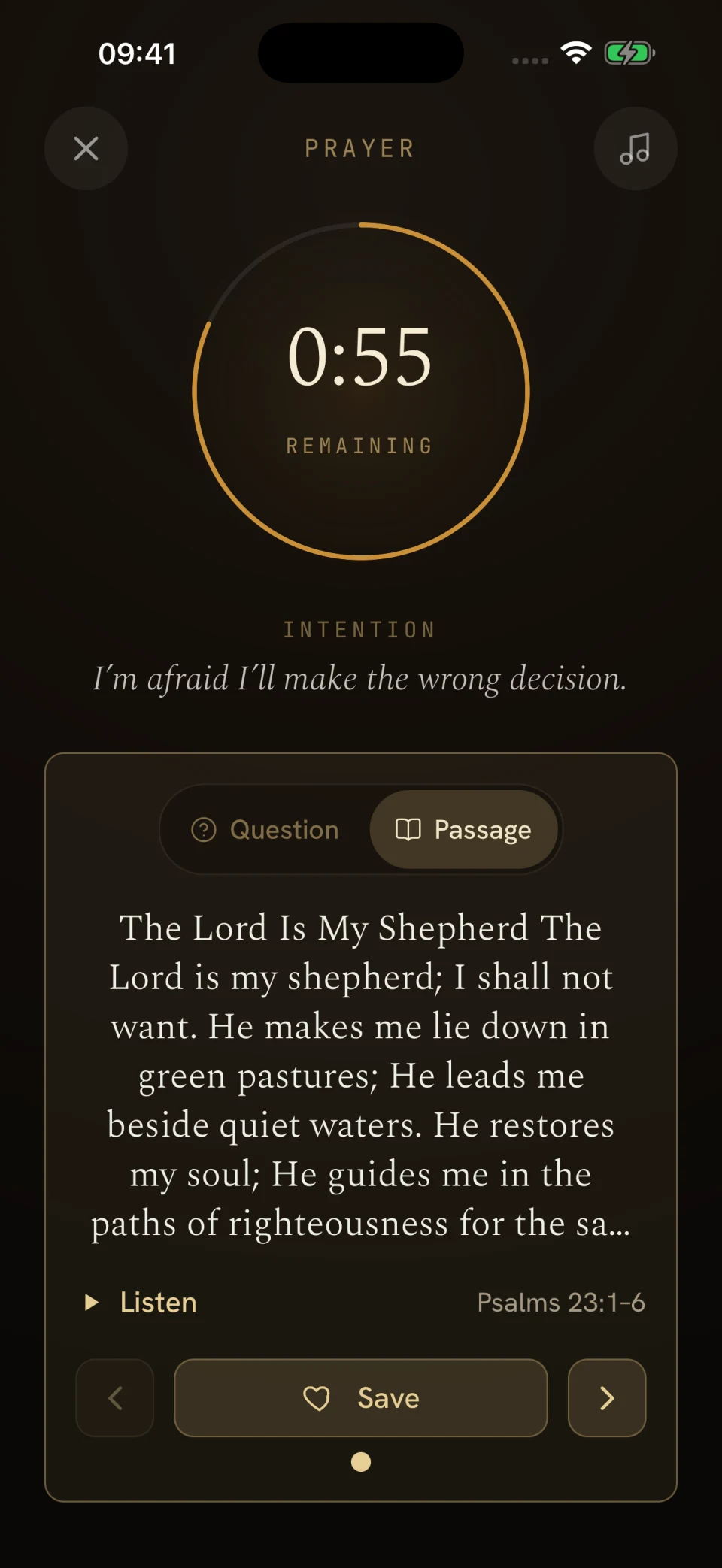
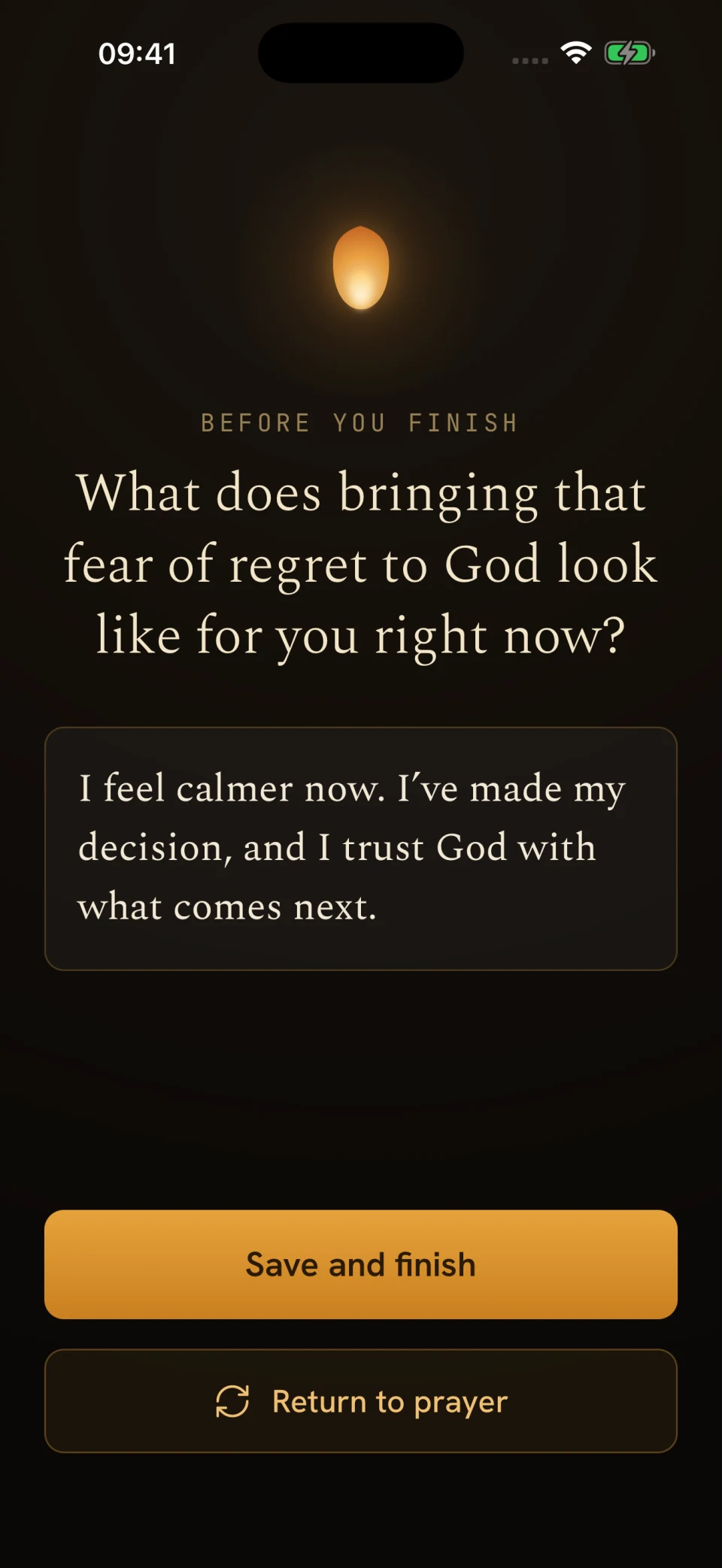
If you’d like something to lean on, try Lampada. It’s an app for praying in your own words: you choose a topic and how long to pray, and when your words run out, Lampada offers a guiding question and finds Scripture passages that fit what you are praying about. At the end you can write down your main takeaway in a journal that stays only on your phone. The prayer itself remains yours: you do the talking.
Pellico spent almost ten years in prison and later wrote a book about them, My Prisons1. But the line he spoke to himself in his first cell fits anyone who is about to talk to God for the first time: “Am I not in excellent company?”6
Frequently asked questions
Do I need to know prayers by heart to start?
No, you can talk to God in your own words. But it helps to know a few prayers and psalms by heart: they will carry you on the days when your own words are gone, as Theophan the Recluse advised above.
How do I start and end a prayer?
There is no required formula. You can simply address God (“Father”, “Lord” or “Lord Jesus”, as Rosalind did) and then say what is on your heart. Many Christians close with “Amen”, which means “so be it”, or with “in Jesus’ name, Amen”.
Can I pray silently, not out loud?
Yes. Little Rosalind Goforth prayed about her toothache silently, without saying a word out loud8.
What if prayer feels empty or boring?
Don’t give up and don’t blame yourself. You can start with a written prayer, read very slowly, and return to your own words when they come back. That is what Thérèse of Lisieux did.
-
Silvio Pellico on Wikipedia: author of the tragedy Francesca da Rimini; arrested in 1820 on a charge of carbonarism; released in 1830; Le mie prigioni (My Prisons) appeared in 1832. a b
-
Silvio Pellico. Le mie prigioni. Capo Primo. (it.wikisource.org) a b c d e f
-
Silvio Pellico. Le mie prigioni. Capo Primo., our translation (it.wikisource.org) a b c
-
Silvio Pellico. Le mie prigioni. Capo VI. (it.wikisource.org) a b c d e f g h i
-
Matthew 6:7–8. Berean Standard Bible (BSB), public domain. ↩
-
Silvio Pellico. Le mie prigioni. Capo VI., our translation (it.wikisource.org) a b c
-
Jonathan Goforth and Rosalind Goforth on Wikipedia: mission in China from 1888 to 1935. ↩
-
Rosalind Goforth. How I Know God Answers Prayer: The Personal Testimony of One Life-Time. II. EARLY LESSONS IN THE LIFE OF FAITH (www.gutenberg.org) a b c d e f
-
Sœur Thérèse de l’Enfant Jésus. Histoire d'une âme. CHAPITRE X Nouvelles lumières sur la charité. — Le petit pinceau : sa manière de peindre dans les âmes. — Une prière exaucée. — Les miettes qui tombent de la table des enfants. — Le bon Samaritain. — Dix minutes plus précieuses que mille ans des joies de la terre. (fr.wikisource.org) a b c d e
-
Sœur Thérèse de l’Enfant Jésus. Histoire d'une âme. CHAPITRE X Nouvelles lumières sur la charité. — Le petit pinceau : sa manière de peindre dans les âmes. — Une prière exaucée. — Les miettes qui tombent de la table des enfants. — Le bon Samaritain. — Dix minutes plus précieuses que mille ans des joies de la terre., our translation (fr.wikisource.org) a b c d e
-
Theophan the Recluse on Wikipedia: retired to the Vysha Hermitage in 1866, died in 1894. Seclusion from 1872 and twenty to forty letters a day: Russian Wikipedia. ↩
-
свт. Феофан Затворник. Письма о молитве. 14 (256) (azbyka.ru) a b c d e
-
свт. Феофан Затворник. Письма о молитве. 14 (256), our translation (azbyka.ru) a b c d e f g
-
Silvio Pellico. Le mie prigioni. Capo XLVI. (it.wikisource.org) a b c d e
-
Silvio Pellico. Le mie prigioni. Capo LI. (it.wikisource.org) a b c d
-
Silvio Pellico. Le mie prigioni. Capo LI., our translation (it.wikisource.org)
-
Silvio Pellico. Le mie prigioni. Capo LII. (it.wikisource.org) a b c d
-
Silvio Pellico. Le mie prigioni. Capo LII., our translation (it.wikisource.org) a b
-
Romans 8:26. Berean Standard Bible (BSB), public domain. ↩