
Mount Athos, early in the twentieth century. Silouan, an Orthodox monk who had once been a peasant in central Russia, was made steward of his monastery, responsible for its whole household. In the mornings he made the rounds of the workshops, but gave the foremen only general instructions and then went back to his cell to weep for “God’s people”. He had as many as two hundred workmen in his charge1. His disciple, Archimandrite Sophrony, recorded in his book about the elder how Silouan spoke of these men: “Here is Mikhail, who left his wife and children back in the village and works here for a pittance. How hard it must be for him, so far from home, never seeing his wife or his dear little children…”2 And so he went through them one by one: Nikita, newly married, who had left a pregnant wife and an old mother at home; Grigory, who had left his parents, his wife and two little ones to earn a crust of bread1. “Here is Nikolka, still just a boy…”2
If you don’t know what to pray about, start the same way: with what is in your life today. The people you saw, the task that worries you, what you are grateful for and where you went wrong. There is no single correct list of things to pray for; you can tell God about anything. But if you want something to hold on to, Christians have long used a few “maps”: the people around you, the parts of prayer (praise, thanksgiving, confession, asking, praying for others) and the Lord’s Prayer. Here is how some very different people used them.
“Here is Mikhail…”
Silouan, born Semyon Antonov, came into the world in a peasant family in 1866 and arrived on Athos in 18923. Back in his village, on the feast day of the local church, Semyon was walking down the street with a friend, playing the accordion. That was when the cobbler came at them: a huge man, a little drunk, known all over the village as a bully, who started jeering and trying to wrench the accordion out of Semyon’s hands3. Semyon asked him to leave off, but the cobbler kept pushing. Apparently he wanted to show all the young men in the village who was strongest, on a day when the girls were out in the street, laughing as they watched the quarrel3. “At first I thought of giving way, but suddenly I felt ashamed that the girls would laugh,”4 the elder remembered. One blow from Semyon to the chest, and the man went flying, landed flat on his back, blood and foam at his mouth3. “Everyone was frightened; I was frightened too; I thought: I’ve killed him. And I just stood there.”4 People doused the cobbler with cold water, and only after half an hour could he get to his feet3; he was ill for two months afterward, but he lived3.
Amid the rowdiness of his youth, Semyon’s old wish to become a monk was slowly fading, but God called him again. Once, after he had sinned against chastity, he dozed off and dreamed that a snake was crawling into his mouth. He shuddered with disgust, woke up, and heard a voice3: “You swallowed a snake in your sleep, and it disgusts you: just so, it is not pleasant for Me to see what you are doing.”4 There was no one to be seen, only a voice of a sweetness and beauty he had never known, and the elder was deeply convinced that it had been the voice of the Mother of God Herself3. Later he would say: “Now I see how the Lord and the Mother of God pity the people. Just think: the Mother of God came down from heaven to bring me to my senses, a young man deep in sin.”4 That young man grew into a monk of whom his disciple would write that he “offered up a great prayer for the whole world”2.
Back to the two hundred workmen. He grieved, too, for the mothers and fathers who had sent a boy off with a heavy heart to live among strangers for a beggar’s wage, and over the fact that nobody cared what became of these poor people1. The workmen never saw him praying for them, but they sensed it and loved him in return. He never drove them or stood over them, yet the work went more cheerfully under him than under the other stewards: treated kindly, people tried their best of their own accord1. “The Lord pities everyone”2, he used to say. And also: “To pray for people is to shed blood”2.
In his own writings Silouan advises praying even for the stubborn ones who won’t do as they are told: “Lord, give Your servant understanding: You love him”5.
That gives us the first and simplest topic: the people you saw today. You don’t need to know what they need. It is enough to ask yourself how they are doing right now, and to tell God about it.
A prayer list and a map
Robert Murray M’Cheyne was the Presbyterian minister of St Peter’s Church in Dundee, Scotland6. Once, out walking in the fields, he was nearly crushed by the realization that all the people in his care would before long be either in heaven or in hell7. One of his manuscripts reads: “Oh, how I wished that I had a tongue like thunder, that I might make all hear; or that I had a frame like iron, that I might visit every one”7. Not long before his death he drew up a private review of everything in his life that needed to change7, and he headed these notes “Reformation”7. His friend Andrew Bonar, also a minister, wrote the Memoir of Robert Murray M’Cheyne after his death and printed the notes in full7.
In the section on prayer, M’Cheyne starts with a rule: “I ought not to omit any of the parts of prayer—confession, adoration, thanksgiving, petition, and intercession.”7 Then he owns up to the parts he skips. Adoration drops out “when I forget to whom I am speaking”7. About thanksgiving he is blunter still: “I have the native tendency of the heart to omit giving thanks.”7 And praying for others goes too: “Often when the heart is selfish, dead to the salvation of others”7. His conclusion is sober: “Perhaps every prayer need not have all these; but surely a day should not pass without some space being devoted to each.”7
Then comes an actual prayer list. On it are his family and friends and, from his congregation, the sick and the grieving, the poor and the rich, believers and the indifferent, teachers and children. All of these he meant to pray for every day, along with shorter prayers for the whole town, the Church of Scotland, fellow ministers by name and missionaries among Jews and Gentiles7. “It would stir me up to pray with the map before me.”7 And: “I must have a scheme of prayer, also the names of missionaries marked on the map.”7 On Saturdays, from seven to eight in the morning and again in the evening, he meant to pray over all of them at length; perhaps, he thought, the different groups could also have different days, so long as his family and congregation were prayed for every day7. His list is not bookkeeping. It is a way of not forgetting the people we usually forget.
Ordinary tasks became topics as well. M’Cheyne noticed that he answered letters, and rushed off to see a sick parishioner, without first asking God, and he came to believe nothing should be done without prayer. He rested this on the words of the apostle Paul7: “Be anxious for nothing, but in everything, by prayer and petition, with thanksgiving, present your requests to God” (Philippians 4:6)8. And for drowsiness at evening prayer he has advice that still works: the best remedy, he writes, is “planning what things I am to ask”7.
The notes break off. Bonar remarks that M’Cheyne evidently never finished this review7. Typhus was raging in his parish at the time, and, worn out as he was, he kept going to the bedsides of the sick7. At an evening meeting in his church he spoke with great fervor, and afterward a chill came over him. In the morning he could tell he was ill, yet that afternoon he still went to a wedding between two members of his congregation7. That night he went to bed, and he never got up again7. He was only twenty-nine when he died7. Among his papers after his death was a letter no one had opened; it had come while he was lying ill with fever. A stranger had written it, someone who had heard M’Cheyne preach the Sunday before7, and who had also been moved by words from his prayer7: “Thou knowest that we love Thee.”7
The prayer that already holds every topic
Simone Weil, the French philosopher, was drawn to Catholicism but declined baptism and stayed on the threshold of the Church. In 1942, as she was preparing to leave France, she wrote a long letter to a priest who was her friend, and it later became part of her book Waiting for God9. In it she admits: “Until last September I had never once prayed in my life, at least not in the literal sense of the word.”10 And about the Catholic prayer to the Virgin Mary: “I had sometimes recited the Salve Regina to myself, but only as a beautiful poem.”10 She tells him she could only bring herself to share all this because she was leaving, and leaving with the thought that she would probably die11.
The change began with the Lord’s Prayer. In the summer, a year before this letter, Weil was studying Greek with an acquaintance; she went through the prayer with him word by word, and the two of them promised to learn it by heart11. “I don’t think he did. Neither did I, at the time.”10 She did keep the promise in the end: a few weeks later, turning the pages of the Gospel, she decided that a good thing she had promised herself was something she had to do11. “The infinite sweetness of this Greek text so took hold of me that for several days I could not stop reciting it to myself over and over.”10 “A week later I began the grape harvest. I recited the Our Father in Greek every day before work, and I repeated it very often in the vineyard.”10 “Since then I have made it my only practice to recite it once every morning with absolute attention.”10 If her mind drifts even slightly, she starts over, until she has said the whole prayer once without a moment’s distraction11. Sometimes she then says it once more, not because of her rule but for the sheer joy of it, whenever she feels like it11.
Her path is no model of church life, but her story points to something simple. If you have no topics of your own, there is the prayer Jesus gave His disciples as a pattern (Matthew 6:9–13). Weil wrote of it: “This prayer contains every possible petition; we cannot conceive of a prayer that is not already contained in it.”12 The main topics are already named there: God’s name and His will; our daily bread, meaning work, money and health; the forgiveness we ask for and the forgiveness we owe; the temptation and evil we ask to be delivered from. You can walk through it slowly and stop at whichever petition speaks to your situation today.
When there are too many topics
In the sixth century two recluses, Barsanuphius and John, lived near Gaza13. Seridos sheltered them from the crowds14: he was abbot of the local monastery, and Barsanuphius sent his answers out through him14. Seridos himself tells how those answers came to be written down. Once, as he listened to the elder, he thought: I will never remember all this; if only I could take ink and write it down as he speaks. Barsanuphius read the thought and told him to go and write without fear, because the Spirit of God would not let him add or drop a single word14. Their replies were collected into a book, known in English as their Letters, and the questions in it sound remarkably like ours.
Someone wrote to ask: when you are praying about many things, should you mention each one? The reply ran like this: since God knows what we need, you can simply ask the Lord to guide you as He wills. For your passions, ask Him to heal you according to His will; about temptations, say that He knows what is good for you and ask for help and deliverance15. Another asked how to pray for healing. John advised against straining to obtain it, since we do not know what is good for us. Better to tell God that you are in His hands, ask for mercy and, if it would do you good, a quick recovery, and to thank Him for everything16.
The advice to trust God is the counterweight to M’Cheyne’s list, and both approaches are honest. A list keeps you from forgetting. Trust keeps you from being afraid to forget.
Things to pray for: a prayer list with questions
Here is a map drawn from these stories. You don’t have to go through all of it: pick one topic for today and ask yourself the question that goes with it.
The people around you
- Family: who among those closest to me is tired, ill or anxious right now?
- Coworkers, neighbors, chance encounters: who did I see today, and how are they doing?
- Someone who hurt me: what good can I wish them before God?
- People far away: whose trouble did I hear about today?
The parts of prayer
- Praise: what about God amazes me today?
- Thanksgiving: what am I grateful for, even something small?
- Confession: what did I get wrong, and what do I regret?
- Petition: what do I really want to ask for?
- Praying for others: who is waiting for my prayer?
Through the Lord’s Prayer
- God’s will: where is it hard for me to say “Your will be done”?
- Daily bread: what do I need today, whether work, money or strength?
- Forgiveness: whom do I need to forgive?
- Temptation: what is pulling me where I don’t want to go?
When it’s all too much
- One request: if I put it in a single sentence, what am I asking for?
- Health: can I ask for healing and leave the outcome to God?
If you have a lot of topics, keep a prayer list of your own, with names and needs. You can spread those names and needs across the week (M’Cheyne considered praying for different circles on different days7) and read the list over from time to time.
One topic at a time
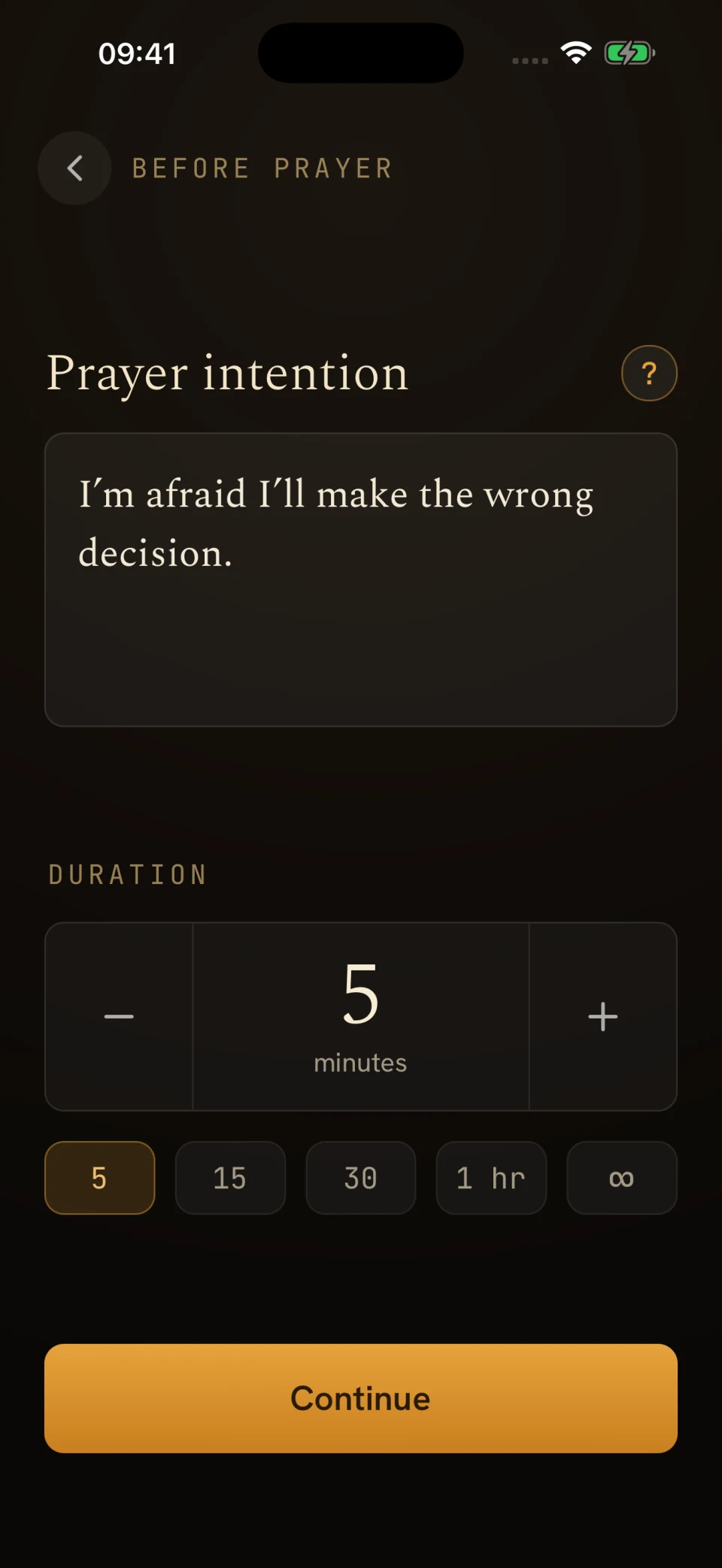
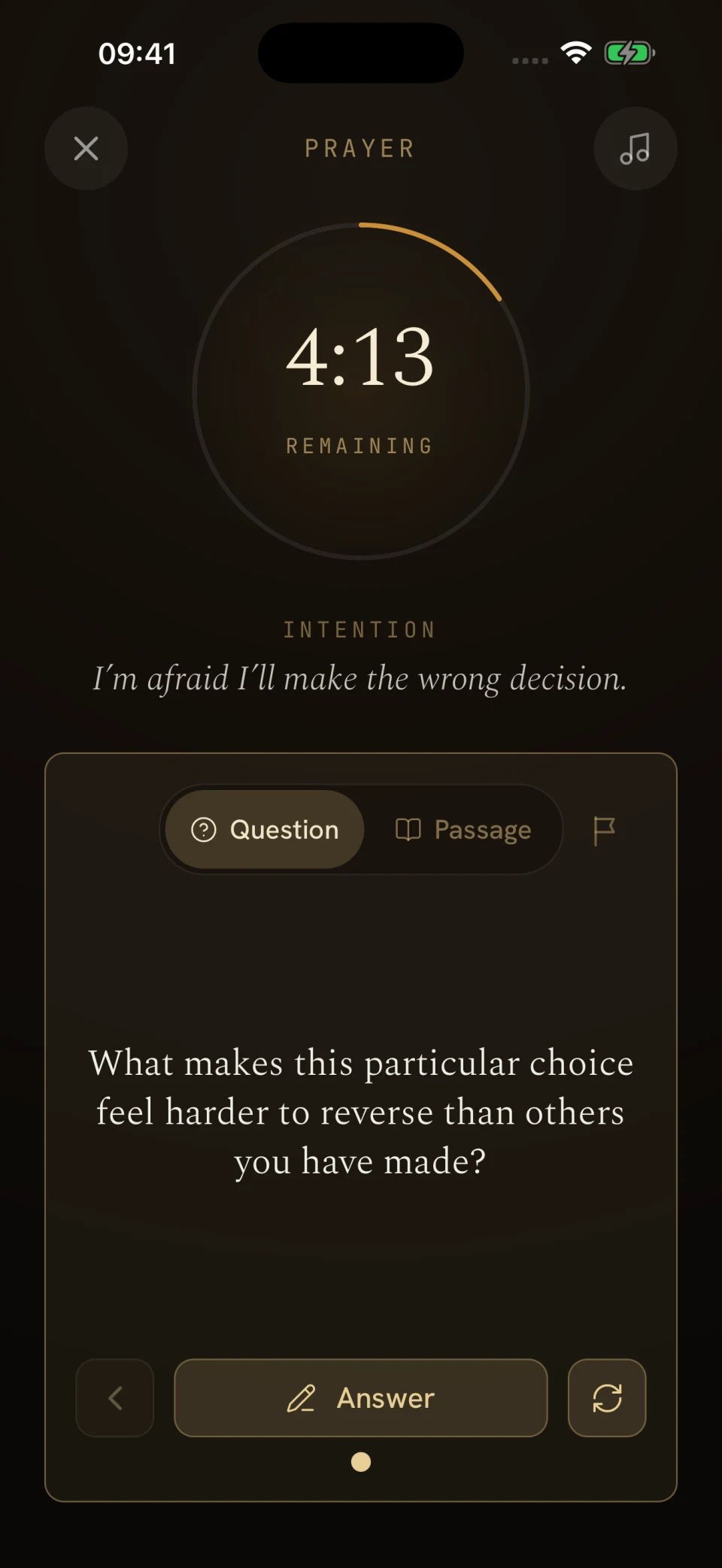
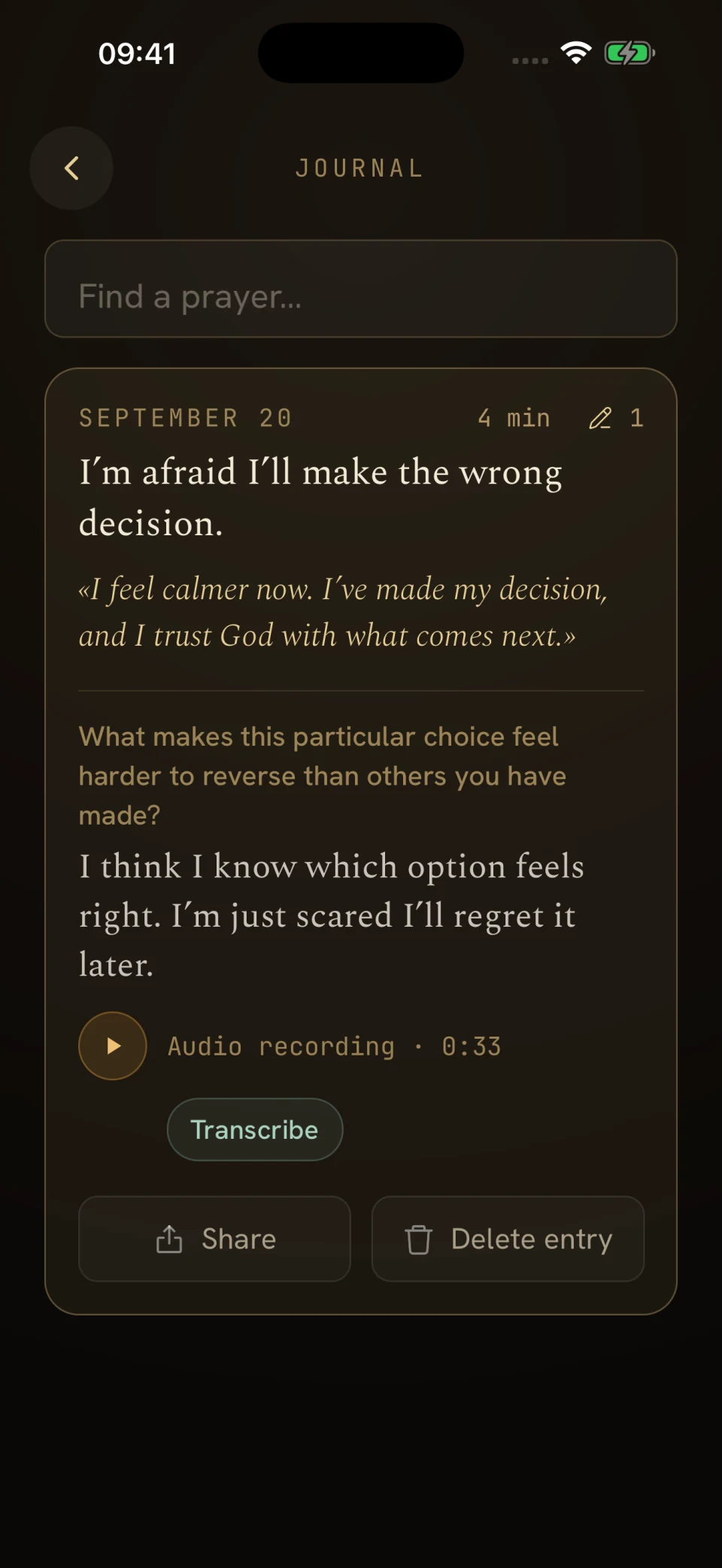
If you’d like a topic and questions close at hand, try Lampada. Before you pray, the app lets you choose a topic, such as a person, a task or a worry, and answer questions by typing or speaking. If you allow it, your answers are sent to a server, where AI asks the next guiding question and finds Scripture passages that fit what you are praying about; but you can also pray without sending your answers anywhere. And a journal on your phone keeps a record of what you prayed about: your own prayer list to come back to.
One last return to Silouan. Once he was asked whether a steward’s busy job, with so many people to deal with, harmed a monk’s inner stillness1. His answer can close our conversation about what to pray for, too: “If the soul loves the people and pities them, prayer cannot cease.”2
Frequently asked questions
What should I ask God for?
Any real need, your own or someone else’s. And if you don’t know exactly what to ask, you can ask God to guide you as He wills, since He already knows what we need15.
Can I pray about money, work and small things?
Yes. The apostle Paul tells us to present our requests to God “in everything” (Philippians 4:6). The elders of Gaza were asked even what to say in prayer if you want to manage your property in a godly way and have no one to advise you17, and M’Cheyne wrote: “I am persuaded that I ought never to do anything without prayer”7.
What are 5 things you should pray for?
There is no fixed rule. M’Cheyne named five parts of prayer: confession, adoration, thanksgiving, petition and intercession7. He allowed that a single prayer need not include them all, but he was sure that each one deserved a place at some point every day7.
-
архим. Софроний (Сахаров). Старец Силуан Афонский. Часть первая ЖИЗНЬ И УЧЕНИЯ СТАРЦА СИЛУАНА — III ВНЕШНОСТЬ И БЕСЕДЫ СТАРЦА (predanie.ru) a b c d e
-
архим. Софроний (Сахаров). Старец Силуан Афонский. Часть первая ЖИЗНЬ И УЧЕНИЯ СТАРЦА СИЛУАНА — III ВНЕШНОСТЬ И БЕСЕДЫ СТАРЦА, our translation (predanie.ru) a b c d e f
-
архим. Софроний (Сахаров). Старец Силуан Афонский. Часть первая ЖИЗНЬ И УЧЕНИЯ СТАРЦА СИЛУАНА — I ДЕТСТВО И МОЛОДЫЕ ГОДЫ (predanie.ru) a b c d e f g h
-
архим. Софроний (Сахаров). Старец Силуан Афонский. Часть первая ЖИЗНЬ И УЧЕНИЯ СТАРЦА СИЛУАНА — I ДЕТСТВО И МОЛОДЫЕ ГОДЫ, our translation (predanie.ru) a b c d
-
архим. Софроний (Сахаров). Старец Силуан Афонский. Часть вторая ПИСАНИЯ СТАРЦА СИЛУАНА — XIV О МОНАХАХ — О монастырском экономе, our translation (predanie.ru)
-
Robert Murray M'Cheyne on Wikipedia: born in 1813; minister of St Peter’s Church, Dundee, from 1836; died of typhus in March 1843. Andrew Bonar, his companion on a journey to Palestine in 1839, published his Memoir and Remains, which went through more than a hundred editions; Bonar places “Reformation” in his account of M’Cheyne’s last months. ↩
-
Andrew A. Bonar. Memoir of Robert Murray M'Cheyne. CHAPTER VI. — THE LATTER DAYS OF HIS MINISTRY. (www.gutenberg.org) a b c d e f g h i j k l m n o p q r s t u v w x y z aa ab
-
Philippians 4:6. Berean Standard Bible (BSB), public domain. ↩
-
Simone Weil on Wikipedia: 1909–1943; worked in the grape harvest on Gustave Thibon’s farm in the Ardèche; her letters to the Dominican Joseph-Marie Perrin appeared in Waiting for God; she declined baptism, and may have been baptized by a friend before her death (unconfirmed). ↩
-
Simone Weil. Attente de Dieu. LETTRES D’ADIEUX — LETTRE IV Autobiographie spirituelle, our translation (fr.wikisource.org) a b c d e f
-
Simone Weil. Attente de Dieu. LETTRES D’ADIEUX — LETTRE IV Autobiographie spirituelle (fr.wikisource.org) a b c d e
-
Simone Weil. Attente de Dieu. LETTRES D’ADIEUX — À PROPOS DU PATER, our translation (fr.wikisource.org)
-
Barsanuphius of Gaza on Wikipedia: a sixth-century recluse near Gaza who communicated with others only through Seridos, abbot of the nearby monastery; together with John the Prophet he left more than 850 letters to hermits, monks, bishops and lay people. ↩
-
прпп. Варсонофий Великий и Иоанн Пророк. Βίβλος ψυχωφελεστάτη… (Руководство к духовной жизни в ответах на вопрошения учеников). Вопрос 435. Когда молюсь о многих предметах, должно ли о каждом из них упоминать в молитве? (azbyka.ru) a b
-
прпп. Варсонофий Великий и Иоанн Пророк. Βίβλος ψυχωφελεστάτη… (Руководство к духовной жизни в ответах на вопрошения учеников). Вопрос 381. Если я попрошу (помолиться) святых о душевной страсти или телесной (болезни), и верую, что тотчас же последует исцеление: бывает ли так, хотя мне и неполезно немедленное исцеление? (azbyka.ru)
-
прпп. Варсонофий Великий и Иоанн Пророк. Βίβλος ψυχωφελεστάτη… (Руководство к духовной жизни в ответах на вопрошения учеников). Вопрос 437. Если кто желает благочестиво распорядиться своим имуществом или предоставить оное кому-либо, сообразно с волею Божиею, и не знает, как надлежит сие сделать, и не имеет возможности получить наставление от отцов, – что он должен говорить в молитве? (azbyka.ru)