
Near Paris, in the Russian émigré community, during Holy Week. A group of teenage boys are called in straight from a volleyball game to listen to a priest, and one of them refuses more sharply than anyone: he believes neither in God nor in priests1. The group leader talks him into at least sitting in a corner, but the talk about meekness and patience makes the boy angrier and angrier. The moment it is over, he runs home and asks his mother for a copy of the Gospels1: “I want to check, because if the Gospel says what this priest is saying, I am done with God, done with Christ, and I’ll throw away my baptismal cross”2.
He had no intention of wasting time on all four Gospels: “I’ll just read the shortest one”2. That turned out to be Mark. It was slow going: the boy kept stumbling over old-fashioned turns of phrase that felt foreign to him even in the Russian translation1. And somewhere between the first and third chapters, as he later recalled, he “suddenly felt that on the other side of the table where I was reading stood the living Christ”2. “I did not see Him, I smelled nothing, I heard nothing”2. He leaned back in his chair to make sure, and it was “not a vision, not a hallucination, but a simple certainty that He was standing there”2.
That boy grew up to be Metropolitan Anthony of Sourozh: a surgeon who provided medical help to members of the French Resistance during the occupation, and later a bishop in London3. He tells the story of that evening in one of his talks, with no labels and no method. Yet this kind of encounter is exactly what lectio divina, or “divine reading,” is for. It is a way of praying with Scripture: you read a short passage slowly, stay with the word that catches you, think about what it is saying to you, answer God in your own words and then simply rest with Him in silence. The four stages of this path (reading, meditation, prayer and contemplation) were described in the twelfth century by a monk named Guigo. They are not a schedule, though. They describe how a word usually makes its way to the heart.
Guigo’s ladder
Guigo was a Carthusian, and from 1174 to 1180 he was prior, the head of the monastery, at the Grande Chartreuse, the order’s mother house in France4. He wrote his Ladder as a letter to a friend, Brother Gervase5. Guigo feels indebted to him: it was this friend who had once helped him become a monk. So Guigo sends his work to him first and asks him to check and correct it, because his friend knows the spiritual life from experience, while Guigo knows it only from books5.
One day, while Guigo was busy at work and thinking about spiritual labor, four rungs came to his mind: reading, meditation, prayer and contemplation. It is a ladder like the one Jacob saw, standing on the ground at one end and reaching into the clouds at the other6. In Guigo’s scheme each rung carries on what the one before began: reading provides the material, meditation works its way into it, prayer lets you taste it, and contemplation fills the soul with joy and strength6.
He shows how this works with a single line: “Blessed are the pure in heart, for they will see God” (Matthew 5:8)7. As the reader meditates on it, the words turn into a personal question: is it enough that I do no wrong, if my heart is not pure?8 Out of that question grows a prayer for a pure heart, the same prayer David once prayed8.
Contemplation, though, is not something you can reach by effort: God gives this gift to whomever He chooses, whenever He chooses8. And Guigo adds a word of reassurance: if the sense of comfort fades, that does not mean God has abandoned you9.
Hannah Smith and a familiar verse
Hannah Whitall Smith grew up in Philadelphia in a prominent Quaker family, and her book The Christian’s Secret of a Happy Life was read all over the world10. In another of her books, The God of All Comfort, she admits that she had known the Twenty-third Psalm since early childhood, yet it had never seemed to mean anything special to her11.
Her Bible was out of reach at a moment in her life when she needed comfort more than ever and saw none anywhere. So she went through the verses she knew by heart, looking for one that might help, and this one came to her at once11: “The Lord is my shepherd; I shall not want” (Psalm 23:1)12.
Her first impulse was to dismiss the verse, almost disdainfully11: “Such a common text as that,” I said to myself, “is not likely to do me any good”11. She wanted something more out of the ordinary, but her memory offered nothing else, until it almost seemed there was no other verse in the whole Bible11. In the end she gave in: “Well, if I cannot think of any other text, I must try to get what little good I can out of this one”11. And she began to say it to herself, over and over11. “Suddenly, as I did so, the words were divinely illuminated, and there poured out upon me such floods of comfort that I felt as if I could never have a trouble again.”11
As soon as she could get hold of a Bible, she leafed through it eagerly: could such treasures of comfort really be hers? Out of the promises about the Lord as Shepherd she built a whole “pyramid” that no doubt could shake11. Her story shows what matters most: there is no need to hunt for a more impressive verse. A familiar word, repeated slowly, can open up all over again.
“What is this word saying to me?”
Back to the boy at the table. After that first encounter he went on reading the Gospels, now dipping in here and there1. Until then he had lived by a hard rule: “to survive in the jungle of the early emigration, you had to turn to stone, to become hard and impenetrable”2. Then he reads in Matthew that God makes His sun rise on the evil and on the good (Matthew 5:45). So if he wants to be with God, he has to love even the people he is afraid of1. “I thought this over and decided: all right; whatever people do to me, I will love them, so that I can stay with Christ”2.
This is meditation and prayer: not stopping at studying the text, but understanding what it says and answering God. Many years later, speaking about prayer, Anthony urged people to read the Gospel honestly. “When you read the Gospel, there are passages that mean very little to us at the moment”13. To others, if we were completely honest, we would answer: “no, no, Lord; even though You say it, no!”13 After his talk on the Beatitudes, one parishioner said exactly that: “Well, Bishop, if that is what you call blessedness, you can keep it; I’ll live without that blessedness”13.
And then there are passages that set your heart on fire, as the hearts of the two disciples burned on the road to Emmaus14. Those, Anthony said, are the ones to underline, and then to live by, not merely to keep in a notebook14. For him, meditation ends in a decision, and prayer can begin with an honest “no.”
When the text is silent
In the mid-1960s Enzo Bianchi went to live alone near the tiny village of Bose in northern Italy. In the autumn of 1968 the first brothers and sisters joined him, Catholics and Protestants alike, and a community grew up that he led until 201715. His book Pregare la Parola is a plain-spoken introduction to lectio divina, yet from the start Bianchi warns that he would not want “this method to become unchangeable and rigid”16.
“Don’t chase quantity: a single page, a chapter, a few verses are more than enough!”16 “Read the text not once but many times, and aloud.”16 “It is God who speaks, and reading is only a means of hearing.”16
Bianchi is candid about this: “The text may also ‘say nothing to me’”16. But even a conversation between friends has its moments of silence. Such silence often does the soul good, even when it comes from dryness and a heart gone numb: it helps you keep your eyes on God and wait for Him17. A silent text is not a sign that you are doing something wrong.
Which passage to choose
Two separate questions remain: which passage to choose, and how much to read. Bianchi advises against picking a passage to suit your situation, and he puts it strictly: “never pick it to suit the occasion, because you cannot pinch off bits of the Word of God”16. He advises taking the passage the Church offers in its lectionary, or reading one book of the Bible straight through, from beginning to end, so that you don’t pick only what you like. He calls this an iron rule17.
Father Alexander Elchaninov, a priest of the Russian emigration in Nice18, once wrote to a young man who felt that with the Gospel “nothing is working”19, and described two ways of reading it. The first is to read very little at a time: “one or two verses at a time, pondering them all day and taking them as words of Christ addressed to you”19. The second is for those who already know the Gospel well: “read in large portions (a whole Gospel, all 4 Gospels at once), to grasp how the events connect and the spirit of the whole”19.
Anthony began with the first chapter of the shortest Gospel; for Hannah, a single verse was enough. And if you come to the Bible with a need of your own, looking for words to pray, see our article on praying Scripture.
How to try it today
Ask God to help you understand what you read, then take a few verses: for example, “Blessed are the pure in heart,” the line Guigo pondered, or the first chapter of Mark, where Anthony began. Read the passage several times, aloud if you like. Where a word catches you, stop and repeat it, the way Hannah repeated her verse. Ask yourself: what is being said here to me? Where do I say “yes,” and where, honestly, “no”? Tell God about it in your own words. Then simply stay quiet for a while, without demanding anything. And take one word with you into your day, as Elchaninov advised.
How long? As long as you have. Other things get in the way more often: wanting to read a lot and quickly, expecting strong feelings, studying the text without ever answering it, and the temptation to bend it to what you want to hear. And if nothing seems to happen the first time, don’t give up.
Lectio divina with an app: what Lampada can and can’t do
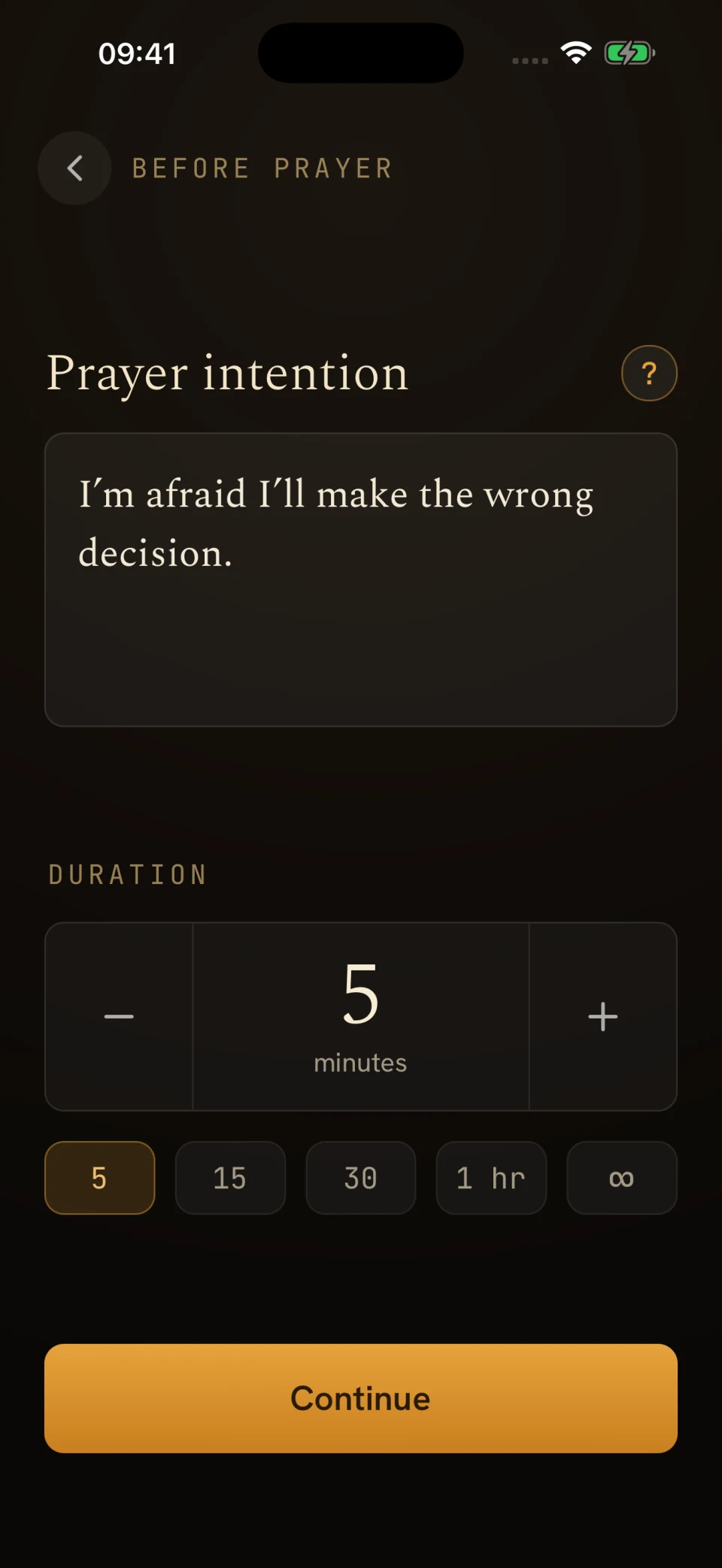
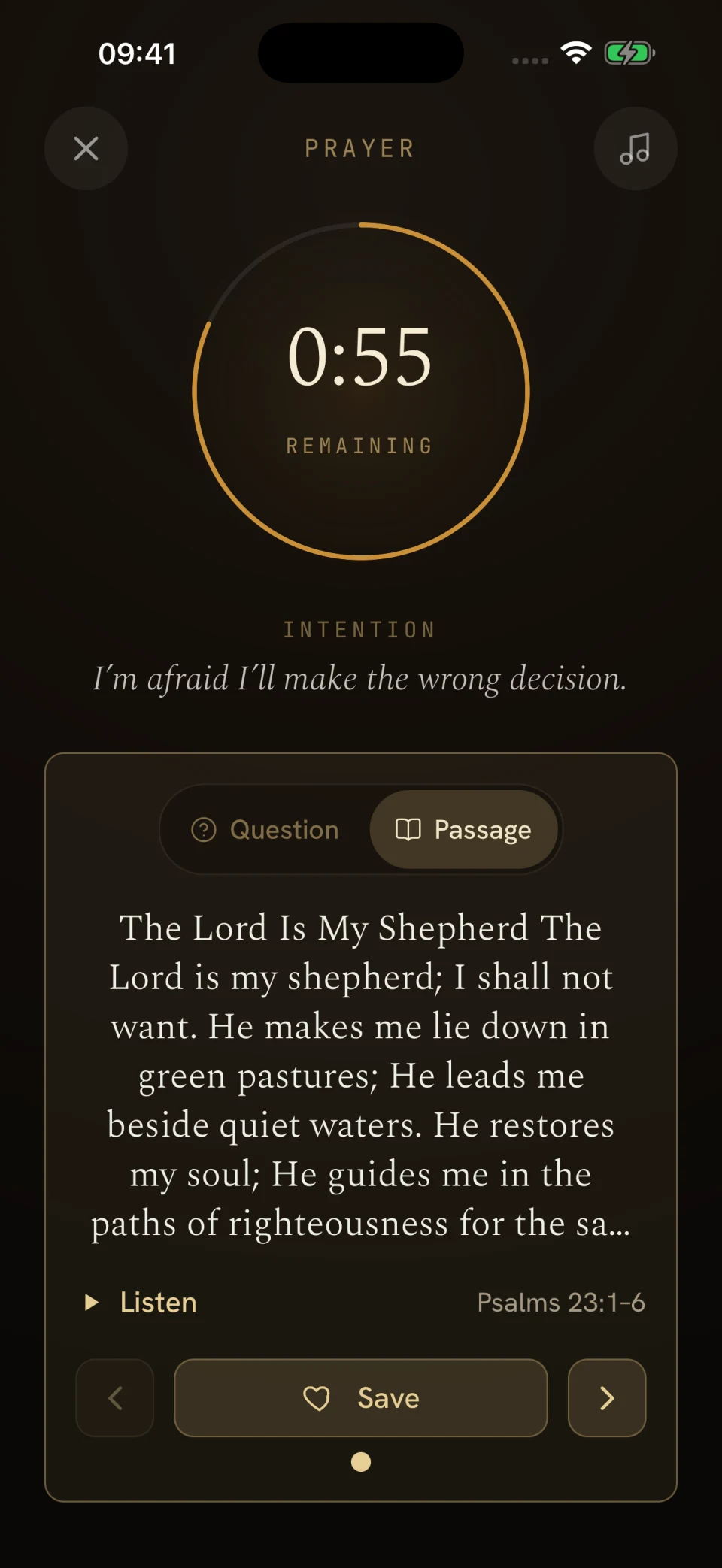
Lampada doesn’t use the words “lectio divina” or walk you through four steps, but prayer in it works in a similar way. Before you pray, you name your topic and choose how long to pray: 5, 15 or 30 minutes or 1 hour, or you can pray without a timer. When the time is up, you can keep going. Quiet music plays if you want it.
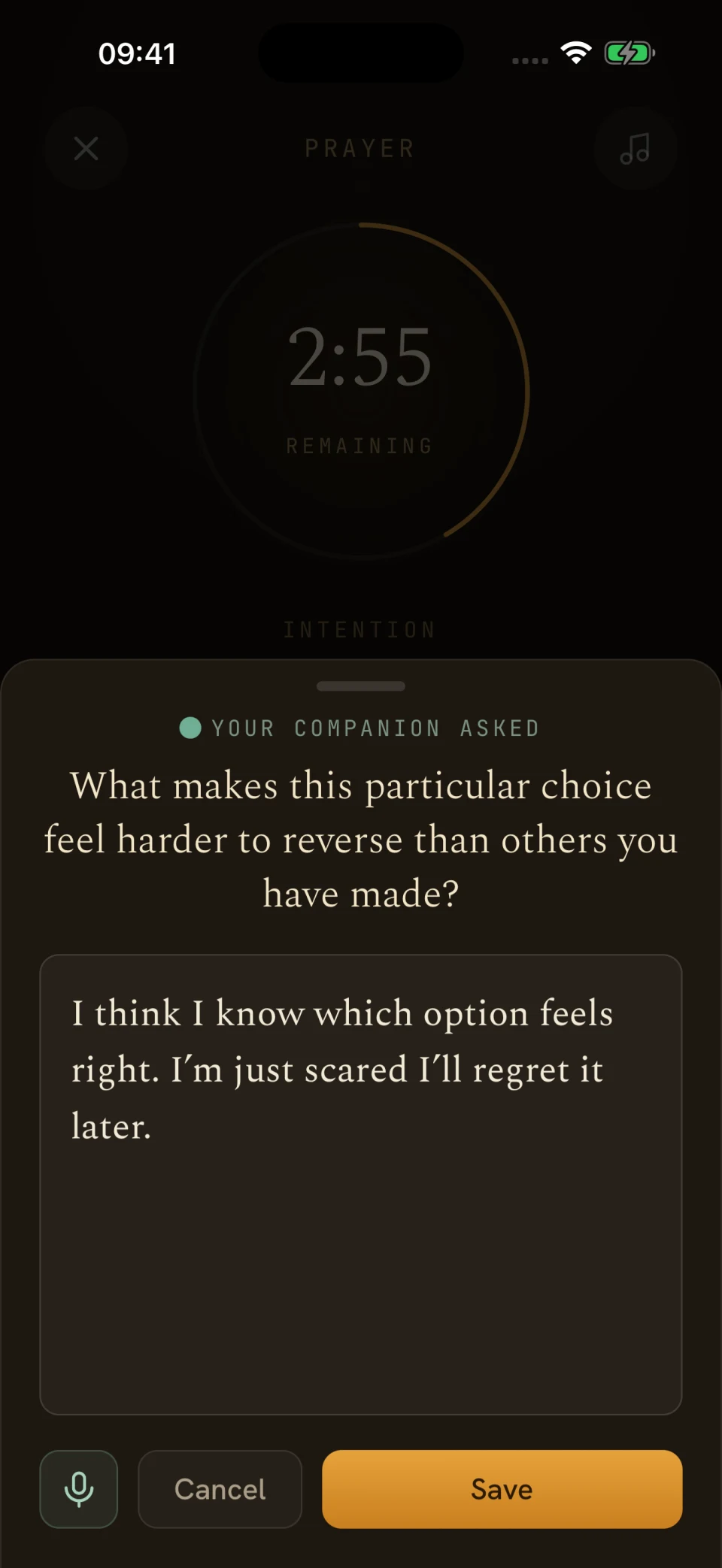
If you allow it, Lampada finds a Scripture passage that fits the meaning of your topic and your answers. Tap the card on the Passage tab to see the whole passage with the verses around it, or listen to it read by a human narrator, as many times as you like, just as Bianchi advises. The guiding questions are about the topic of your prayer, not about the verse: you can skip them, and you can answer by typing or by voice. At the end, write a short takeaway. And if there is a passage you want to underline, as Anthony advised, tap Save: it stays in your journal next to that prayer.
What Lampada doesn’t have: a reading calendar, a way to read a book straight through, or questions about the passage itself. You can’t open a whole chapter, and the AI doesn’t interpret the passage or write prayers for you. Choosing by topic is different from Bianchi’s advice to read a book straight through. For that kind of reading, use your own Bible, on paper or in the Bible Garden app, and bring the word you’ve read into your prayer.
The day after that decision, to love everyone for Christ’s sake, the boy from the beginning of this article went out and watched the crowd hurrying to the railway station: “God made them all, He loves them all, and I will love them all”2. A word read slowly at a table had gone out into the street with him.
Frequently asked questions
What is lectio divina in simple terms?
It is a way of praying with Scripture: you read a short passage slowly, reflect on the word that catches you and answer God in your own words.
How do you do lectio divina?
Take a few verses and read them slowly. Enzo Bianchi advises reading the text “not once but many times, and aloud”16. Stop where a word catches you, ask what it is saying to you and answer God in your own words. Then stay quiet for a while without demanding anything.
How long does lectio divina take?
There is no set length: what matters is not to hurry or chase quantity. Enzo Bianchi writes that “a single page, a chapter, a few verses are more than enough”16.
Is lectio divina only a Catholic practice?
The name comes from Western monasticism, but slow, prayerful reading of Scripture is found among other Christians too. The Orthodox priest Alexander Elchaninov suggested reading “one or two verses at a time and pondering them all day”19.
Which passage should I use for lectio divina?
A short one: a few verses or a chapter. Enzo Bianchi recommends reading one book of the Bible straight through or following the Church’s lectionary17. If you come to Scripture with a need of your own, see our article on praying Scripture.
-
митр. Антоний Сурожский. Быть христианином. О ЦЕРКВИ (www.mitras.ru) a b c d e
-
митр. Антоний Сурожский. Быть христианином. О ЦЕРКВИ, our translation (www.mitras.ru) a b c d e f g h
-
Anthony of Sourozh on Wikipedia: 1914–2003; grew up in Paris, where his family had settled by 1923; in 1939, before leaving for the front as a surgeon in the French Army, secretly took monastic vows; during the German occupation of France worked as a doctor and took part in the French Resistance; sent to Britain in 1948; from 1957 a bishop and from 1962 head of the Russian Orthodox Diocese of Sourozh for Great Britain and Ireland; best known as a writer and broadcaster on prayer and the Christian life. Антоний (Блум) on Wikipedia (in Russian): during the occupation, helped members of the Resistance as a doctor. ↩
-
Guigo II on Wikipedia: Carthusian monk and ninth prior of the Grande Chartreuse from 1174 to 1180; probably died in 1188; author of the Scala Claustralium. ↩
-
Guigo II. Scala claustralium. THE FIRST CHAPTER: OF THE FOUR RUNGS IN GENERAL (umilta.net) a b
-
Matthew 5:8. Berean Standard Bible (BSB), public domain. ↩
-
Guigo II. Scala claustralium. THE THIRD CHAPTER: OF THE FIRST AND SECOND RUNGS: READING AND MEDITATION (umilta.net) a b c
-
Guigo II. Scala claustralium. THE FIFTH CHAPTER: THAT THIS GRACE COMES AND GOES, FOR OUR GOOD (umilta.net)
-
Hannah Whitall Smith on Wikipedia: 1832–1911; born in Philadelphia into a long line of prominent Quakers; her book The Christian’s Secret of a Happy Life (1875) was known internationally; of her seven children, only three survived to adulthood; in 1888 the family moved to England. ↩
-
Hannah Whitall Smith. The God of All Comfort. Chapter 4. The Lord our Shepherd (ccel.org) a b c d e f g h i
-
Psalm 23:1. Berean Standard Bible (BSB), public domain. ↩
-
митр. Антоний Сурожский. Может ли еще молиться современный человек. Митрополит Сурожский Антоний. МОЛИТВА – ВСТРЕЧА, our translation (www.mitras.ru) a b c
-
митр. Антоний Сурожский. Может ли еще молиться современный человек. Митрополит Сурожский Антоний. МОЛИТВА – ВСТРЕЧА (www.mitras.ru) a b
-
Enzo Bianchi on Wikipedia: born in 1943; in late 1965 moved to an isolated farmhouse in the hamlet of Bose; in October 1968, two Catholics and two Protestants formed the Bose Monastic Community, which welcomed men and women, Catholics and Protestants; he was its founder and first prior and resigned as prior effective January 25, 2017. ↩
-
Enzo Bianchi. Pregare la Parola. Introduzione alla lectio divina, translated by Ю. А. Гинзбург, our translation (predanie.ru) a b c d e f g h
-
Enzo Bianchi. Pregare la Parola. Introduzione alla lectio divina, translated by Ю. А. Гинзбург (predanie.ru) a b c
-
Alexander Elchaninov on Wikipedia (in Russian): 1881–1934; emigrated in 1921 and settled in Nice; ordained a priest in 1926 and served at St. Nicholas Cathedral in Nice; one of the leaders of the Russian Student Christian Movement. ↩
-
свящ. Александр Ельчанинов. Записи. Из писем к молодежи, our translation (azbyka.ru) a b c d