
Berlin, May 1943. Dietrich Bonhoeffer, a Lutheran pastor, is being held in Tegel prison, awaiting trial. He could have sat out the war in safety: in 1939 he had been invited to teach in New York. But he went back to Germany, became involved with a circle working to overthrow Hitler, and in April 1943 he was arrested1.
On May 15 he writes to his parents. His letters from prison would later be published as Letters and Papers from Prison. There is a wedding in the family, and he will not be there: by the time his letter arrives, the celebration will be over, and with it, he admits, his longing to be there will ease a little2. “Oh, if only we could see each other or talk, even for a minute!”3 He writes, reads, thinks and paces his cell; really, he says, he would be living much the same way outside2. And he paces “not like a polar bear rubbing its sides bloody against the walls of its cage”3. Yet sometimes his calm vanishes on its own, for no visible reason, and the heart becomes, in the words of the prophet Jeremiah2, “stubborn and faint-hearted”3.
He also tells them that he is working on a short study of how a prisoner awaiting trial experiences time2. Someone who had been in the cell before him had scratched a line above the door2: “in a hundred years it will all be over”3. Further on in the letter Bonhoeffer quotes a psalm: “My days are in Your hand”3 (Psalm 31:15). This, he says, is Scripture’s answer “to the question that threatens to crowd out everything else here”3: “How long, O Lord?”3 (Psalm 13).
That is what praying Scripture looks like. When you have no words of your own, you can take the words of a psalm and say them to God as your own. And when you come to the Bible with a question, look for the answer not in a random line but in a passage read as a whole: who is speaking, to whom, and about what. Bonhoeffer’s answer did not come by chance. In the same letter he admits that the Psalter is perhaps the book he knows and loves best of all, and he has read it every day for many years2.
The Psalms as a mirror
Athanasius the Great was bishop of Alexandria for almost half a century and spent more than seventeen years in five exiles, ordered by four emperors4. His friend Marcellinus had just got back on his feet after an illness, though the trial in which he had already endured a great deal was not yet over. The messenger who brought his letter told Athanasius how Marcellinus was spending his days: he was reading all of Scripture, but the Psalms with particular care, trying to find the hidden meaning of each psalm5. Athanasius wrote back with his Letter to Marcellinus on the Interpretation of the Psalms. In it he passes on what a vigorous old man told him about the Psalter, with the book in his hand5.
The old man believed that for anyone who sings them, the psalms are like a mirror: looking into them, a person recognizes what is stirring in their own soul5. “For even someone who hears them read takes in the song as though it were being sung about him.”6 And: “If someone, for example, sings the third psalm and looks at his own troubles as he does so, he takes the words of that psalm as his own words”6.
Then he goes through the Psalter, matching a psalm to each state of the soul. He counts the psalms as the Greek Bible does, so his numbers usually run one lower than in an English Bible7; the English numbers follow in parentheses. For example: “If you see that the Lord is shepherding you and leading you well, rejoice and sing the twenty-second about it as well”6 (Psalm 23, “The Lord is my shepherd”). Or: “If you have sinned, and you are ashamed, and you repent and long to obtain mercy, you will find words of confession and remorse in the fiftieth”6 (Psalm 51).
And one more: “If persecution by your enemies drags on, do not lose heart as if the Lord had forgotten you, but call upon the Lord”6 with the words of the twelfth psalm8, our Psalm 13. It is the same psalm that echoed in Bonhoeffer’s cell: “How long, O Lord? Will You forget me forever? How long will You hide Your face from me?” (Psalm 13:1)9
Matching a psalm to what is on your heart is not a new idea: the advice is more than sixteen centuries old. What matters is not the number of the psalm but discovering that you can make these ancient words your own.
Take up and read
In the summer of 386, in Milan, came what is perhaps the best-known moment of Scripture answering a prayer. Augustine tells the story himself in his Confessions. He is thirty-one and teaches rhetoric. Behind him are years among the Manichaeans; ahead of him are baptism and his life as bishop of Hippo10. He knows he has to change his life, and he keeps putting it off.
In a garden, without knowing how, he ends up on the ground under a fig tree, weeping freely11. And he cries out to God: “How long, how long? Tomorrow and tomorrow? Why not now? Why not this very hour make an end to my uncleanness?”11 It is the same question the psalmist asked, and Bonhoeffer after him.
Suddenly a child’s voice drifts over from the house next door, a boy’s or a girl’s, he never could tell, chanting the same words again and again11: “Pick it up, read it; pick it up, read it.”11 These are the famous words tolle, lege. He takes it as a command from God to open the book and read the first passage he comes to11. He remembers Antony the Great, the Egyptian hermit: Antony once came into church while the Gospel was being read and took the words as if they were meant for him personally11. Augustine grabs the volume of Paul’s letters he had left there, opens it and reads silently where his eyes first land: a call to give up revelry and drunkenness, debauchery and envy, and to put on the Lord Jesus Christ (Romans 13:13–14)11. “I wanted to read no further, nor did I need to.”11
His friend Alypius asked to see what he had read, and, in Augustine’s words, “he looked on even further than I had read. I had not known what followed.”11 What followed was a call to welcome the one who is weak in faith (Romans 14:1). Alypius took these words for himself11.
This story is often told as proof that you can open the Bible at random. But look closer. The answer did not come instead of prayer; it came in the middle of a long struggle and many tears. Antony did not open anything at random either: he heard the Gospel at an ordinary reading in church. And Alypius found his answer by reading on in the same passage. What happened to Augustine is an exception, not a method.
Not a fortune-telling book
Thomas Boston was a Presbyterian minister in Ettrick, a rural parish in the south of Scotland. Six of his ten children died young, and his book on the fourfold state of human nature became a Scottish devotional classic12. He approached Scripture with a clear head. “I think it dangerous to make a fortune-book of the Bible”13, he wrote in his Discourses on Prayer. When tempted, some people open the Bible hoping that the first word they see will tell them where they stand13. “This is an unwarrantable and dangerous practice”13, Boston writes, though he grants that “a merciful God may sometimes condescend to outshoot the devil in his own bow”13, beating the devil at his own game.
As a rule, he says, the Spirit brings a person to the right word in other ways: through a sermon, or while reading Scripture with the family or alone13. And any verse that comes to mind, Boston advises, should be tested: how does it agree with the rest of Scripture in its sense and purpose? After all, when the devil tempted Christ, he too quoted a psalm, only against its true meaning (Matthew 4:6)13.
Boston followed his own advice. It all began with a walk in the country, when Dr. Trotter unexpectedly suggested that Boston should publish his sermons. Boston happened to have some old notes on him, including the sermons on man’s fourfold state, and handed them over to the doctor14. After reading them, the doctor and a Mr. Willis wrote to him insisting that he take up the work14. On January 16, 1712, he wrote in the diary that later became part of his Memoirs: “I spent most of this day in prayer and meditation, for light in this matter”14. On January 22, toward evening, he examined whether his motives were pure: was he after gain, or a reputation? To make the book useful he was willing to lose money on it. About fame he was honest: he could not claim to be free of vanity altogether, but before God he could say that what moved him was not a reputation for himself but the glory of God14. It was then that a verse came to him, “Him that honoureth me I will honour”14, but, he writes, “I saw little to my purpose in that word”14. In his regular daily reading he came to a psalm that was useful to him but did not seem to speak to his question14.
Later, Boston writes, that same verse, 1 Samuel 2:30, “returned with a new light about it, appearing pat to my case”14: suddenly it fit him exactly. Boston had looked at whom the words were spoken to: “I saw that promise particularly directed to priests in the exercise of their office”14. And that is what he was: a minister wondering how to serve with his sermons. “It melted my heart, and I said I would believe it.”14 For Boston, the promise of walking before God as a child before a father was enough. Even if he could have written a promise for his own situation, he would have asked for nothing more: “If I had had the word a-framing for my case, I would have desired no more in the matter secured to me, than walking before the Lord, as a child before his father”14.
Notice what happened. At first the verse said nothing to him. His ordinary reading did him good but did not answer his question. The answer came when Boston understood whom the words addressed and what they concerned. Even then he did not decide on the strength of one verse. After praying for clear judgment, he reread everything he had written down about the matter from the beginning, and the letters about it14. Last came a letter from a Mr. Colden, which closed by urging him to be guided by duty and by the salvation of perishing souls14. Boston writes:
That word, “perishing souls,” nailed my heart; and it burst out and answered, “Then let me be a fool for perishing souls.”14
Now, he writes, he had no right to turn the work down, whatever it might cost him, for the sake of those perishing souls14.
How to pray Scripture
These stories add up to a simple practice.
- When you have no words of your own, take a psalm. Find one in which you recognize yourself, as the old man in Athanasius’s letter advised, and read it slowly, in the first person, speaking to God. Where a line matches what is on your heart, stop and go on in your own words. If you are not sure what to bring to God, start with our article on what to pray about.
- When you come with a prayer of your own, name what it is about and read the whole passage. Who is speaking? To whom? What comes before and after? What in these words is about me, and what is not? That is how Boston saw that the promise was addressed to priests in their ministry.
- Before you read, ask for understanding. A psalm gives you the words: “Open my eyes that I may see wondrous things from Your law” (Psalm 119:18)15. And if something opens up for you, write it down, even in a single sentence.
- If a passage stays silent, don’t squeeze a meaning out of it. Boston’s verse said nothing to him at first, too. Keep reading at your usual pace, and don’t make decisions based on one random line.
A passage for your prayer in Lampada
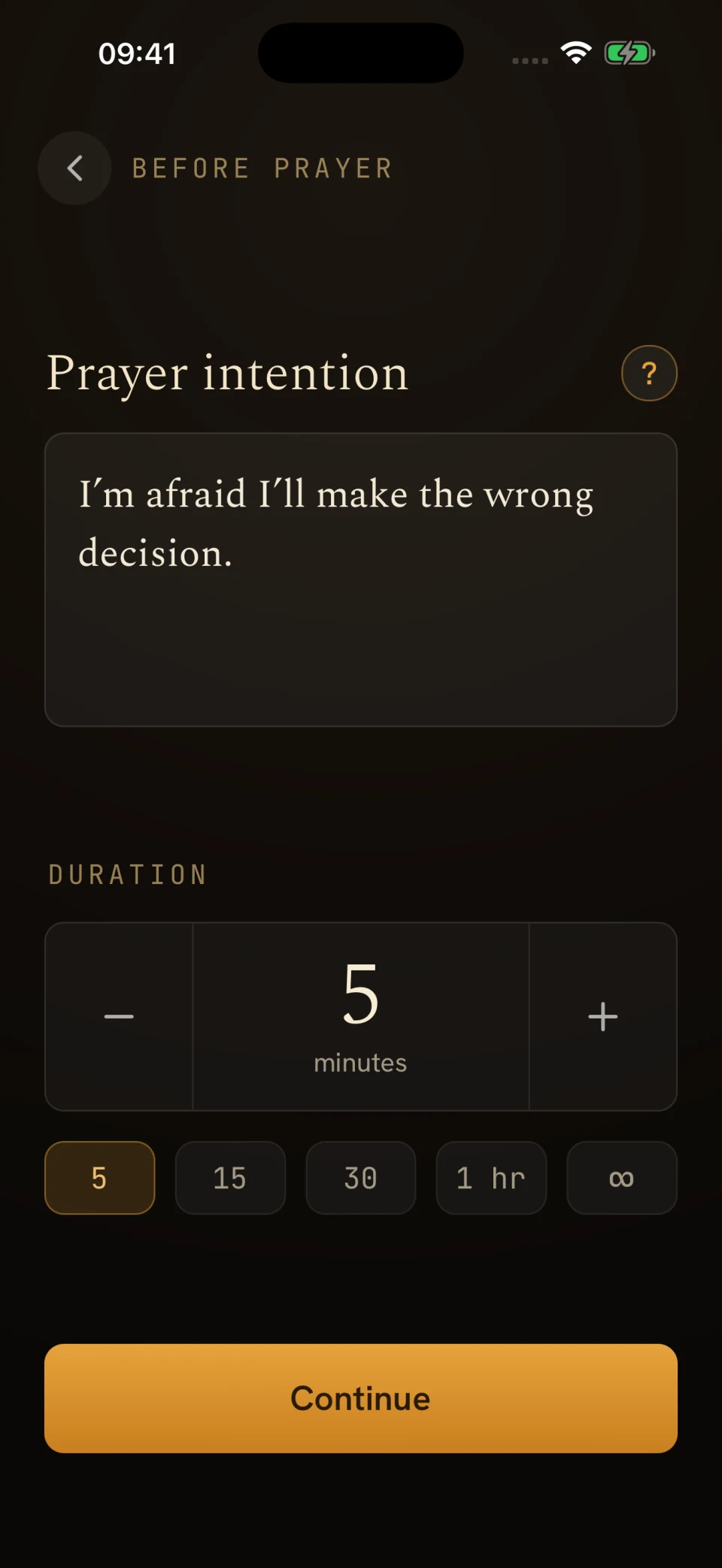
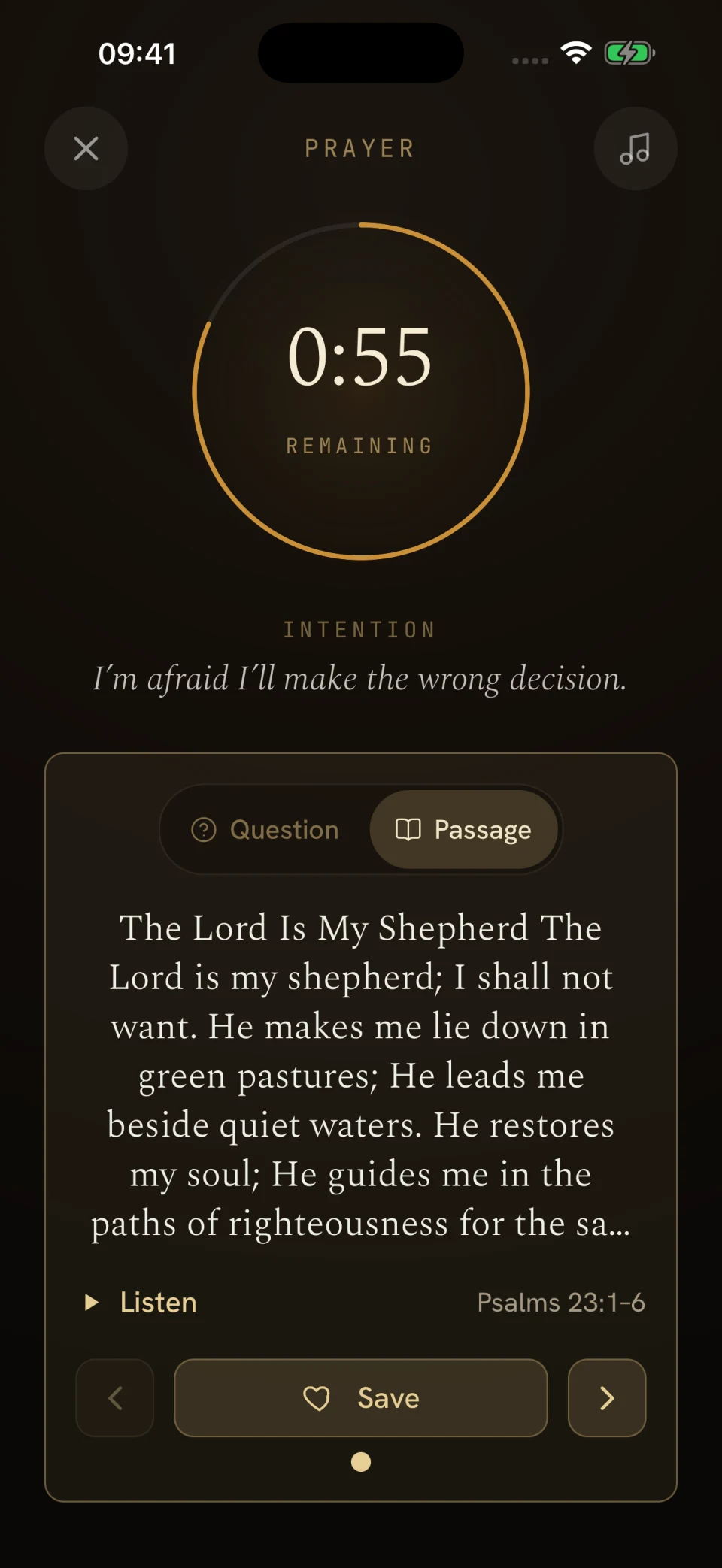
Lampada can help you find a passage for your prayer without guessing. Before you pray, you name your topic, for example, “I’m afraid of making the wrong decision.” If you have allowed the app in its settings to send your topic to the server, the Passage tab will find a passage that fits its meaning, not one that simply shares a word with it or one picked at random. If you have allowed your answers too, the app takes into account what you have already said in your prayer. If the passage doesn’t fit, the Next passage arrow shows you another, and you can go back to earlier ones.
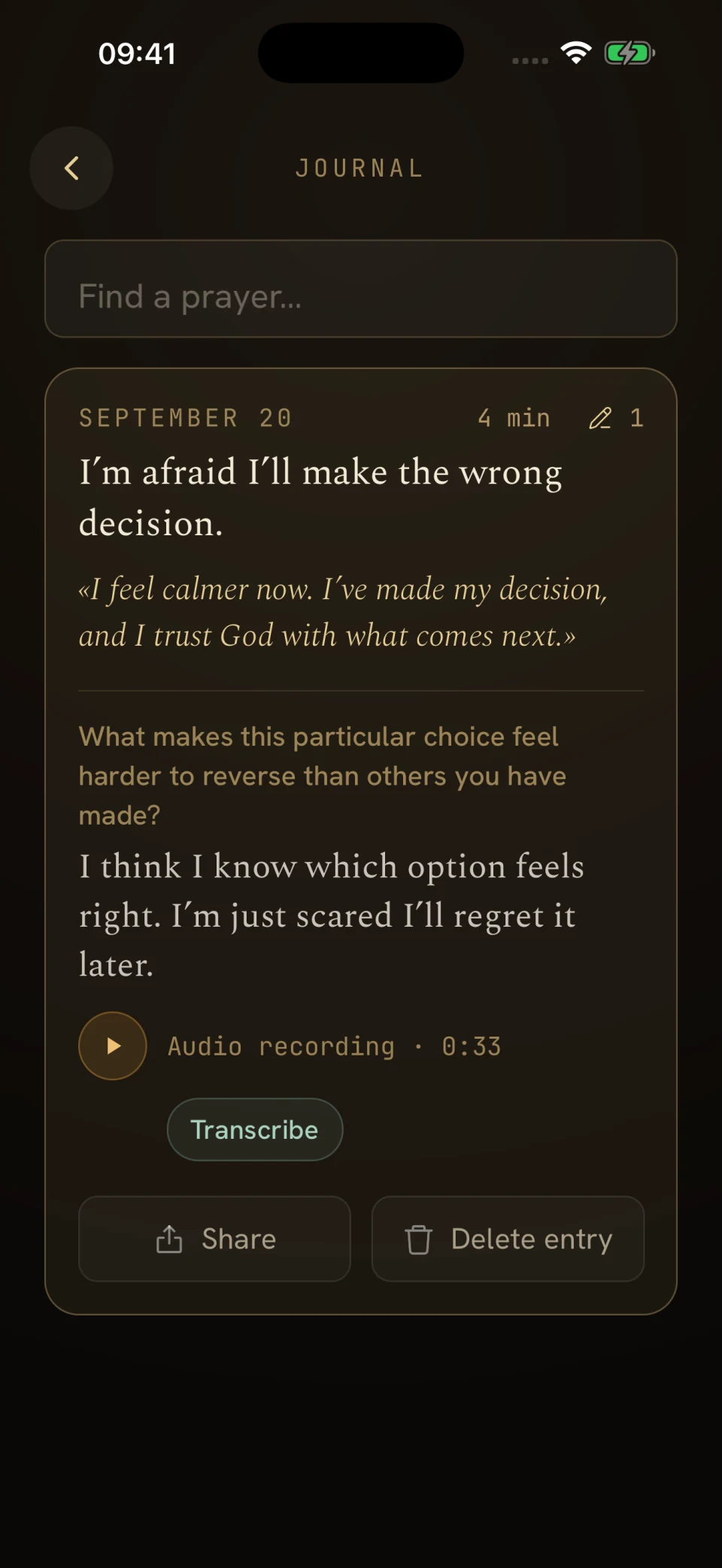
The card shows the key verses. Tap it to open the whole passage: the surrounding verses appear paler, so you can see what comes before and after, as Boston advised. You can listen to the passage read by a human narrator, with the verse being read underlined in the text. If something speaks to you, tap Save: the passage stays in your journal next to this prayer and in Saved passages.
What Lampada doesn’t do: you can’t open a psalm by its number or read a whole chapter, and the AI doesn’t write prayers for you or interpret the passage. Read the whole psalm in your own Bible, on paper or, for example, in the Bible Garden app, which has the Berean Standard Bible quoted in this article.
Bonhoeffer spent a year and a half in Tegel. Then he was moved to another prison, and on April 9, 1945, a month before Germany surrendered, he was executed at the Flossenbürg concentration camp1. The letter of May 15 does not promise that the question “How long, O Lord?” will go away. But an answer was already there beside it, not drawn at random but found in the psalms he read every day: “My days are in Your hand”3.
Frequently asked questions
Is it okay to open the Bible at random?
Not as a way to learn God’s will. Thomas Boston called it dangerous to open the Bible at random and read your situation in the first word you see: that turns it into a fortune-telling book13. Even Augustine found his answer in the middle of a long prayer, and his friend read further on in the passage. If you want Scripture to speak to you, read it regularly and in whole passages.
Which psalm should I read when life is hard?
The one in which you recognize yourself. The letter of Athanasius has a whole list: for example, after a sin, the fiftieth by his count5, which is Psalm 51 in English Bibles, and when it feels as if God has forgotten you, Psalm 13 (see above). You can read several in a row and stay with the one closest to how you feel.
How do I pray Scripture?
Choose a psalm or a passage about what is happening in your life and read it slowly, in the first person, speaking to God. Where the words match yours, stop and continue in your own. To learn how to start praying in your own words, read our article on how to start praying.
-
Dietrich Bonhoeffer on Wikipedia: Lutheran pastor and theologian; in 1939 turned down an invitation to teach in New York and returned to Germany; from 1938 in contact with a group in the Abwehr, German military intelligence, seeking Hitler’s overthrow, and later joined the Abwehr himself; arrested on April 5, 1943, and held at Tegel Prison for a year and a half; later moved to the Gestapo headquarters on Prinz-Albrecht-Strasse; hanged at Flossenbürg concentration camp on April 9, 1945. His letters from prison were published after his death as Letters and Papers from Prison. a b
-
Dietrich Bonhoeffer. Widerstand und Ergebung, translated by А. Б. Григорьев (predanie.ru) a b c d e f
-
Dietrich Bonhoeffer. Widerstand und Ergebung, translated by А. Б. Григорьев, our translation (predanie.ru) a b c d e f g h
-
Athanasius of Alexandria on Wikipedia: bishop of Alexandria from 328 to 373; spent more than 17 years in five exiles ordered by four Roman emperors. ↩
-
Athanasius von Alexandrien. Epistula ad Marcellinum de interpretatione Psalmorum, translated by J. Fisch (bkv.unifr.ch) a b c d
-
Athanasius von Alexandrien. Epistula ad Marcellinum de interpretatione Psalmorum, translated by J. Fisch, our translation (bkv.unifr.ch) a b c d e
-
Psalms: Numbering on Wikipedia: the numbering of the psalms differs, mostly by one, between the Hebrew text and the Greek Septuagint; Protestant translations follow the Hebrew numbering, and Eastern Orthodox translations follow the Greek. The Berean Standard Bible we quote uses the Hebrew numbering. ↩
-
The psalm number follows the Russian translation of the Letter to Marcellinus (in Russian), ch. 16, where the old man advises calling on the Lord with Psalm 12, that is, Psalm 13 in English Bibles. The German translation by J. Fisch (1875), from which we quote the letter, has the twenty-sixth psalm here (Psalm 27 in English Bibles); the old man names the twenty-sixth a little further on as well, for a different occasion. ↩
-
Psalm 13:1. Berean Standard Bible (BSB), public domain. ↩
-
Augustine of Hippo on Wikipedia: born in 354 in Thagaste; taught rhetoric in Carthage, then in Rome and Milan; spent ten years as a Manichaean; converted in late August 386, aged 31; baptized by Ambrose in Milan at the Easter Vigil of 387; later bishop of Hippo Regius. ↩
-
Augustine. Confessiones. Book Eight, translated by Albert C. Outler (ccel.org) a b c d e f g h i j
-
Thomas Boston on Wikipedia: 1676–1732; minister of Simprin from 1699 and of Ettrick from 1707; his Human Nature in Its Fourfold State (Edinburgh, 1720) is one of the religious classics of Scotland; six of his ten children died in infancy or early childhood. ↩
-
Thomas Boston. Discourses on Prayer. Of the Spirit's Help in Prayer (www.monergism.com) a b c d e f g
-
Thomas Boston. Memoirs of the Life, Times, and Writings of the Rev. Thomas Boston (www.monergism.com) a b c d e f g h i j k l m n o
-
Psalm 119:18. Berean Standard Bible (BSB), public domain. ↩