
Bristol, January 1838. George Müller, a Protestant preacher who runs homes for orphans without asking anyone for money to support them1, is ill in bed. He has had a bad headache for eight days, cannot preach, and trusts that God will soon restore him to ministry2. He spends about three hours praying over two psalms, laying his requests before the Lord and asking Him to record them in heaven and answer them2. There are eight requests, and under the list he writes the date: “I have recorded these my petitions this 14th day of January, 1838, that, when God has answered them, He may get, through this, glory to His name.”2
Müller later published his journal as a book, and while writing its second part he added a note to this entry in square brackets2: “petitions 4, 5, 6, 7, and 8, have been fully answered, and the other petitions, likewise, in part.”2
That is what a prayer journal is: short notes on what you brought to God, what you asked for and what happened next. You can keep one in a notebook or in an app; what matters more is writing honestly and coming back to what you wrote. The difficulties along the way are much the same for everyone, and five very different people ran into them long before us.
So you don’t forget the answers
As a young man Müller stole from his father, drank and gambled. After a prayer meeting in 1825 his life turned around, and over the following decades more than ten thousand orphans passed through his homes1. At the end of 1841, taking stock of the year, he wrote: “In reading over my journal, I find that the Lord has given me during this year many precious answers to prayer”3.
Some of those answers would have been easy to forget. From May 21 until September he prayed every day to find a master who would take one of the orphan boys as an apprentice; he had written this request on his list, and in September a place was found for the boy3. In mid-June he began praying for a fellow believer who was shut in by deep spiritual anxiety3. “The year passed away, and it was not granted. But yet at last this request also has been granted”3.
Without a written record it is easy to forget a request you have brought to God for months, and easier still to forget one that has been answered. The psalmist reminds himself: “Bless the Lord, O my soul, and do not forget all His kind deeds” (Psalm 103:2)4. A journal helps you not forget.
A record of the soul, not a log of the day
Henry Martyn graduated from Cambridge as the top mathematician of his year, but instead of an academic career he chose mission work in India. He would go on to translate the New Testament into Urdu and Persian, and he would die at thirty-one in Tokat, in Turkey5. For now, though, he is a young Anglican clergyman in Cambridge, and his own journal is troubling him.
January 1, 1804. That afternoon Martyn preaches at Trinity Church, earnestly but, as he notes himself, without much feeling. Afterward he reads back over his journal for the past year6 and sees that lately it has become “a diary of my life, instead of being a register of my state of mind.”6 He puts this down “partly to sloth, and partly to having devoted too much time and attention to the outward and public duties of the ministry.”6 And he says plainly that this has been a mistake6. Since he was ordained, he admits, joy has rarely come his way, and he prays that in the new year he may keep close to God6. Two days later he gives an entire day to fasting and prayer, so lifeless and barren does he feel6. The day’s entry ends: “but I could not get near to God”6.
Almost everyone falls into this trap: you open the notebook to pray and end up writing down what you got done that day. Martyn’s experience suggests a question that brings you back to what matters: what did I talk to God about today, and what was on my heart?
When there’s nowhere to write, and when it hurts
Eugénie de Guérin, a Catholic, lived at Le Cayla, a secluded country house in the south of France. When her younger brother Maurice left for Paris, she began keeping a journal for him7. Wherever she went, she needed something to write on: “I need tables and paper everywhere, because my thoughts follow me everywhere and want to pour themselves out in one place, for you, my friend”8. Little by little, as her editor would later put it, the journal became “her chief occupation, the secret and the joy of her days”9.
Fine days are rare by now, so when one comes, Eugénie welcomes it as a blessing. That evening she will go to Cahuzac, her favorite place of pilgrimage; until then she takes stock of how things have stood between her soul and God these last eight days10. Sharing what is on her heart is sweet and comes easily to her, and it lifts the sadness from her soul10: “When water runs, it carries the foam away with it and grows clear along the way. My way is God, or a friend, but God above all”8.
In the summer of 1839 Maurice died7. Autumn comes. She wants to send two pomegranates to Maurice’s friend, from the very tree whose roots her brother had been digging around a few days before he died10: “It was the last thing he did on earth”8. On October 6, at noon on a Sunday, she remembers how exactly a year earlier, at that very hour, she had been in his arms in Paris, shocked at how thin he was and how he coughed. Now she is at Lentin, with rain, loneliness and memories that hurt10. On October 19, three months after Maurice’s death, Eugénie writes: “Three months today since that death, that parting. Oh, the sorrowful date, which I still want to write down every time it comes round”8. And she admits: “I was about to stop; it was too bitter to talk to him in his grave”8. But someone she calls her “living brother” had asked her to keep up these notebooks, and he was glad to hear from her, so she went on10: “I will write for you as I wrote for him”8.
Her journal was a letter to someone who listens, and above all to God. That is why you don’t have to give up the journal when things are hard: you can tell the One who listens about a loss, too.
Back to the same day
Barsanuphius of Optina was an army colonel who left the service at forty-six and entered Optina, an Orthodox monastery in Russia, where he became one of its last great elders. His secretary, a young novice named Nikolai Belyaev, later venerated as St Nikon of Optina, kept a diary, and that is where the scene below comes from11.
In September 1909 (Nikon could no longer remember whether it was the sixteenth or the seventeenth) the elder read him a little from his own diary12 and told him how he used to read it back: “I wrote every day back then, and this is how I reread my diary: say it’s the 20th of August, or some other date, and I take all my diaries and read what I thought and felt and did on that same day and month in other years. It is a great thing, keeping watch like that…”13
That same day Nikon came across a slim booklet published by Bishop Mikhei, and in it were the words of John of Kronstadt, who tried to write something down every day12, “so that, reading my diaries over, I could see whether I was going forward or going backward”13. On September 21 Nikon was the last to come in for a blessing; he confessed a few small failings of his and told the elder about the coincidence12. “That means Father John has set the royal seal on my words. Yes, it is a great thing!”13 Barsanuphius replied. Nikon thought he might have stirred the elder’s deepest feelings: the old man got up, sent Brother Nikita away and stayed alone with Nikon12. “Yes,” said the elder, “I wanted to spend this day with you.”13 They talked from nine in the evening until almost midnight12. The elder spoke of a hidden design behind the whole of our lives: everything in them is wonderfully arranged, only we do not see it12. “I even think,” he said, “that the reason we live so carelessly and sin is that we do not understand the inner meaning of the events of our lives.”13
A journal comes alive when you go back to it. Of the mother of Jesus the Gospel says: “But Mary treasured up all these things and pondered them in her heart” (Luke 2:19)14. A journal, too, helps us treasure up and ponder what we have lived through, and entries from the same day in earlier years show what has changed and what hasn’t.
Honest, not beautiful
Vasily Kharitonov, the son of a peasant from Saratov, graduated from the Kazan Theological Academy and served as an inspector at the seminary in Vologda; then, in 1901, he gave it all up and left for Mount Athos. There, at Karoulia, a place of especially austere hermit life, he became Father Theodosius, a priest-monk of the Great Schema and one of the best-known confessors among the Russian monks of Athos15.
In the summer of 1937, starting on the feast of the Prophet Elijah, he takes up his labor of prayer again. His rule is to say the Jesus Prayer ten thousand times a day16. That is a monastic feat, not a model for us. What we can take from him is the honesty with which he keeps his “prayer journal.” He doesn’t dress anything up: “During prayer my mind sometimes wandered and even drifted off for a moment, but then became focused on the words of the prayer again”17.
He writes down the unpleasant things too. On August 5, the anniversary of his tonsure into the Great Schema, after vespers and before supper, he and his companion were reading the Philokalia, a collection of monastic teaching on prayer: from the next feast day Theodosius was to begin using a particular prayer technique described by the ancient fathers, and they had picked out the passage that dealt with it18. Theodosius remarked on something as they read, and his companion reproached him, first for being suspicious, and then for his frequent outbursts of temper and impatience, and said that this was exactly why prayer would not come to him18. “I fully accepted his rebuke and his advice”19. But Theodosius did not take him for an infallible guide: his companion was a beginner himself at the prayer of the mind, the inward prayer of mind and heart, and knew it mostly from books18. The evening ended with a decision: “And so I gave up that prayer technique as untimely for me, and went on as before with simple prayer, trusting in God’s mercy”19.
He did not hide his journal. One afternoon, over tea after the midday meal, the two of them read through his entries for the last three days, and his companion pointed out that he was breathing the wrong way during prayer20. “I agreed with this”21.
His last entry is dated September 19: “After my illness I am going through distraction and a cooling toward prayer. And I cannot tell whether it is from the weakness of illness, or from sloth”22. He never settled the cause, but he did draw a conclusion: either way, he needed to humble himself before God and earnestly ask for His help23. The next day he took to his bed and could no longer write, and on October 2 he died23. His last page is not about lofty spiritual states but about coldness, confusion and a plea for help. What makes a journal valuable is not beauty but truth, and an entry like that is one you can show to someone close to you.
How to keep a prayer journal: an example and prompts
These stories add up to a simple practice. An entry can be very short:
March 14. Came to God worried about Mom: she has tests on Friday. Asked that she wouldn’t be scared and that I could be there for her. Noticed I’ve been angry at my brother all day, and told God about it.
A week later: it turned out fine. My brother and I talked.
Their questions make good journal prompts. Take one at a time, whichever fits today:
- What did I talk to God about today? Not what I did, but what was on my heart (Martyn).
- What request did I write down earlier, and what came of it? (Müller)
- What is hard today, and what brings me joy? (Eugénie)
- What was happening with me on this same day a year ago? (Barsanuphius)
- Where was I distracted, impatient or in the wrong? (Theodosius)
Reread your journal once a week, at the end of the year or on dates that matter to you. If you have no energy, one line about the main thing is enough. And if you don’t know where to start, see our articles on how to start praying in your own words and what to pray about.
Paper or app?
In a notebook you write more slowly, there is no screen and no notifications, and it feels good in your hands. But it’s hard to find an entry from three years ago, a notebook is easy to lose, and someone else might read it. A phone is always with you: you can search your entries by keyword, record your voice and protect the journal with a passcode. Choose the one you will actually come back to.
A prayer journal in Lampada
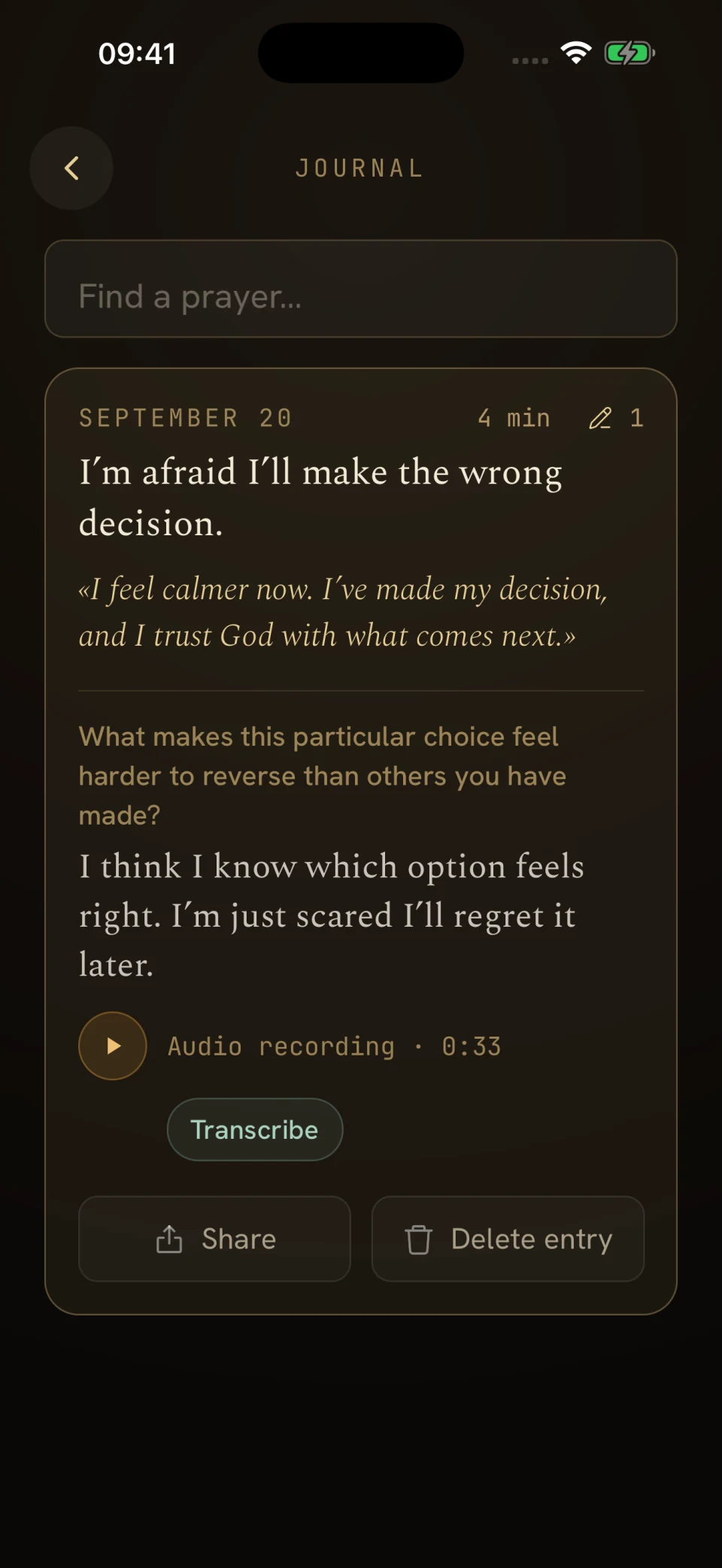
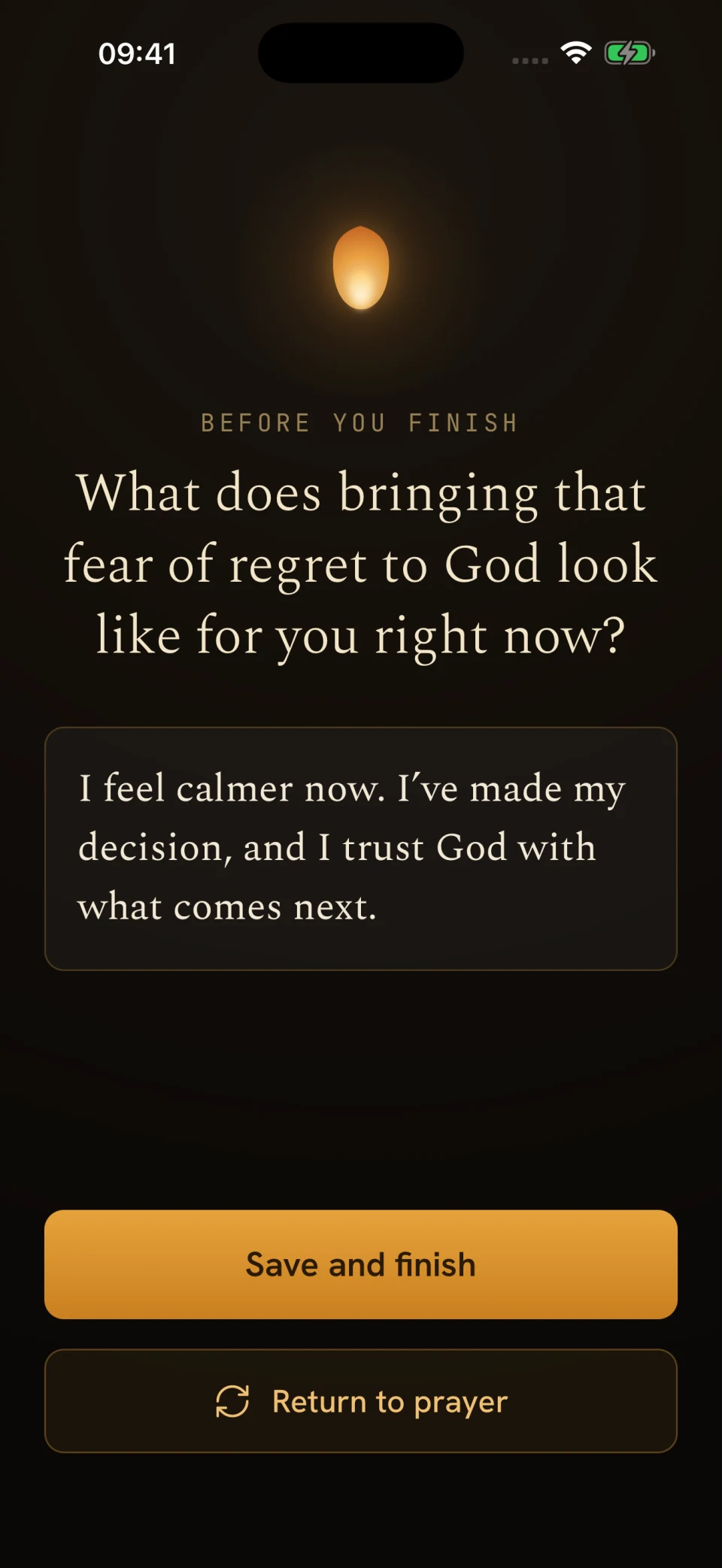
If a phone suits you better, try Lampada. In Lampada every prayer is itself a journal entry: a topic, guiding questions about it, your answers and, at the end, a one-sentence takeaway. The questions help you start with what is on your heart right now rather than with a report on your day.
Each prayer keeps its date, topic, answers and takeaway. Search finds words in the topic, answers, takeaway and voice transcript. That way you can find the prayers that mention a particular person and see how long you prayed for them and what changed, much like Müller’s list. You can’t add to an old entry; instead, a new prayer about the same thing becomes its continuation.
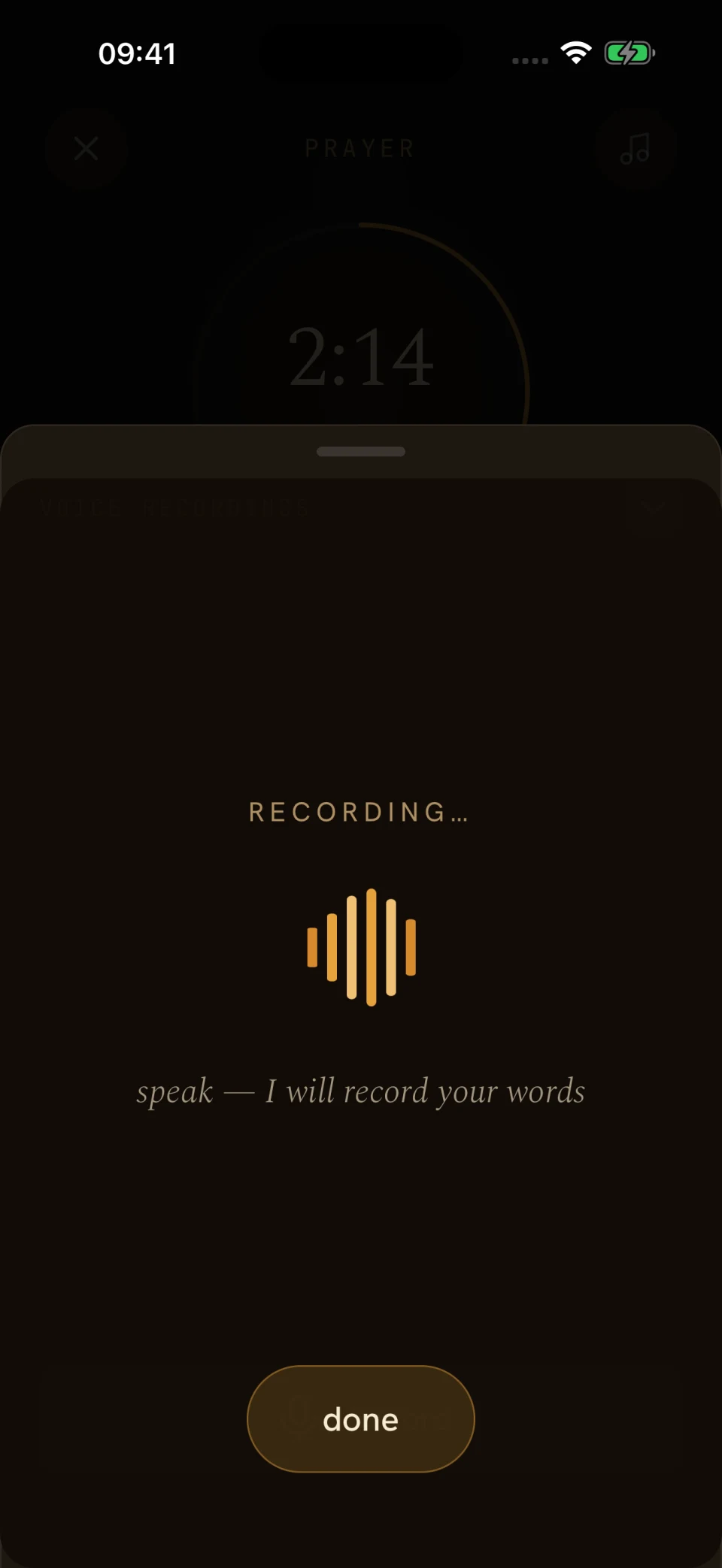
When words are hard to find, you can answer by voice. A recording is turned into text only when you tap a button, and for that it is sent to a server. You can scroll back through old prayers in a dated feed and replay your voice answers. To find the same day last year, the way Barsanuphius did, you scroll back to it: there are no “a year ago” reminders. The journal is stored only on your phone, you can lock it with a PIN or biometrics, and you can share a single prayer as text with someone you trust.
Müller put a date under eight requests without knowing how things would turn out. Moments like that are why a journal is worth keeping: so that one day you can go back to an old entry and see what happened next.
Frequently asked questions
What should I write in a prayer journal?
The date, a request, a thank-you or whatever is on your heart right now. Later, when you reread it, note what happened.
Do I need to write in my prayer journal every day?
Not necessarily. Barsanuphius of Optina recalled, “I wrote every day back then”13, but if a daily entry turns into a chore, one honest line when you have something to say is enough. Reading it back matters more: once a week, at the end of the year, on dates that matter to you.
Is a paper prayer journal or a prayer journal app better?
Whichever you will come back to. A notebook is slower and screen-free; an app makes it easier to search old entries, answer by voice and keep your journal away from other people’s eyes.
-
George Müller on Wikipedia: 1805–1898; as a young man he stole from his father, drank and gambled, and changed after a prayer meeting in 1825; one of the founders of the Plymouth Brethren; ran the orphan houses on Ashley Down in Bristol, took 10,024 orphans into his care during his lifetime and never asked anyone for money for the work. a b
-
George Müller. A Narrative of Some of the Lord's Dealings with George Müller. Volume 2 (gutenberg.org) a b c d e
-
George Müller. A Narrative of Some of the Lord's Dealings with George Müller. Volume 3 (gutenberg.org) a b c d
-
Psalm 103:2. Berean Standard Bible (BSB), public domain. ↩
-
Henry Martyn on Wikipedia: 1781–1812; Senior Wrangler at Cambridge in 1801; went to India in 1805 as a chaplain of the East India Company; translated the New Testament into Urdu and Persian; died at Tokat aged 31. ↩
-
Henry Martyn (ред. S. Wilberforce). Journal and Letters of the Rev. Henry Martyn (archive.org) a b c d e f g
-
Eugénie de Guérin on French Wikipedia: 1805–1848; born at the Château du Cayla near Albi; the journal she began in 1834 is addressed to her brother Maurice and was published after her death. Maurice de Guérin on Wikipedia: lived in Paris after 1833; died of consumption at Andillac on 19 July 1839, aged 28. a b
-
Eugénie de Guérin. Journal, our translation (www.gutenberg.org) a b c d e f
-
Eugénie de Guérin. Journal. AVERTISSEMENT DE L’ÉDITEUR., our translation (www.gutenberg.org)
-
Barsanuphius of Optina on Russian Wikipedia: 1845–1913; a colonel who came to Optina in 1891 and became an elder there. Nikon of Optina on Russian Wikipedia: Nikolai Belyaev, 1888–1931; secretary to Barsanuphius from 1908; died in exile on the Pinega. Both were canonized in 2000 among the Optina elders. ↩
-
прп. Никон Оптинский (Беляев). Дневник. 1907–1910 гг.. 1909 г. — 16 или 17 сентября (predanie.ru) a b c d e f
-
прп. Никон Оптинский (Беляев). Дневник. 1907–1910 гг.. 1909 г. — 16 или 17 сентября, our translation (predanie.ru) a b c d e f
-
Luke 2:19. Berean Standard Bible (BSB), public domain. ↩
-
Fr Nikolai Solodov, “Korrespondent svt. Feofana Zatvornika ieroskhimonakh Feodosii Karulskii” (Hieroschemamonk Theodosius of Karoulia, a correspondent of St Theophan the Recluse), Bogoslovsky Vestnik, 2023, no. 3 (50), pp. 223–244, in Russian: Vasily Vasilyevich Kharitonov (1869–1937); the son of a peasant from Saratov province (pp. 225–226); graduated from the Kazan Theological Academy in 1894; inspector of the Vologda seminary from 1897 to 1901, then on Athos for the rest of his life; the prayer journal was written a few months before his death. ↩
-
старец Феодосий Карульский (Афон). Молитвенный дневник. 20 июля 1937 г. (azbyka.ru)
-
старец Феодосий Карульский (Афон). Молитвенный дневник. 20 июля 1937 г., our translation (azbyka.ru)
-
старец Феодосий Карульский (Афон). Молитвенный дневник. 5 августа (День моего пострига в схиму) (azbyka.ru) a b c
-
старец Феодосий Карульский (Афон). Молитвенный дневник. 5 августа (День моего пострига в схиму), our translation (azbyka.ru) a b
-
старец Феодосий Карульский (Афон). Молитвенный дневник. 27 августа (azbyka.ru)
-
старец Феодосий Карульский (Афон). Молитвенный дневник. 27 августа, our translation (azbyka.ru)
-
старец Феодосий Карульский (Афон). Молитвенный дневник. 19 сентября, our translation (azbyka.ru)
-
старец Феодосий Карульский (Афон). Молитвенный дневник. 19 сентября (azbyka.ru) a b