
Scotland, the first half of the nineteenth century. The house has two rooms, and between them a closet so small it holds nothing but a bed, a small table and a chair; light comes in through one tiny window1. The father goes in there and closes the door behind him1, “daily, and many times a day, generally after each meal”1. Nobody at home talks about it, “for the thing was too sacred to be talked about”1. Yet even without words the children know that behind that door someone is praying for them1, and they learn to tiptoe past it1.
This is how John G. Paton, who grew up to become a missionary in the New Hebrides, remembered his childhood2. In the son’s memory, his father’s prayer is tied to something that came round every day: meals.
That already holds the answer to how to pray every day. A daily prayer habit needs its own place in the day, a cue that will come anyway: waking up, breakfast, the commute, bedtime. Start with a few minutes you can set aside even on a difficult day. And give yourself permission to fail: a missed day is a reason to come back tomorrow, not to give up. The Anglican bishop J. C. Ryle advised giving prayer its own place in the day, just as meals, sleep and work have theirs, and picking the hours for yourself34. And he added: “At the very least, speak with God in the morning, before you speak with the world: and speak with God at night, after you have done with the world.”3
A door closed after meals
Paton doesn’t record the words of his father’s prayers. He calls the closet the sanctuary of their cottage: in it his father prayed for his children, as the high priest of old prayed behind the veil in the Holy of Holies1. Only now and then did the children hear through the door the echo of “a trembling voice, pleading as for life”1. And they saw their father’s face: “The outside world might not know, but we knew, whence came that happy light, as of a new-born smile, that always was dawning on my father’s face”1. Many years later Paton wrote: “Never, in temple or cathedral, in mountain or in glen, can I hope to feel that the Lord God is more near, more visibly walking and talking with men, than under that humble cottage roof of thatch and oaken wattles.”1
The Scottish preacher David MacIntyre quoted these memories in his book The Hidden Life of Prayer. Everything rested on a door the father closed after meals, on a cue that came round by itself.
“One thing interrupting after another”
Andrew Bonar was a pastor in Scotland for half a century, first in the country parish of Collace, then in Glasgow, and he kept a diary all his life5. He was a friend of Robert Murray M’Cheyne, whom we wrote about in our article on what to pray about. What makes Bonar’s diary worth reading is that you won’t find a model saint in it.
In the winter of 1841 he notices that he is restless and more scattered than usual, and finds the reason: his time has gone to people and outward business, and he has had no real, unhurried time alone with God6. Yet being close to God, he writes, “is like light shining upon a gloomy country in summer time”6. “I was willing to pray, and felt much in the disposition for it, yet prayed little, one thing interrupting after another.”6 And he sums it up: “in consequence my soul has become low.”6 He decides he will not rest content until he is giving at least two hours a day to prayer and nothing else6.
In August 1843 Bonar preaches three times in one day, twice at Tealing and again in the evening at Newtyle; riding home late, he spends the journey in prayer and praise. The next day he notes that tomorrow he will lead Communion under the open sky in Glenshee, a Highland glen, and that tonight belongs to prayer6. And now he sees clearly that his lack of prayer is among the chief sins of omission in his life6. Of his praying he admits: “I am too short, ask too little”6. So he resolves to begin the day alone with God: “I must also resist the temptation of doing or reading anything before having found God”6. Christ did the same before a day full of people. The evening before, the whole town had gathered at the door of the house (Mark 1:33), and then: “Early in the morning, while it was still dark, Jesus got up and slipped out to a solitary place to pray” (Mark 1:35)7.
Years later, still in rural Collace, Bonar finds it bitter that his preaching seems to leave no mark on anyone, and that often plunges him into a hopeless kind of sadness6. So he tries something different: “I have been endeavouring to keep up prayer at this season every hour of the day, stopping my occupation, whatever it is, to pray a little”6.
And in 18848, by now an old pastor, he notes that the day before he never got to a long, unhurried time of prayer, and he blames his own deceitful heart, with Satan at work through it6. What got in the way was not idle amusement. The lapwing is a bird that flutters off to lure intruders away from its nest, and Bonar borrows the picture: “Satan, like the lapwing, drew me away from the real object (prayer and fellowship with God) by suggesting every now and then something about some other part of my work, or something to examine about my lecture, sermon, etc.”6 The entry goes on: “and so the best hours of yesterday were in a great measure lost”6. And he asks God to give him back the years that the locust has eaten6 (Joel 2:25).
Bonar never formed the habit once and for all. He came back to it again and again, and what got in its way was more often not trivia but necessary, good work.
How long should you pray?
Bonar longed for two hours a day. John Wesley, the founder of Methodism, took a small notebook with him wherever he travelled1. MacIntyre writes: “On the front page of each successive copy of this memorandum book he always recorded a resolution to spend two hours daily in private prayer, no evasion or proviso being admitted.”1 Having given this example, he adds a caveat straight away: “Perhaps such a rule may seem to some to be rigid even to formality.”1 Nobody should treat someone else’s habit as a rule for themselves, he says, but everyone should make sure there is proper room in life for being with God1.
Ryle thought the same: “I do not maintain that prayers should always be of the same length; but I do say, let no excuse make you give up prayer.”3 Someone else’s two hours are not your yardstick. Better a modest amount of time you can keep up even on a tired day: five minutes, a quarter of an hour. You can add more later, when prayer itself asks for more. If you keep a rule of prayer and wonder what to read in that time, see our article on the rule of prayer.
Evening: a place to lay down the day
Taisia (Solopova), who would later become an abbess, entered a convent very young, soon after finishing at the Pavlovsky Institute, a school for girls of the nobility in St Petersburg9. In her memoirs she recalls how she received a prayer rope, the sign of unceasing prayer: it was at Easter, when the abbess clothed her in the monastic robe10. Her joy was not of this earth, but Mother Glafira, the older nun guiding her spiritual life, warned her that with the monastic habit she was also taking up the monastic cross. At the time, Taisia did not understand what those words meant10. “But life itself soon opened my eyes and showed me that cross in all its weight.”11
For a week she was on duty washing up after the sisters’ meals, as many as two hundred plates at a time10. Afterwards, she writes, “I could find no relief for my hands, eaten away by the hot lye until they bled”11, and “for a long time I could not take up any work at all, because the skin came off my hands in petals”11. Complain of the pain, and you would be laughed at10: “Some hard-working novice, can’t even wash the dishes!”11 Her first summer, like every newcomer, she also went out to work in the fields: the vegetable gardens, haymaking and the harvest10. “It goes without saying that I worked very badly,”11 she admits. Yet she worked almost until Vespers, the evening service, and then she still had to get the samovar going for her mentor and her cellmate10. The cellmate saw her as a rival, and Taisia was tormented by longing for her mother10. She wrote about everything to her spiritual father, Archimandrite Lavrenty12, but her letters never reached him10.
Yet one thing she kept up. The monastic rule of three canons, an akathist and the commemoration of names was read after Vespers, and every day she came to the five o’clock service and stayed on for it10, “even though this was obligatory only for nuns, not for novices”11. Why? “I found relief in church, where I would pour out all my sorrow before God in tears—and I had plenty of sorrow.”11
Canons and akathists are forms of Orthodox hymnody. Here, they belonged to the convent’s prayer rule; they are not advice for lay people. But what kept Taisia going is familiar to everyone: evening prayer is a place where you can lay down a hard day. Not to report on it, but to hand it over to God just as it is.
If you miss a day
The Catholic nun Rachele Guardini led the house of the Sisters Teachers of St. Dorothy in Venice13. In a letter to Letizia she urges her, every morning, before leaving her room, to offer God the work of the day ahead14. And for the days when things go wrong, she writes: “Also make a point of reviewing once a week the resolutions you wrote down in your fervour, so that you can carry them out; and if for some reason you have failed in any of them, try not to give way to annoyance, but humbly ask pardon of our good God and take heart again.”15
For Guardini, a lapse is part of the road: ask forgiveness without annoyance and begin again. If the break has stretched to months or years, start the same way, small, as you did the first time; our article on how to start praying can help. And if you do sit down to pray but your thoughts keep running off, see how to focus during prayer.
Where to start tomorrow
Choose a cue that will happen no matter what: the first cup of coffee, the drive to work, a minute after lunch, switching off the light at bedtime. Set aside a few minutes you can manage even on a difficult day. A morning prayer routine doesn’t have to mean getting up in the dark: if your mornings belong to the children or an early shift, your time comes later. Guard it not only from trivia but from useful work too, as Bonar had to learn. In the evening, don’t report on your day; give it to God. Once a week, review how it’s going and adjust how much time you set aside.
Your prayer habit and Lampada
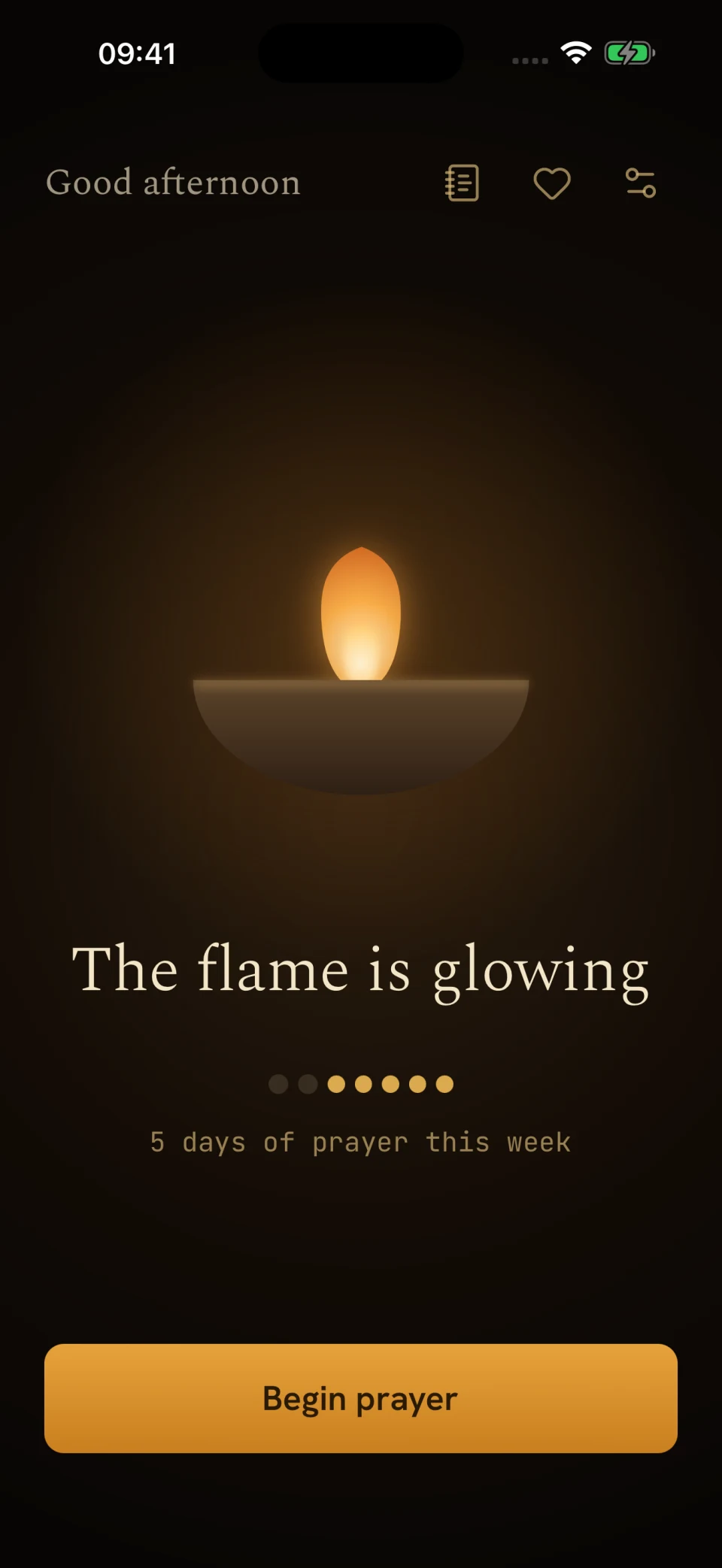
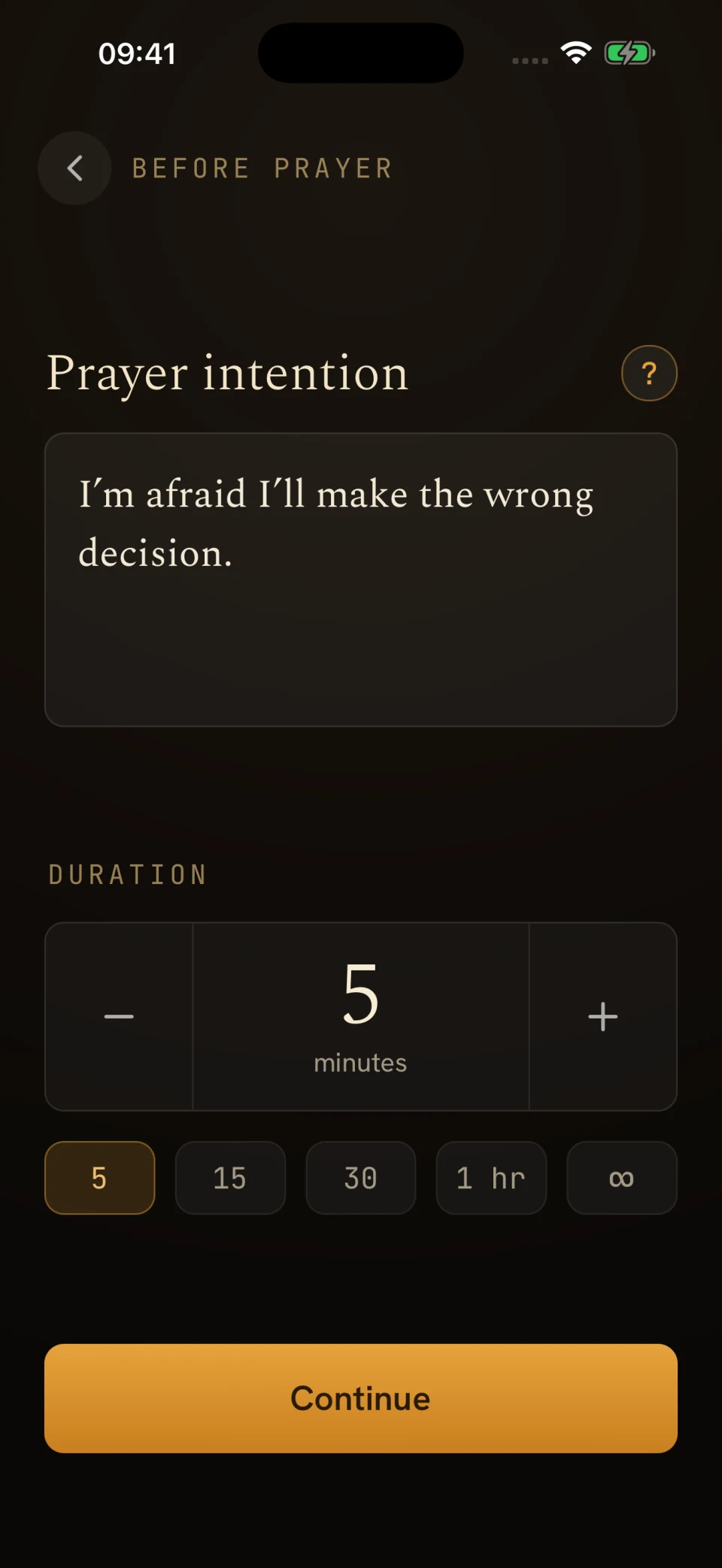
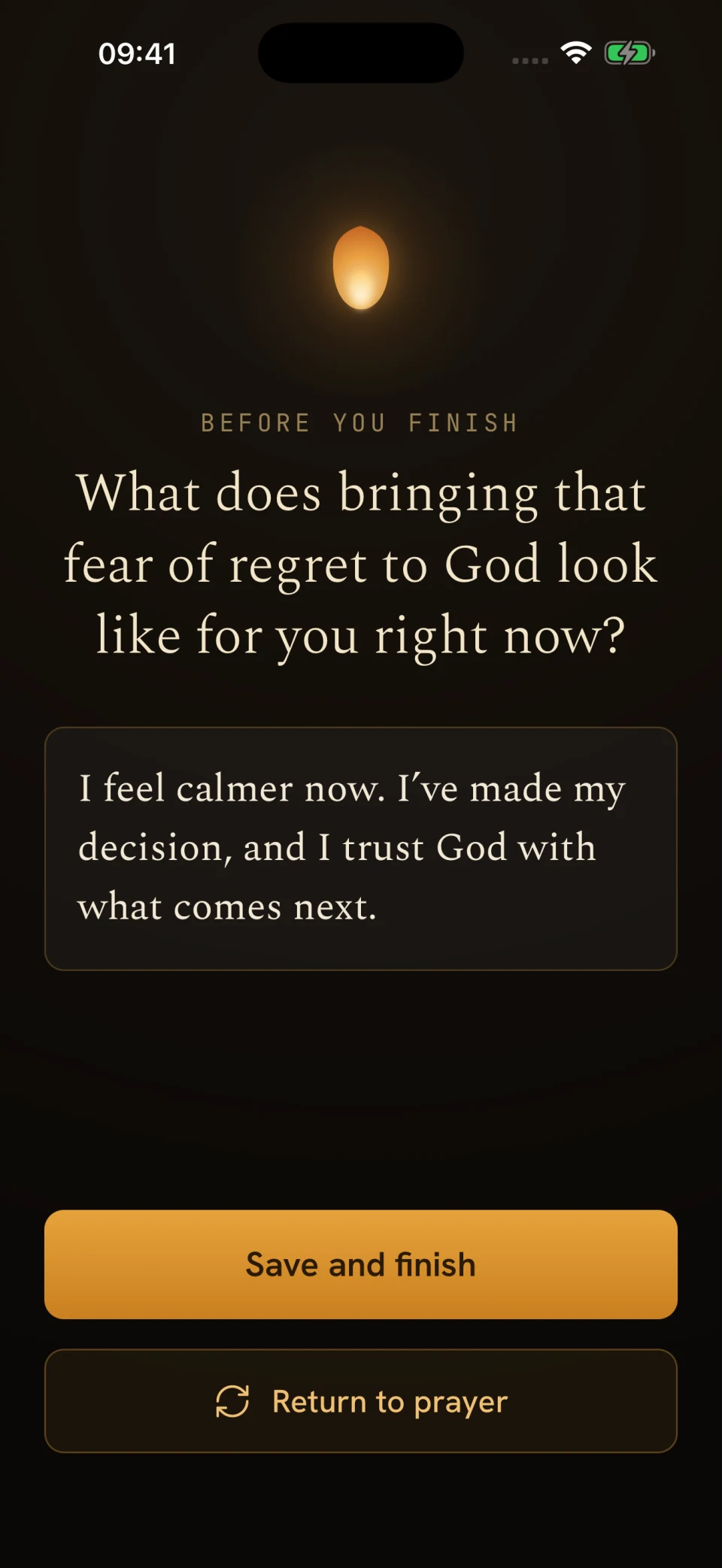
In Lampada you can set reminders for your chosen cue by day of the week and time of day, for example after breakfast and before bed. Seven dots on the home screen show the days you prayed in the app; a missed day leaves an empty dot, and there is no streak to lose. Lampada has no prayer book, no morning or evening prayers, no statistics and no rewards.
Ryle wrote that our prayers should be “like the fire on the altar, not always consuming sacrifices, but never completely going out”3. That is how it burned in the Scottish cottage too: prayer after meals, a closed door, and children tiptoeing past.
Frequently asked questions
How do I build a daily prayer routine?
Tie prayer to something that already happens every day. John Paton’s father went to pray “daily, and many times a day, generally after each meal”1, and Ryle advised making room for prayer the way you make room for meals and sleep, at hours of your own choosing3. Start small, and come back after you miss a day.
How do I pray in the morning?
Before you reach for your work or your phone. Bonar wrote to himself: “I must also resist the temptation of doing or reading anything before having found God”6. Rachele Guardini asked Letizia not to leave her room without first offering God the day’s work14. The psalm says: “In the morning, O Lord, You hear my voice; at daybreak I lay my plea before You and wait in expectation” (Psalm 5:3)16. Morning means waiting on God, not a compulsory start before dawn.
How long should I pray?
There is no set amount. Ryle didn’t require prayers to be the same length every day; what mattered was never letting anything make you abandon prayer3. MacIntyre warned against copying someone else’s routine as a rule, but insisted that everyone make room for time with God1. Start with a few minutes you can set aside even on a difficult day.
What if I miss a day?
Come back tomorrow, without beating yourself up. Rachele Guardini advised rereading your resolutions once a week and, if you had failed in any, not giving way to annoyance but asking God’s pardon and taking heart again14.
-
David M’Intyre (David MacIntyre). The Hidden Life of Prayer. Notes (www.chapellibrary.org) a b c d e f g h i j k l m n o p
-
John Gibson Paton on Wikipedia: 1824–1907; Scottish missionary of the Reformed Presbyterian Church in the New Hebrides (now Vanuatu), on the islands of Tanna and Aniwa; his father was a stocking manufacturer; his autobiography appeared in 1889. ↩
-
J. C. Ryle. A Call to Prayer. Introduction (www.monergism.com) a b c d e f
-
J. C. Ryle on Wikipedia: 1816–1900; evangelical Anglican; from 1880 the first Bishop of Liverpool. ↩
-
Andrew Bonar on Wikipedia: 1810–1892; minister at Collace, Perthshire, from 1838 to 1856, then at Finnieston Church in Glasgow until his death; in the Free Church of Scotland from 1843; in 1839 travelled to Palestine with Robert Murray M’Cheyne and later wrote his biography. ↩
-
Andrew A. Bonar (ред. Marjory Bonar). Diary and Letters (archive.org) a b c d e f g h i j k l m n o p
-
Mark 1:35. Berean Standard Bible (BSB), public domain. ↩
-
The year of the entry comes from the running head of the page in the 1894 edition of Diary and Letters; the day of the week and the date are damaged in the scanned text. ↩
-
Taisia (Solopova) on Wikipedia (in Russian): 1842–1915; born Maria Solopova; graduated from the Pavlovsky Institute in St Petersburg in 1861; from 1881 head of the Leushino community, which became a convent; a spiritual daughter of John of Kronstadt. ↩
-
игумения Таисия (Солопова). Записки игумении Таисии. Глава XII (azbyka.ru) a b c d e f g h i
-
игумения Таисия (Солопова). Записки игумении Таисии. Глава XII, our translation (azbyka.ru) a b c d e f g
-
игумения Таисия (Солопова). Записки игумении Таисии. Глава XX (azbyka.ru)
-
Rachele Guardini (письма); Vincenzo Carbone (биография и издание). Una contemplativa nella vita attiva. Madre Rachele Guardini. Volumi I–VI. 1. Principali dati biografici. (www.intratext.com)
-
Rachele Guardini (письма); Vincenzo Carbone (биография и издание). Una contemplativa nella vita attiva. Madre Rachele Guardini. Volumi I–VI (www.intratext.com) a b c
-
Rachele Guardini (письма); Vincenzo Carbone (биография и издание). Una contemplativa nella vita attiva. Madre Rachele Guardini. Volumi I–VI, our translation (www.intratext.com)
-
Psalm 5:3 (Psalm 5:4 in Russian and Ukrainian Bibles, which count the psalm’s title as a verse). Berean Standard Bible (BSB), public domain. ↩