
Ávila, the Convent of the Incarnation. A nun spends the hour of prayer she has set herself waiting, not for God, but for the clock to strike. Years later she will admit: “Very often, and for some years, I cared more about wishing the hour I had set myself would be over, and about listening for the clock to strike, than about other good things”1. And: “Many times, I think, I would have undertaken any severe penance more gladly than settled down to pray”1.
That nun was Teresa of Ávila. She would go on to reform the Carmelite order and write books people still read, and almost four centuries later she would become one of the first women the Catholic Church named a Doctor of the Church2.
If your mind wanders during prayer, you are in good company. Everyone gets distracted, even saints, and it doesn’t mean your prayer has failed. Don’t scold yourself for every distraction: when you notice it, calmly come back to the words of your prayer. A short “Lord, help me,” the familiar words of a psalm or a Gospel passage, and fewer words overall all help. The task that suddenly came to mind can wait. And if you keep nodding off, rest first. Here is how four very different people learned this.
Years with a book in hand
In her Life, Teresa describes her weakness without dressing it up. She dreaded the oratory: as soon as she went in, sadness weighed on her, and only by calling up every ounce of courage could she make herself pray. People said she had courage to spare, though by her own account she put it to poor use. In the end it was the Lord who helped her through3. And she noticed something: “After I had forced myself like this, I found more quiet and delight than at some times when I wanted to pray”1.
Unable to meditate, she went through eighteen years of great dryness, and through all of them she never dared to start praying without a book, unless she had just received Communion3: “my soul was as afraid to be at prayer without it as if it were going out to fight a whole crowd”1. The book “was like a companion or a shield”1, taking the blows her many thoughts rained down on her3. Without a book, her thoughts would scatter and her soul would lose all order; the book helped her gather them little by little and lead her soul along gently, almost coaxing it3. And many times, as soon as she opened it3, “nothing more was needed: sometimes I read a little, sometimes a lot, according to the grace the Lord gave me”1.
For Teresa, distraction was not a verdict on her prayer but a difficulty she lived with for years. And leaning on someone else’s words was no disgrace to her; it was a lifeline.
The same hour and the same weakness appear in the Gospel. In the garden of Gethsemane, Jesus comes back to His disciples and finds them asleep. “Were you not able to keep watch with Me for one hour?” He asks Peter. And then: “Watch and pray so that you will not enter into temptation. For the spirit is willing, but the body is weak” (Matthew 26:40–41)4. He sees their weakness and still calls them to keep watch and pray.
“God help me!”
For more than fifty years Edward Pusey was Professor of Hebrew at Oxford, and he was one of the leaders of the Oxford Movement in the Church of England5. Yet the voice in his Spiritual Letters is not a scholar’s but a confessor’s. In February 1847 he was answering a woman he guided; among other things, she had complained that her mind kept wandering when she prayed. Pusey’s first guess was the simplest one: “I hope the distractions you speak of were rather the effect of sleepiness”6. Then he urged her to take a proper rest before Lent arrived6. As for the self-regarding thoughts that had flashed through her mind at the worst possible moment, he writes that she could no more have prevented them than a lame man can make himself walk6.
In another letter from 1847, Pusey explains what to do at the very moment you realize your thoughts have drifted. There is no need to keep telling yourself “I must fix my mind,” or to make a separate act of contrition and then ask for help as well: such a double effort is itself a distraction. Better a single, instant, simple plea, “God help me!”, and then straight back into prayer6. He adds: “Involuntary distraction is infirmity, not sin.”6
The rest of his advice is just as down to earth. A good thought that turns up at the wrong moment can be asked to wait its turn, or entrusted to your guardian angel to keep for you6. And when the children are pressing you to hurry, make them the subject of your prayer6. “Be not anxious about many prayers, but about praying much.”6
His “God help me!” sits well beside a line from the psalms: “Give me an undivided heart, that I may fear Your name” (Psalm 86:11)7. It is a prayer for anyone whose heart is pulled in ten directions at once.
You don’t need a dark cell
Anna Sebryakova, later known as Abbess Arsenia, was the daughter of a landowner from the Don Cossack lands. She entered the Ust-Medveditsa convent on the Don at seventeen and was its abbess for more than forty years. In 2016 the Orthodox Church canonized Abbess Arsenia as a locally venerated saint8. In 1871, writing to Pyotr Brianchaninov, the brother of St Ignatius Brianchaninov9, she makes an admission you would hardly expect from an abbess: “I avoid talking about prayer, because I do not have it myself”10. And yet she answers, with a caveat: “I will set out my understanding so that you can correct it”10.
During her daily prayers — her rule of prayer, as Orthodox Christians call it — she tries to keep her attention on the Jesus Prayer alone. Only sometimes, when her mind wanders badly, does she turn to the canons to the Mother of God and to the saints11, which are long hymns used in Orthodox prayer. But she reads them, she says, “in order to direct attention toward prayer, not to turn it away from prayer to reading”10. She admits something else, too: her prayer still depends too much on feelings and outward impressions. “If there were less of the senses in our prayer, everything would add to it; as it is, sometimes even the canons and the church services get in its way”10, and then “we need dark cells for recollection, like mine in the garden, which I call my ‘infirmity’”10. “But all these are temporary aids; nothing helps me as much as life itself”10. Through the bitter circumstances of life, she writes, the Lord heals the weakness of the senses, and in them she comes to know both her own weakness and Him11, “so that I learn prayer, too, from life itself”10.
That summer Pyotr was waiting for her answers to some new questions, and she confessed: “somehow I have become very scattered and caught up in the bustle”10. She could not find enough free time for a proper letter about spiritual things, and it grieved her so much11 that one night, she writes, “I see in a dream that you have come, and I am complaining to you about my distracted life”10. And what he had asked about was exactly what to occupy the mind with “when thoughts are given freedom to drag one into the abyss”10. She answered honestly: “they drag us away precisely because there is no strength, no ability to hold them”10. In such moments, the support is not one’s own strength: “Not in the mind, not in the memory, not by attention, but deep in the soul the awareness comes alive that there is One who saves”10.
Props help, but you don’t have to wait for perfect quiet: even an abbess with a dark cell in her garden lived a busy, scattered life.
Her correspondent’s brother, St Ignatius Brianchaninov, a Russian bishop, gives a general rule in his letter “On Attention in Prayer”: “to enclose the mind in the words of the prayer”12. He advises beginners to pray “a little at a time, but often”12. And: “When you are alone, pray aloud enough to hear yourself: this helps you pay attention”12. “If you do not have proper attention in prayer, do not be troubled by it”12: God will give attention in His own time to the one who keeps at prayer and keeps pushing himself to pay attention13.
Brother Lawrence’s kitchen
Nicolas Herman grew up in Lorraine during the Thirty Years’ War, became a soldier out of poverty and was left lame for life by a wound14. At eighteen, one winter, he saw a tree stripped of its leaves and thought how soon it would be in leaf again, then in flower and in fruit. In that moment God’s providence and power opened up to him, and that sense never left him again15. Later he was in service as a footman to the treasurer Fieubert and, by his own account, was a big, clumsy fellow who broke everything he touched15. He asked to be admitted to a monastery expecting to be made to suffer there for his clumsiness and his blunders, but God, he said, disappointed him: he found nothing there but joy15.
So, at a monastery of the Discalced Carmelites in Paris, he became Brother Lawrence. He worked for fifteen years in the kitchen, a place he naturally disliked, and yet everything there came easily to him, because he had trained himself to do each task for the love of God and to ask for His grace every time16. Buying wine was hardly a job for a lame brother with no head for business, yet he was once sent to Burgundy to get the monastery’s supply; on the barge he could only get around by rolling himself over the casks. He simply told God that this was His affair, and later he saw that it had all turned out as well as could be16. Abbé Joseph de Beaufort wrote down his conversations with Lawrence, and after Lawrence died they were published with his letters as The Practice of the Presence of God14.
He planned his tasks before he began, deciding what had to be done and in what order, and as he got to work he would ask God to help him remain aware of Him throughout17. Afterward he looked back at how it had gone. A job done well meant thanks to God; a job done badly meant asking forgiveness and then, without losing heart, carrying on with God as if nothing had broken the thread17. He said it made no difference to him whether he was kneeling before the Blessed Sacrament or busy in the bustle of the kitchen with several people wanting something from him at once: in both places he was with God and equally at peace17.
But that peace did not come to him at once. In his early years he often spent the whole of his prayer time in a struggle: pushing stray thoughts away and then sinking back into them16. So when someone complained to him in a letter about such thoughts, Lawrence began with comfort: his correspondent was far from the only one who struggled with them18. He advises against piling up words in prayer, since a flood of words is often what sends the mind off course18. He suggests simply standing before God and owning that you need His help, even when you have nothing to say18. When the mind slips away, he says, don’t get upset, because agitation only scatters it further; let your will lead it back calmly18. There is one more approach, and it concerns the rest of your day: the less you let your mind drift away from God in ordinary hours, the easier it is to gather it at prayer, and a habit of turning to Him often makes it simpler to stay focused when you pray, or at least to bring your attention back18.
For Lawrence, attention in prayer is built out of the whole day.
How to try it today
Start small, and pray more often rather than longer. If you keep nodding off, rest first instead of beating yourself up. Give yourself something to lean on, such as a psalm, a chapter of the Gospels or a prayer you know well, and read slowly, aloud if you like; our articles on lectio divina and praying Scripture go into more detail. When you notice your mind has drifted, say “Lord, help me” and go back, without counting how many times it has happened. A task pops into your head? Let it wait: jot it down on paper and return. Someone comes to mind? Pray for them. If words are hard to find, start with what is on your heart right now, in your own words, about one thing. And say less.
What works for you is something you will have to find out. St Ignatius advised praying aloud when you are alone, while Pusey suggested saying the Lord’s Prayer and the Creed silently to yourself, which leaves less room for distraction, with not even your own voice to pull you away6. And don’t judge your prayer by how many times you got distracted.
Keep your intention in view
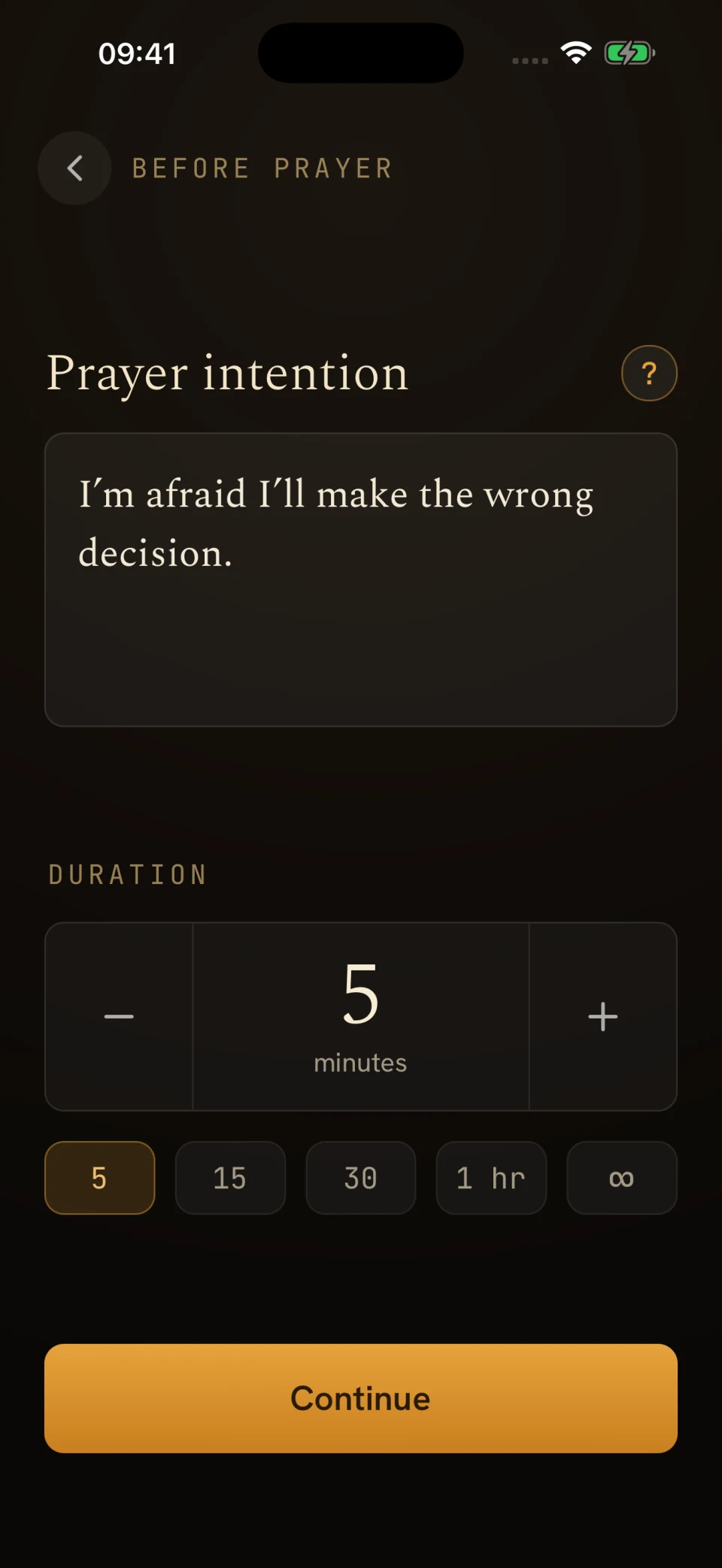
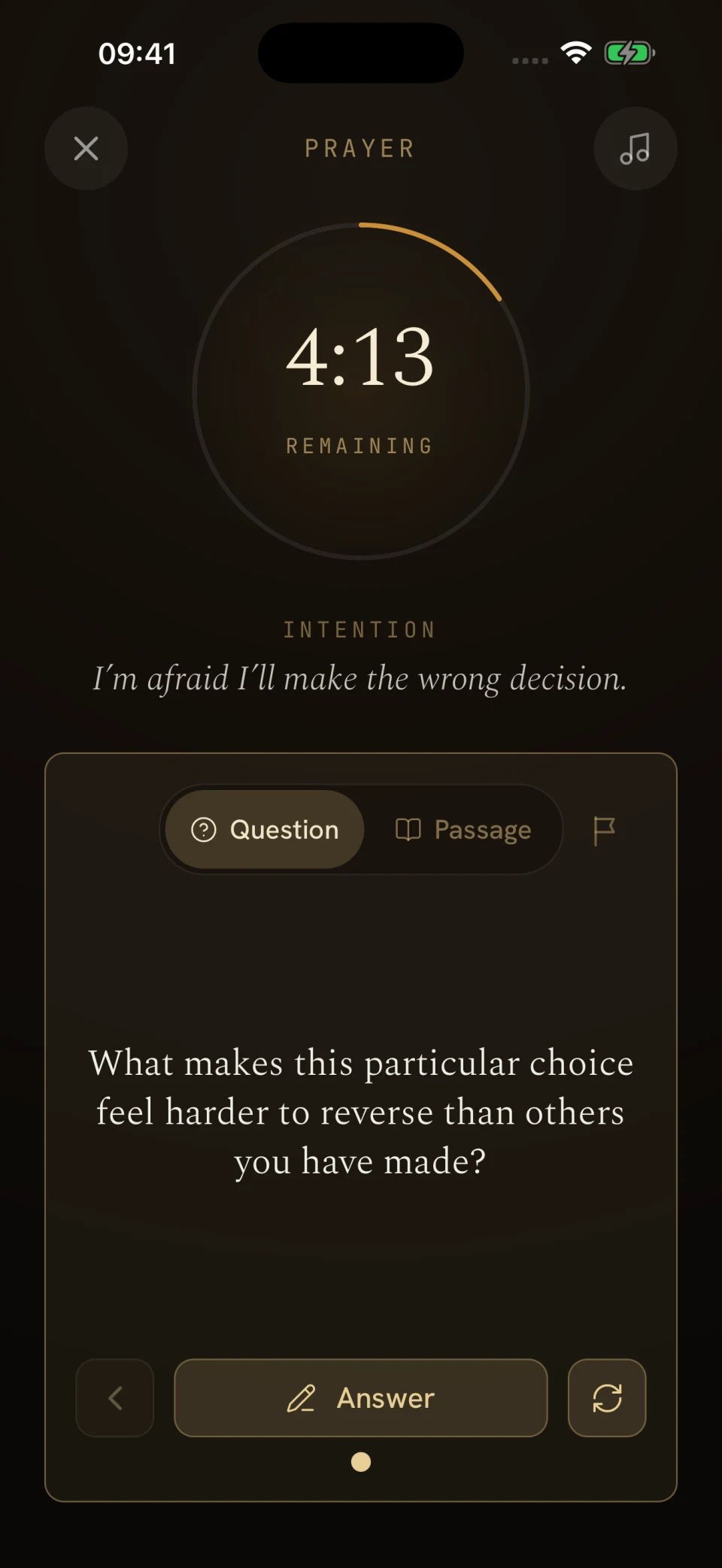
In Lampada, prayer begins with an intention: in one sentence you write what you want to talk to God about, and that sentence stays on the screen for the whole prayer. When your thoughts wander, you have something to come back to. You can pray for 5, 15 or 30 minutes, 1 hour, or with no timer, and the buttons let you shorten the time to as little as one minute: better short and often. You don’t have to watch the clock the way Teresa did. When the time is up, the app tells you: “Time is up. You can continue.”
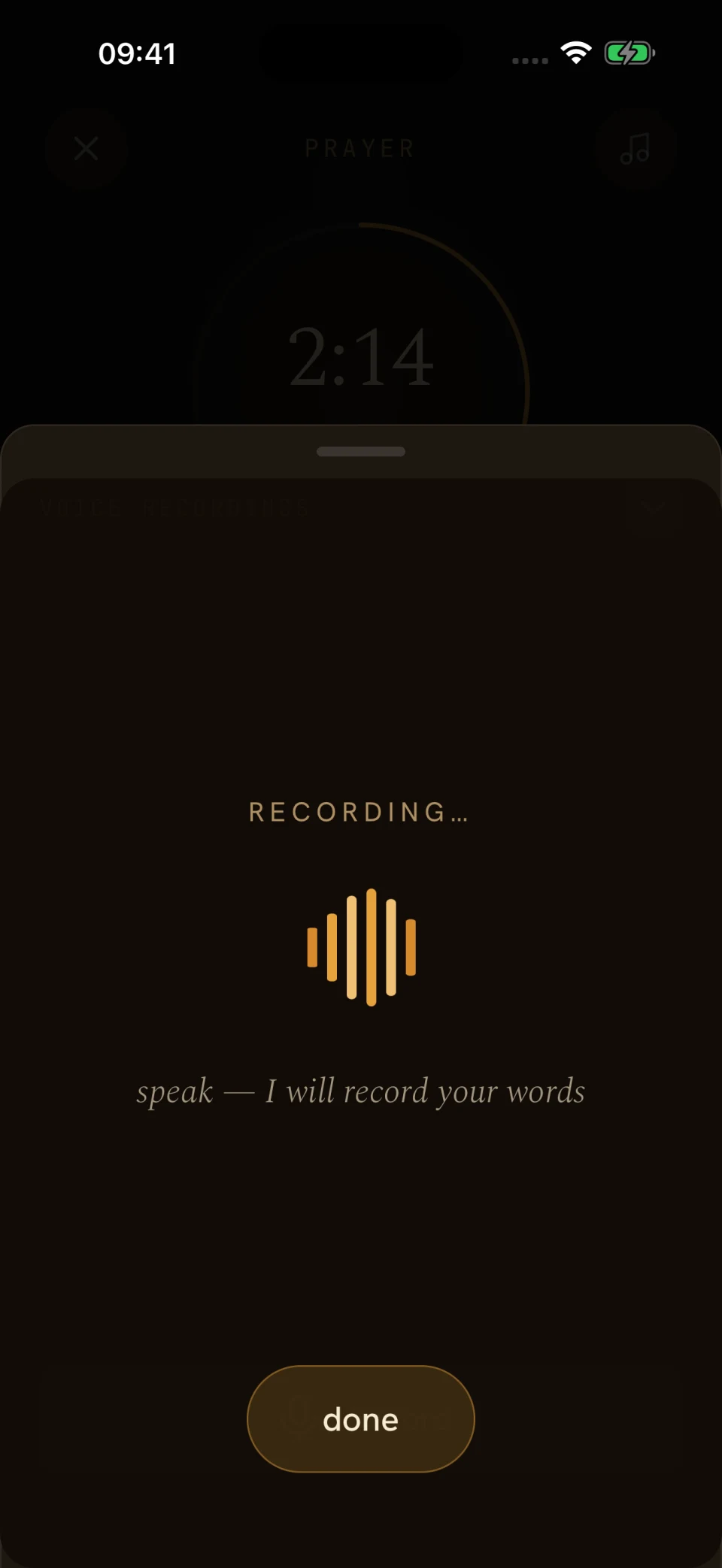
Guiding questions about your intention also bring you back to it. You can skip them, and you can answer by typing or by voice: what you say out loud is easier to hold on to. If you allow it, Lampada finds a Scripture passage that fits what you are praying about, something to lean on, like Teresa’s book, and you can listen to it read by a human narrator. Quiet music is optional: for some people it covers background noise, for others it gets in the way. At the end you can write a short takeaway in your own words, and it is saved in your journal. And reminders on the days and at the times you choose help you pray a little at a time, but often.
What Lampada doesn’t do: there is no place to park thoughts for later, so jot that task down on paper or in your notes app. The app doesn’t notice when you get distracted and doesn’t train your attention, it won’t cure sleepiness or fatigue, and it has no ready-made prayers or canons.
And in the same chapter where she remembers listening for the clock, Teresa writes about God’s patience: He is willing to be even with those who are far from Him, to make them good, if only they will bear His presence for at least two hours a day, even when their heads are full of a thousand cares and worldly thoughts. That, she admits, is exactly how she herself used to pray3. You don’t have to wait for your thoughts to quiet down. It is enough to come, and to keep coming back.
Frequently asked questions
Why do I get so distracted during prayer?
Because the mind is restless by nature: Brother Lawrence wrote that the mind is a great wanderer18. Sometimes the cause is simpler, and it is tiredness: in one of his letters Edward Pusey hoped that drowsiness was what lay behind the wandering attention a correspondent had described6.
Is it a sin to get distracted during prayer?
Edward Pusey answered: “Involuntary distraction is infirmity, not sin.”6 St Ignatius Brianchaninov advised: “If you do not have proper attention in prayer, do not be troubled by it”12.
What if I fall asleep while praying?
Get some sleep first: Pusey’s advice in that situation was to take a proper rest6. Our own suggestion: pray sitting or standing rather than lying down, and try praying aloud.
Is it okay to pray from a book?
Yes. For eighteen years Teresa of Ávila did not dare to begin praying without a book, except right after Communion3, and Abbess Arsenia turned to reading canons when she was badly distracted11.
-
Santa Teresa de Jesús. Libro de la vida, our translation (commons.wikimedia.org) a b c d e f
-
Teresa of Ávila on Russian Wikipedia: 1515–1582; at twenty she entered the Carmelite Convent of the Incarnation in Ávila; in 1970 Pope Paul VI declared her a Doctor of the Church, the first woman to be so named, together with Catherine of Siena. Teresa of Ávila on Wikipedia: reformer of the Carmelite order who, with John of the Cross, founded the Discalced Carmelites; author of the Life, The Interior Castle and The Way of Perfection. ↩
-
Santa Teresa de Jesús. Libro de la vida (commons.wikimedia.org) a b c d e f g
-
Matthew 26:40–41. Berean Standard Bible (BSB), public domain. ↩
-
Edward Bouverie Pusey on Wikipedia: 1800–1882; Anglican priest, Regius Professor of Hebrew at the University of Oxford for more than fifty years and one of the leading figures of the Oxford Movement. ↩
-
Edward Bouverie Pusey. Spiritual Letters (archive.org) a b c d e f g h i j k l
-
Psalm 86:11. Berean Standard Bible (BSB), public domain. ↩
-
Arsenia (Sebryakova) on Russian Wikipedia: 1833–1905, born Anna Mikhailovna Sebryakova, the daughter of a landowner in the Don Cossack Host region; from December 1850 she lived at the Ust-Medveditsa Transfiguration Convent and became its abbess; on 21 October 2016 she was canonized as a locally venerated saint of the Volgograd Metropolis. Her biography on Azbyka.ru, in Russian: she became abbess in 1864. ↩
-
Pyotr Brianchaninov on Russian Wikipedia: 1809–1891, younger brother of Bishop Ignatius Brianchaninov. ↩
-
прп. Арсения (Себрякова), игумения. Письма к П. А. Брянчанинову и другим лицам. Письма 1–14, our translation (azbyka.ru) a b c d e f g h i j k l
-
прп. Арсения (Себрякова), игумения. Письма к П. А. Брянчанинову и другим лицам. Письма 1–14 (azbyka.ru) a b c d
-
свт. Игнатий (Брянчанинов). Письма к разным лицам. 24. О внимании в молитве, our translation (azbyka.ru) a b c d e
-
свт. Игнатий (Брянчанинов). Письма к разным лицам. 24. О внимании в молитве (azbyka.ru)
-
Brother Lawrence on Wikipedia: Nicolas Herman, c. 1614–1691; grew up in Lorraine during the Thirty Years’ War, joined the army out of poverty, was wounded and left lame for life; a lay brother at the Discalced Carmelite monastery in Paris, where he worked in the kitchen for many years; Abbé Joseph de Beaufort held and recorded conversations with him and, after his death, compiled The Practice of the Presence of God. a b
-
Brother Lawrence. La pratique de la présence de Dieu. CONVERSATIONS — FIRST CONVERSATION (ccel.org) a b c
-
Brother Lawrence. La pratique de la présence de Dieu. CONVERSATIONS — SECOND CONVERSATION (ccel.org) a b c
-
Brother Lawrence. La pratique de la présence de Dieu. CONVERSATIONS — FOURTH CONVERSATION (ccel.org) a b c
-
Brother Lawrence. La pratique de la présence de Dieu. LETTERS — EIGHTH LETTER (ccel.org) a b c d e f