
England, around 1770. A teenage girl in the small town of Macclesfield read in a devout book that at the judgment everyone’s deeds would be weighed: if the good outweighed the bad, the way to heaven lay open, and if the bad outweighed the good, condemnation awaited. She decided to test herself honestly by this rule1. “I therefore made a little day-book, in which I put down every good and bad action, with great sincerity; at the same time praying to God to shew me if I was in the way to heaven or not.”1 Obedience to her elders, her prayers and the church services all counted. To add one more good deed she would sometimes skip games and parties and stay home reading to her mother, and now and then she fasted for whole days, yet the bad still outweighed the good1. But she promised herself once more to be better and went on keeping the account1, until one day at a dance she pulled her handkerchief out of her pocket, and the day-book came out with it: “it was found, and made the jest of the company”1. Mortified, she abandoned her method1. The girl was Hester Ann Roe; later, as Hester Rogers, she would become a well-known Methodist writer2.
The examen (from the Latin for the tongue of a balance, and so a weighing or a test)3 is a short prayer in which you look back over your day together with God. Ignatius of Loyola described it in his Spiritual Exercises. You will also hear it called the daily examen, the examination of conscience or, in today’s Ignatian spirituality, the examen of consciousness4. A few minutes is enough: Sacred Space, the prayer site of the Irish Jesuits, suggests five or ten5. It isn’t confession: Catholics also examine their conscience before the sacrament of reconciliation, but the examen is a daily personal prayer4. Nor is it a journal: you don’t have to write anything down.
In Ignatius the examen has five movements: give thanks, ask for light, go back over the day, ask forgiveness, and resolve, with God’s grace, to do better. It isn’t a mandatory template, and it isn’t bookkeeping like Hester’s day-book. You can shorten the steps; what matters is that you are not looking at your day alone.
The wounded soldier who listened to his thoughts
In May 1521, during the defense of Pamplona, a cannonball shattered the leg of a Basque nobleman named Íñigo de Loyola, the future Ignatius. His recovery was long. There were no tales of chivalry in the castle, so he was given a life of Christ and lives of the saints instead. He noticed that daydreams of glory left him empty, while thinking about the saints left him joyful and at peace6. So he learned to listen for the trace that thoughts leave in the soul, and the examen is exactly that kind of listening, only to the whole day.
Later, with six companions, Ignatius founded the Jesuits, the Society of Jesus. In time the Society became the largest Catholic religious order of men, known for its schools and universities and, from the sixteenth century on, for missions all over the world7. Ignatius made the examen obligatory for his brothers twice a day, at midday and in the evening, and Jesuits still pray it today8.
In the Spiritual Exercises the general examen of conscience does not start with sins. Here are its five points in Elder Mullan’s English translation:
- “The first Point is to give thanks to God our Lord for the benefits received.”9
- The second: “to ask grace to know our sins and cast them out.”9
- The third: “to ask account of our soul from the hour that we rose up to the present Examen, hour by hour, or period by period”9, in thoughts, words and deeds.
- The fourth: “to ask pardon of God our Lord for the faults.”9
- The fifth: “to purpose amendment with His grace.”9
Then the Our Father. Notice that light is something you ask God for, not something you wring out of yourself by self-reproach. The psalmist prayed the same way: “Search me, O God, and know my heart; test me and know my concerns. See if there is any offensive way in me; lead me in the way everlasting” (Psalm 139:23–24)10.
Ignatius could count, too. Against one chosen fault he has a “particular examen”. The record is a line of dots, one for each recurrence of the chosen fault since getting up. For this review after dinner, Ignatius joins a careful look back over each part of the day so far with prayer: ask God to help you recognise the failures and change, and commit to resisting the fault until the next review11. After supper comes a second examen of the same kind, on a second line11. Here counting is part of prayer, and Ignatius began the general examen with gratitude. Hester, by contrast, was testing herself by someone else’s rule: she hoped to tell from the balance of her good deeds whether there was any hope of salvation for her1.
Abba Dorotheus’s questions
Long before Ignatius, in the sixth century, Abba Dorotheus lived in a monastery near Gaza. His teachings shaped monks in both East and West12. He passes on a rule the fathers left: take stock twice a day, looking back in the evening on the day just past and in the morning on the night, and repent before God of whatever sin you find13. His questions are strikingly down to earth: did I hurt my brother, did I judge him when I saw him at his work, did I grumble against the cellarer, the monk in charge of supplies, when he refused me, did I complain about bad food13.
He doesn’t spare himself. Not long after a serious illness he was put in charge of receiving guests at the monastery: he spent the evenings with travelers, then served the camel drivers, and at night he was woken again13. The monk who woke the brothers for the night vigil would come to rouse him, and Dorotheus, exhausted, would mumble in his sleep that he was coming, then drift off again and later grieve over being late. His solution was simple: he asked one brother to wake him and another to keep him from dozing at the vigil. He honored these two as men through whom God was bringing about his salvation13. His look back ended not in beating himself up but in asking for help.
Dorotheus promises slow change: whoever examines himself like this, repents and tries to amend will commit eight faults instead of nine, little by little, with God’s help13.
“My poor heart”
What if, looking back over the day, you remember something bad? Francis de Sales, bishop of Geneva and author of the Introduction to the Devout Life14, advised against scolding yourself. A French priest, Joseph Tissot, gathered passages from his letters and books into a short volume on how to make good use of our faults. De Sales warns against harshly berating your own heart15. Instead, speak like this: “Well, my poor heart, here we are, fallen into the very pit we had so firmly resolved to escape. Ah! let us get up and leave it for good”16. To a woman who complained that she still took slights painfully, he replied: “But, my dear daughter, what does this ‘still’ refer to? Have you already beaten many such enemies?”17 And he advised: “Be content to win, from time to time, some small advantage over the passion you are struggling against”17. And again: “We cannot walk without touching the ground. We must not lie down and wallow in it, but neither must we think of flying, for we are little chicks that don’t yet have our wings”17.
John Woolman’s night
Looking back in the evening is not only about the past. John Woolman was a Quaker and a tailor from New Jersey, one of the first to speak out against slavery18. In the spring of 1772 he was looking for a passage to England. As he tells it in his Journal, his friend had taken a place in the cabin of a ship bound for London, while Woolman felt drawn toward the steerage of the same ship19, the cramped common quarters below deck. On this visit, Woolman met the ship’s owner in the steerage, amid the sailors at work. He had also been into the spacious cabin19. “Here my Mind was turned toward Christ, the heavenly Counsellor; and I feeling, at this Time, my own Will subjected, my Heart was contrite before him.”19 The owner suggested moving to the cabin, where it was quieter, but Woolman left the ship with an easy mind, without agreeing on a passage19.
That night, he recalls, “my Mind was under a deep Exercise before the Lord; whose helping Hand was manifested to me as I slept that Night, and his Love strengthened my Heart”19. In the morning he went to the owner and told him of the scruple of conscience that kept him from traveling in the cabin19. Why the cabin troubled him, Woolman doesn’t say in these lines. Then he booked a passage in the steerage19. After that he went home for a couple of days, and early one morning he said goodbye to his family, feeling the humbling hand of God upon him. In Philadelphia his friends were worried for him: the part of the ship where he was to lodge was a miserable place19. On May 1, 1772, he went on board19: “as I sat down alone, on a Seat on the Deck, I felt a satisfactory Evidence that my Proceedings were not in my own Will, but under the Power of the Cross of Christ.”19 In his entry for May 7 he thanks his heavenly Father for keeping him free of seasickness. Other passengers had suffered bouts of it during a voyage marked mostly by bad weather since his arrival on board19. He adds: “my Afflictions now being of another Kind”19. In the same entry: “I have, this Day, great Cause to be thankful, in that I remain to feel Quietness of Mind”19.
This isn’t the examen, and it isn’t a review of a whole day: Woolman is describing a night of wrestling before one particular decision. But the movement is similar: notice where your soul has no peace, bring it to God, and take a step in the morning. That autumn he fell ill with smallpox in England and died in York20.
How to pray the examen tonight
This evening, even for five minutes, recall one specific thing you want to thank God for. Ask: “Show me this day.” Recall the people and events of the day. Ask yourself, as Dorotheus did: whom did I hurt or judge? And, as with Woolman: where was there peace in my soul, and where heaviness? Talk to yourself about what went wrong the way de Sales did, not like a prosecutor, and ask for forgiveness. Choose one small step for tomorrow; sometimes it will be asking for help, as Dorotheus did. Finish with the Lord’s Prayer or in your own words.
You don’t have to write anything down. If you’d like to, one line is enough; for how to keep notes and read them back, see our article on keeping a prayer journal. If you already pray in the evening from a prayer book or with the Daily Office, the examen can sit alongside those prayers rather than replace them; on finding a regular rhythm of prayer, see our article on the rule of prayer. There are two traps: turning the evening into bookkeeping, as Hester did, or into a sleepless interrogation of yourself. If looking back over the day keeps leaving you anxious, cut it down to gratitude and trust, and talk to a priest or pastor. If the anxiety won’t let go of you, see a mental health professional.
Evening prayer in Lampada
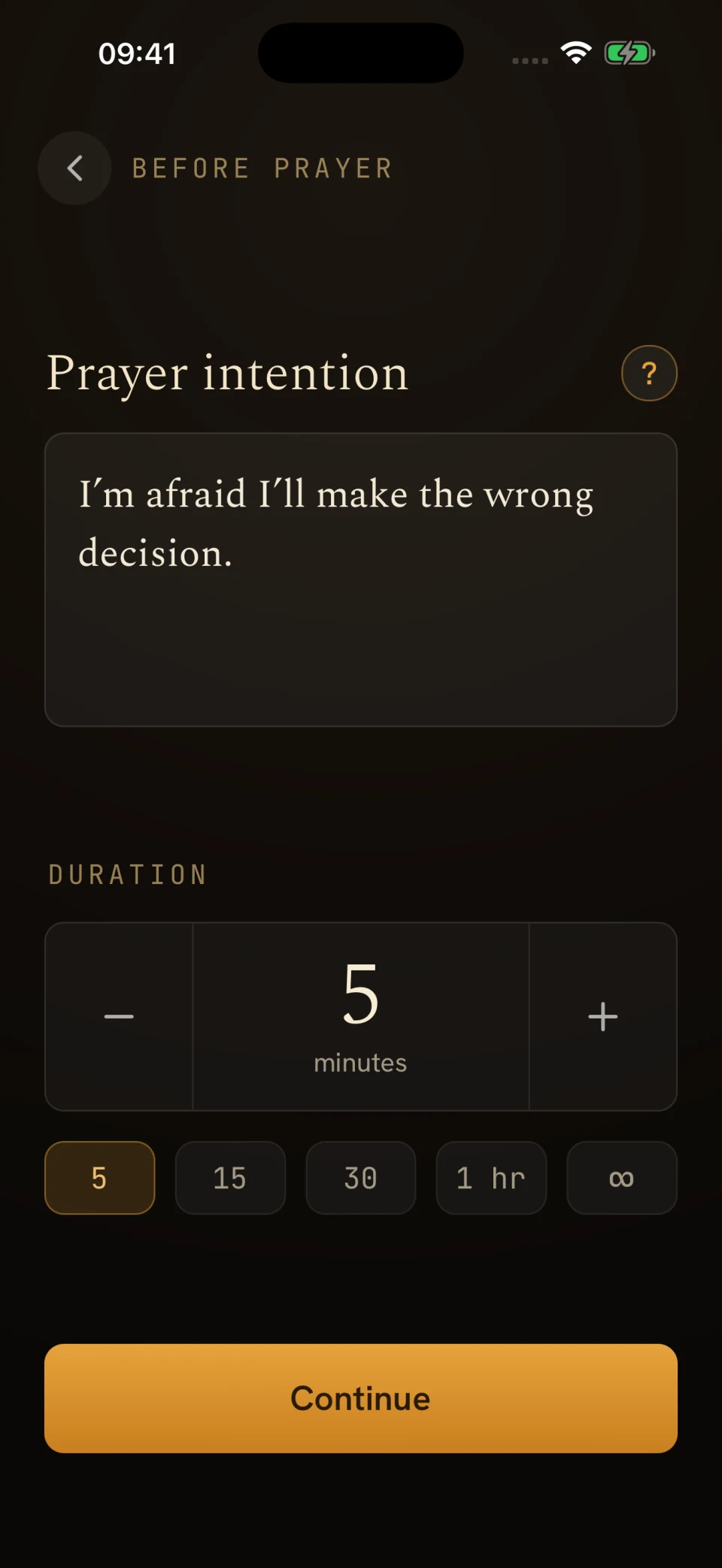
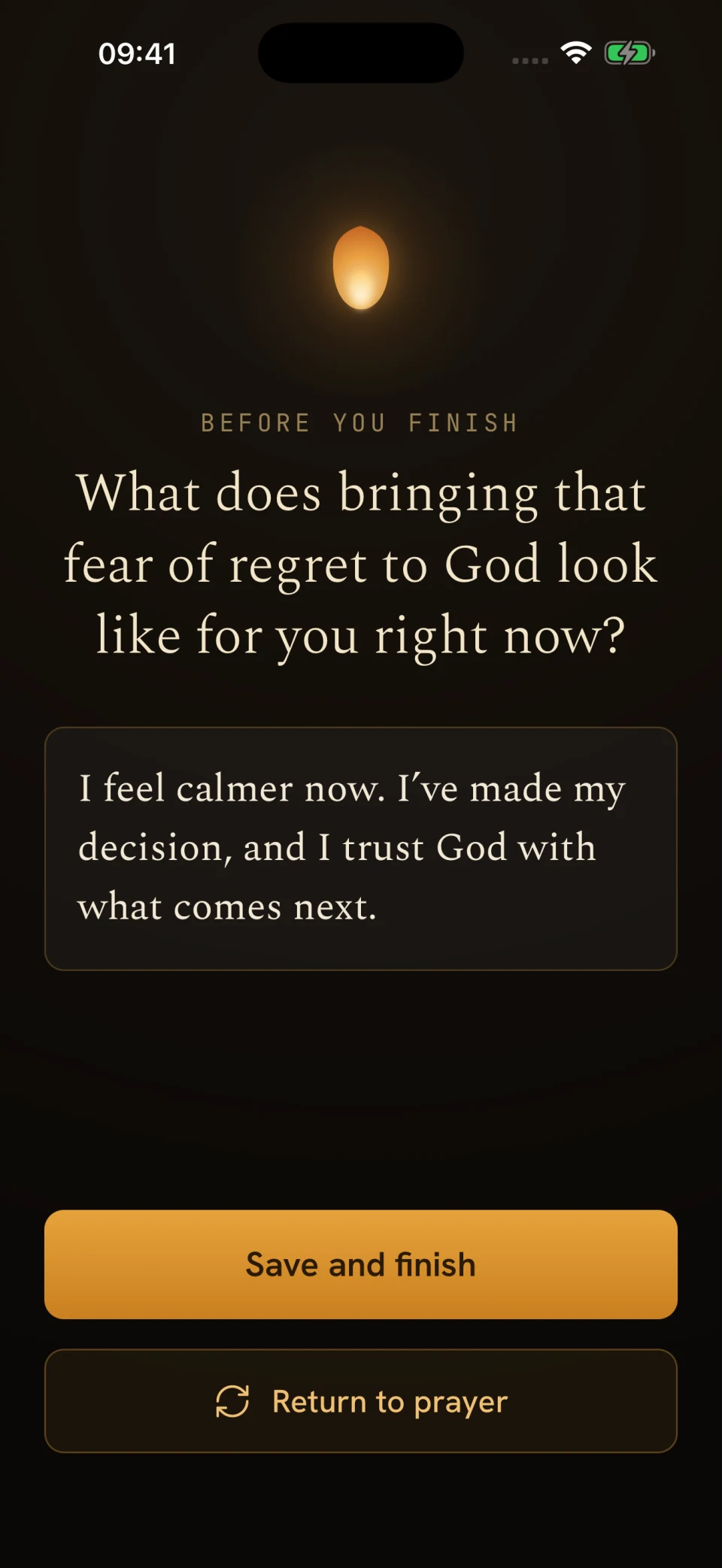
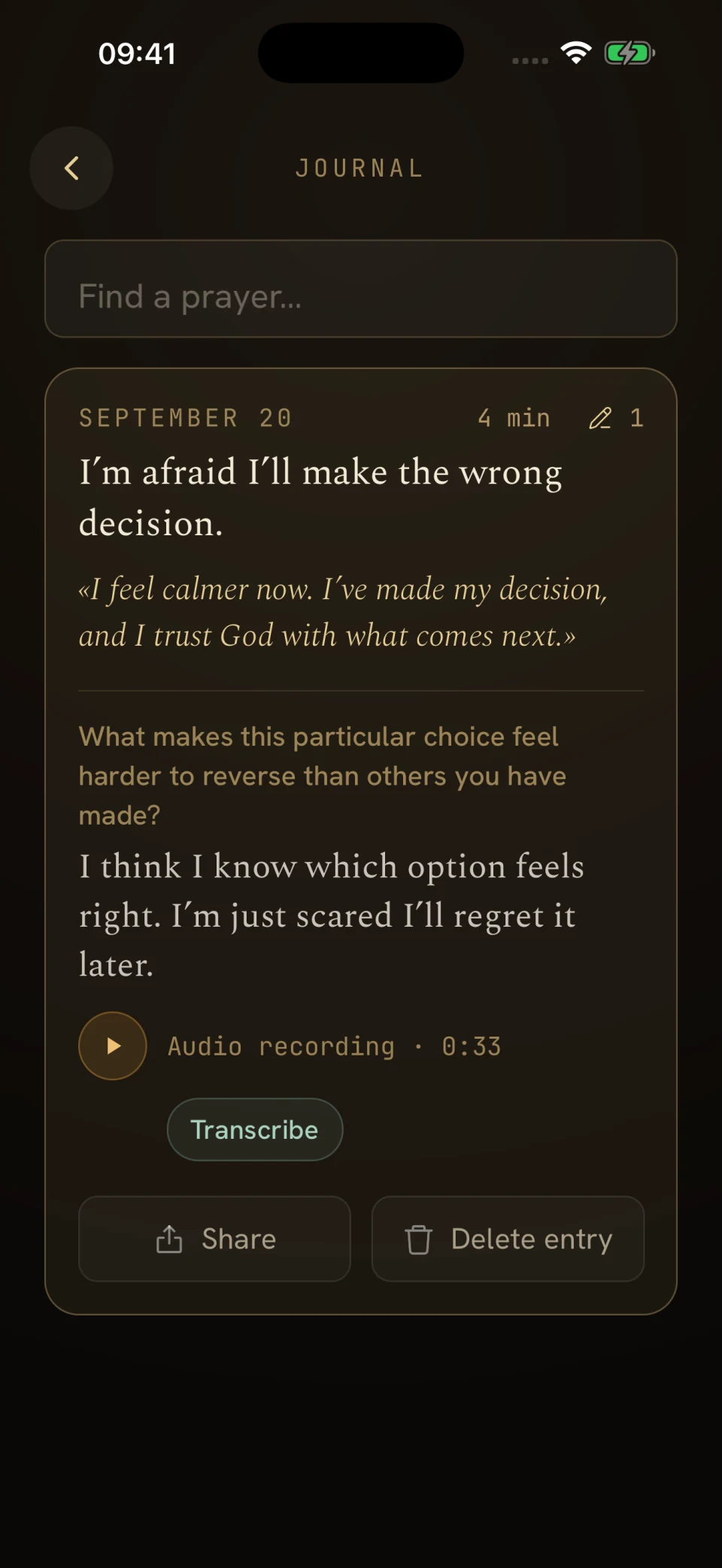
Lampada has no examen mode and no five steps, but you can start an evening conversation with God in it. You write your own prayer intention, for example “Look back on today.” You can pray without a timer. The guiding questions depend on your intention and your answers; you can answer them by typing or by voice, or skip them. Passages of Scripture are chosen to match the meaning. You can set an evening reminder for the days you want.
At the end the app asks one closing question: what mattered most in this prayer, or what you want to bring to God. If you like, you can write a takeaway of a line or two. Your prayers are kept in a journal on your device, and you can search them. But this is not the examen: the closing question is about this prayer, not your whole day. There is no gratitude list and no tally of faults. The app’s questions are prompts for reflection, not spiritual direction. Lampada helps you set aside time for evening prayer; how you look back on the day is up to you, whether with Ignatius or with Dorotheus.
Hester did not find her way out in a new day-book. In the autumn of 1774, after hearing a Methodist preacher21, she cried out in despair: “What shall I do? O teach me, O help me, or I am lost!”1 Then words came to her heart: she could cast all her care on God, because He cares for her1. “Lord, dost thou care for me!”1 she answered, and then came a doubt: “Is it not too easy a way?”1 But she felt the Lord bring the words “Fear not, only believe” home to her heart1. She describes a sudden freedom as she placed herself entirely in Christ’s care, trusting him alone to save her1. “My sins were gone; my soul was happy”1, she wrote, and tears of joy ran down her cheeks1. Her mother was astonished at the change in her face; as she listened to her daughter she wept with her, but said very little, she was so amazed1.
The evening is not for balancing the books but for handing the day over to God and going to sleep: “I will lie down and sleep in peace, for You alone, O Lord, make me dwell in safety” (Psalm 4:8)22.
Frequently asked questions
What is the examen prayer?
A short prayer in which you look back over your day with God. In Ignatius of Loyola’s words, its first point is “to give thanks to God our Lord for the benefits received.”9 Then come asking for light, going back over the day, asking forgiveness and resolving, with God’s grace, to do better.
How long does the examen take?
A few minutes. Sacred Space, the Irish Jesuits’ prayer site, speaks of five to ten5. Ignatius asked the Jesuits to pray it twice a day, at midday and at the end of the day8.
Can non-Catholics pray the examen?
The name and the five points come from the Jesuits, but other Christians also know the practice of looking back on the day in the evening. Abba Dorotheus passed on the rule of the fathers: every evening, look back on how you spent the day13.
What if all I remember in the evening is my mistakes?
Start with gratitude and speak to yourself gently. Francis de Sales advised addressing yourself like this: “Well, my poor heart, here we are, fallen into the pit”16. If the evening still turns into an anxious interrogation, talk to a priest, a pastor or a mental health professional.
Is there a guided examen in Lampada?
Not a ready-made examen with five steps. You can set your intention as “Look back on today” and pray with guiding questions that you can skip; at the end the app asks a closing question about this prayer.
-
Hester Ann Rogers. An Account of the Experience of Mrs. H. A. Rogers (archive.org) a b c d e f g h i j k l m n o p
-
Hester Rogers on Wikipedia: Hester Ann Roe was born in Macclesfield in 1756 and died in 1794; a British Methodist writer. ↩
-
exāmen on Wiktionary: Latin exāmen, “the tongue of a balance”, “a weighing, an examination”, from exigere, “to weigh accurately”. ↩
-
Examination of conscience on Wikipedia: in the Catholic Church an examination of conscience is recommended before the sacrament of penance; the daily Ignatian examen, also called the examen of consciousness, is distinguished from the examination before confession. a b
-
The Daily Examen / “5 at 5” Prayer on Sacred Space, a ministry of the Irish Jesuits: look back on the day for “about 5/10 minutes”; for example, five minutes at five in the evening. a b
-
Ignatius of Loyola on Wikipedia: on 20 May 1521, during the siege of Pamplona, a cannonball shattered his right leg; while he recovered he was given a life of Christ and lives of the saints instead of romances of chivalry; dreams of knightly deeds left him desolate, dreams of the saints joyful and at peace; with six companions he founded the Jesuits. ↩
-
Jesuits on Wikipedia: the Society of Jesus was founded in 1534 by Ignatius of Loyola and six companions, students at the University of Paris; the largest Catholic religious order of men, known for its work in education; Jesuit missions around the world from the sixteenth to the eighteenth century. ↩
-
The Daily Examen / “5 at 5” Prayer on Sacred Space: one of the few rules of prayer Ignatius gave the Society of Jesus is the examen twice a day, at noon and at the end of the day; Jesuits and many other Christians still practice it. a b
-
St. Ignatius of Loyola. Ejercicios espirituales. FIRST WEEK — GENERAL EXAMEN OF CONSCIENCE, translated by Elder Mullan (ccel.org) a b c d e f
-
Psalm 139:23–24 (Psalm 138 in Orthodox Bibles). Berean Standard Bible (BSB), public domain. ↩
-
St. Ignatius of Loyola. Ejercicios espirituales. FIRST WEEK — PARTICULAR AND DAILY EXAMEN, translated by Elder Mullan (ccel.org) a b
-
Dorotheus of Gaza on Wikipedia: c. 500 – 560 or 580; a monk of the monastery of Abba Seridus near Gaza, author of teachings on the ascetic life that influenced monasticism in East and West. ↩
-
прп. авва Дорофей. Душеполезные поучения и послания (рус. пер. с греч.). Поучения — Поучение 11. О том, что должно стараться скорее отсекать страсти, прежде нежели они обратятся в злой навык души (azbyka.ru) a b c d e f
-
Francis de Sales on Wikipedia: 1567–1622, bishop of Geneva from 1602, author of the Introduction to the Devout Life. ↩
-
Joseph Tissot. L'Art d'utiliser ses fautes, d'après Saint François de Sales. CHAPITRE II ne pas se troubler à la vue de ses fautes (fr.wikisource.org)
-
Joseph Tissot. L'Art d'utiliser ses fautes, d'après Saint François de Sales. CHAPITRE II ne pas se troubler à la vue de ses fautes, our translation (fr.wikisource.org) a b
-
Joseph Tissot. L'Art d'utiliser ses fautes, d'après Saint François de Sales. PREMIÈRE PARTIE CHAPITRE PREMIER ne pas s’étonner de ses fautes, our translation (fr.wikisource.org) a b c
-
John Woolman on Wikipedia: a Quaker preacher, tailor and one of the early opponents of slavery in colonial America; lived in Mount Holly, New Jersey. ↩
-
John Woolman. The Journal, with Other Writings. A JOURNAL OF THE LIFE AND TRAVELS OF JOHN WOOLMAN, In the Service of the Gospel — CHAPTER X (www.gutenberg.org) a b c d e f g h i j k l m
-
John Woolman on Wikipedia: in 1772 he sailed to England in steerage and spent his time with the crew; in York he caught smallpox and died on 7 October 1772. ↩
-
Hester Rogers on Wikipedia: she dated her conversion to 11 November 1774, after a sermon by the Methodist preacher Samuel Bardsley. ↩
-
Psalm 4:8 (Psalm 4:9 in Orthodox Bibles). Berean Standard Bible (BSB), public domain. ↩