
April 1859. Someone writes to Anthony, an elder of Optina Monastery in Russia, with hints of hard times and war ahead1. The old monk doesn’t follow the news: “I read no newspapers at all, and so I know nothing of what is happening in the world”2. But he knows fear well enough without them. Trouble, he writes, can come not only from robbers but from one’s own family, from friends and from enemies1, while the enemy prowls around “like a hungry lion”2, and everyone has reason to beware “of ending up in its teeth”2. And then he admits what he does himself: “to calm myself in this fear, I always read David’s Psalm 26”2. In most English Bibles that is Psalm 273.
This was written by a man whose life was not easy. For fourteen years Anthony led the Optina skete, then a monastery in Maloyaroslavets, and illness more than once made him ask to be relieved of his post4. “I have had sores on my legs for 25 years”5, he writes in another letter, but it doesn’t sound like a complaint: the righteous Lazarus suffered without shelter or medicine, with only the dogs to comfort him6, while he himself has “both doctors and medicines”5.
A short prayer for anxiety can be very simple: “Lord, have mercy.” Or the Jesus Prayer: “Lord Jesus Christ, Son of God, have mercy on me.” Or the first line of the psalm Anthony read: “The Lord is my light and my salvation — whom shall I fear?” (Psalm 27:1)7. You don’t need eloquence, and fear in itself is not a sin. If borrowed words don’t fit, tell God in your own words exactly what frightens you. The apostle Paul says as much: “Be anxious for nothing, but in everything, by prayer and petition, with thanksgiving, present your requests to God” (Philippians 4:6)8. Prayer doesn’t promise that the anxiety will go away, and it is no substitute for a doctor. But in prayer you are no longer alone with your fear.
Psalm 23 and other psalms for anxious moments
Psalm 23 speaks of fear and of God being near. Here it is in full, in the Berean Standard Bible9:
The Lord is my shepherd; I shall not want.
He makes me lie down in green pastures; He leads me beside quiet waters.
He restores my soul; He guides me in the paths of righteousness for the sake of His name.
Even though I walk through the valley of the shadow of death, I will fear no evil, for You are with me; Your rod and Your staff, they comfort me.
You prepare a table before me in the presence of my enemies. You anoint my head with oil; my cup overflows.
Surely goodness and mercy will follow me all the days of my life, and I will dwell in the house of the Lord forever.
Anthony’s own psalm was Psalm 27. In a letter from 1831, again about unsettling rumors, he first remarks that “not every rumor should be believed, least of all those that trouble us”10. Then he advises his correspondent “at every anxious imagining, to read through Psalm 26 of David before God, to the end”10. Before God and to the end: not skimming it, but saying it to Him.
Many people also turn to Psalm 91, which begins: “He who dwells in the shelter of the Most High will abide in the shadow of the Almighty. I will say to the Lord, ‘You are my refuge and my fortress, my God, in whom I trust’” (Psalm 91:1–2)11. To find a psalm that matches what is on your heart right now, see our article on praying Scripture.
Fear is not a sin
Julian of Norwich was thirty and a half when an illness brought her so low that she did not expect to see the morning12. It was May 1373. By the time the priest arrived, she could no longer speak, and her eyes had become fixed12. He set a crucifix before her face and said: “I have brought thee the Image of thy Master and Saviour: look thereupon and comfort thee therewith”12. Later she wrote: “my sight began to fail, and it was all dark about me in the chamber, as if it had been night, save in the Image of the Cross whereon I beheld a common light; and I wist not how. All that was away from the Cross was of horror to me, as if it had been greatly occupied by the fiends.”12. And then, all at once, the pain left her completely12.
She recovered, became an anchoress in a cell attached to a church in Norwich, and her Revelations of Divine Love is thought to be the earliest surviving book in English written by a woman13.
Something else troubled her as well: the evil in the world. Julian admits that she had often wondered, and grieved, why God had not stopped sin at the very start14. In the revelation she describes, Jesus answers this question. His words became famous: “all shall be well, and all shall be well, and all manner of thing shall be well”14. It is not a cheerful slogan. It was the answer to this very anxiety, and, she writes, “These words were said full tenderly, showing no manner of blame to me”14.
Julian also reflects on fears themselves, and she counts four kinds. The first she describes like this: “One is the dread of an affright that cometh to a man suddenly by frailty. This dread doeth good, for it helpeth to purge man, as doeth bodily sickness or such other pain as is not sin.”15 The last, the fourth, is the good kind of fear: the one that makes us “hastily to flee from all that is not good and fall into our Lord’s breast, as the Child into the Mother’s bosom, with all our intent and with all our mind, knowing our feebleness and our great need”15. She calls this fear natural, gracious, good and true15.
So a panic that hits you out of nowhere does not mean your faith has failed. And a short prayer in that moment can be exactly that: a child running to God.
Name what you are afraid of
Hudson Taylor, an English Protestant missionary, had come home from China in poor health16. He knew he ought to call new missionaries to go deep into inland China, but he feared that some of the less experienced believers he invited might not hold up under the dangers and hardships, and might then turn on him with bitter reproaches for drawing them into something beyond their strength17. He could see no way out, and the sense of guilt for those who were perishing grew ever stronger17. In his memoir A Retrospect he writes: “Simply because I refused to ask for them, the labourers did not come forward—did not go out to China—and every day tens of thousands were passing away to Christless graves!”17 China would not leave his thoughts: “there was no rest by day, and little sleep by night, till health broke down”17.
In the summer of 1865 he was staying with a friend in Brighton. Taylor’s distress centred on the millions dying without knowing God. The sight of so many Christians content in their own salvation was more than he could bear. That Sunday, June 25, he was alone on the sands, still deeply troubled17. There, he recalls, “the Lord conquered my unbelief, and I surrendered myself to God for this service”17. He told God that “all the responsibility as to issues and consequences must rest with Him; that as His servant, it was mine to obey and to follow Him—His, to direct, to care for, and to guide me and those who might labour with me”17. “Need I say that peace at once flowed into my burdened heart?”17 Right there he asked God for twenty-four people to work with him17 and, as he recalls, wrote the request down “on the margin of the Bible I had with me”17. He went home with a rest in his heart that he had not known for months17. The China Inland Mission was founded that same year16.
There are no fine phrases in this prayer. Taylor named exactly what he was afraid of and separated what depended on him from what he was handing over to God. Peace came to him at once, but that was his experience, not a rule.
When the anxiety doesn’t go away
It was different for Elder Thaddeus of Vitovnica. In the late twentieth century pilgrims came in great numbers to this Serbian archimandrite18, but his life had begun hard. “You’re good for nothing. Look at Miladin (he was some boy my age), how he helps his father, while you eat your bread for nothing”19: that is what little Thaddeus often heard at home20. Those words stung. The boy would often slip away to a tree that grew near the farmstead and pray there that someday he, too, might turn out to be good for something20.
The rest is told by the compiler of a book about him. Thaddeus was born after only seven months, right at a fair20, and later he would say with a wry smile: “Nothing better could have come of me anyway, since I was born at a fair”19. His mother died early, he was raised by stepmothers, and things were so hard at home that the boy ran away more than once, taking a piece of bread with him. Life as a tailor’s apprentice was no easier20. Then came a lung disease: “The doctors told him that the most he could live was five years”19. He decided to give the years he had left to God, and that is how he came to Milkovo Monastery and to Archimandrite Ambrose20.
Father Ambrose became his spiritual father and told him: “Whatever you do, keep saying within yourself without ceasing: ‘Jesus, Son of God, have mercy on me!’”21 In time Thaddeus felt the prayer entering his heart along with the air he breathed22. But then, Thaddeus recalls, “my spiritual father died, and for many years I lived in terrible anguish of soul. Grief was tearing my soul apart. The fear I had picked up as a child tormented me again. I was afraid my elders would not be pleased with me, and I could never catch my breath”21.
What did he do? “Most often I would take my accordion, go off somewhere and play alone. I always loved music, and it brought me comfort”21. He also tried talking himself round: “What do you want? Are you hungry, are you thirsty, are you naked, barefoot, sick? God has given you everything, so what more do you want?”21 But it brought no relief: his soul still ached and longed for comfort, and there was no one to give it22. The spiritual fathers he went to for counsel could not help him either22. The Lord helped him only when he read The Path to Salvation by Theophan of Vysha22. “When there is no one among people to comfort us, then the Lord comes even through a book, to gladden the soul”21. This is Theophan the Recluse, whom we wrote about in our article on how to start praying.
Prayer did not work like a pill, and that was not Thaddeus’s fault. Even after he had known prayer of the heart, his childhood fear came back, and finding help took years. He himself warns: “If we have no experienced spiritual father to guide us, it is dangerous even to force ourselves into inner prayer”21.
How to pray when you’re anxious
- Choose one short phrase, “Lord, have mercy,” the Jesus Prayer or a line from a psalm, and come back to it whenever the fear rises. That is how Thaddeus prayed.
- Read the psalm before God, all the way to the end, as Anthony advised.
- If borrowed words don’t fit, use your own to say exactly what you are afraid of. Then say, separately, what here depends on you and what you are handing over to God: “Lord, I’m afraid that… I will do what is mine to do. The rest I leave with You.” Taylor wrote his request for fellow workers in the margin of his Bible. You too can write down your prayer, for example in a prayer journal.
- If you don’t feel better, don’t blame yourself. A sudden fright, Julian says, is not a sin. Music, a walk or a talk with someone close is no betrayal of prayer: Thaddeus found comfort in his accordion.
If anxiety lasts for weeks, keeps you from sleeping or working, or comes as panic attacks, that is a reason to see a doctor or a mental health professional. Prayer is no substitute for treatment and does not promise results. Getting treatment is not a sin. Ambrose of Optina was once asked whether, in ordinary illnesses, it was a sin to use simple remedies instead of always waiting for a miraculous cure23. He replied: “There is no sin in this at all, for everything is from the Lord God, both the remedies and the doctors themselves”24. If you are having thoughts of ending your life, tell someone close to you right away and call your local emergency number or a crisis line.
Praying through anxiety with Lampada
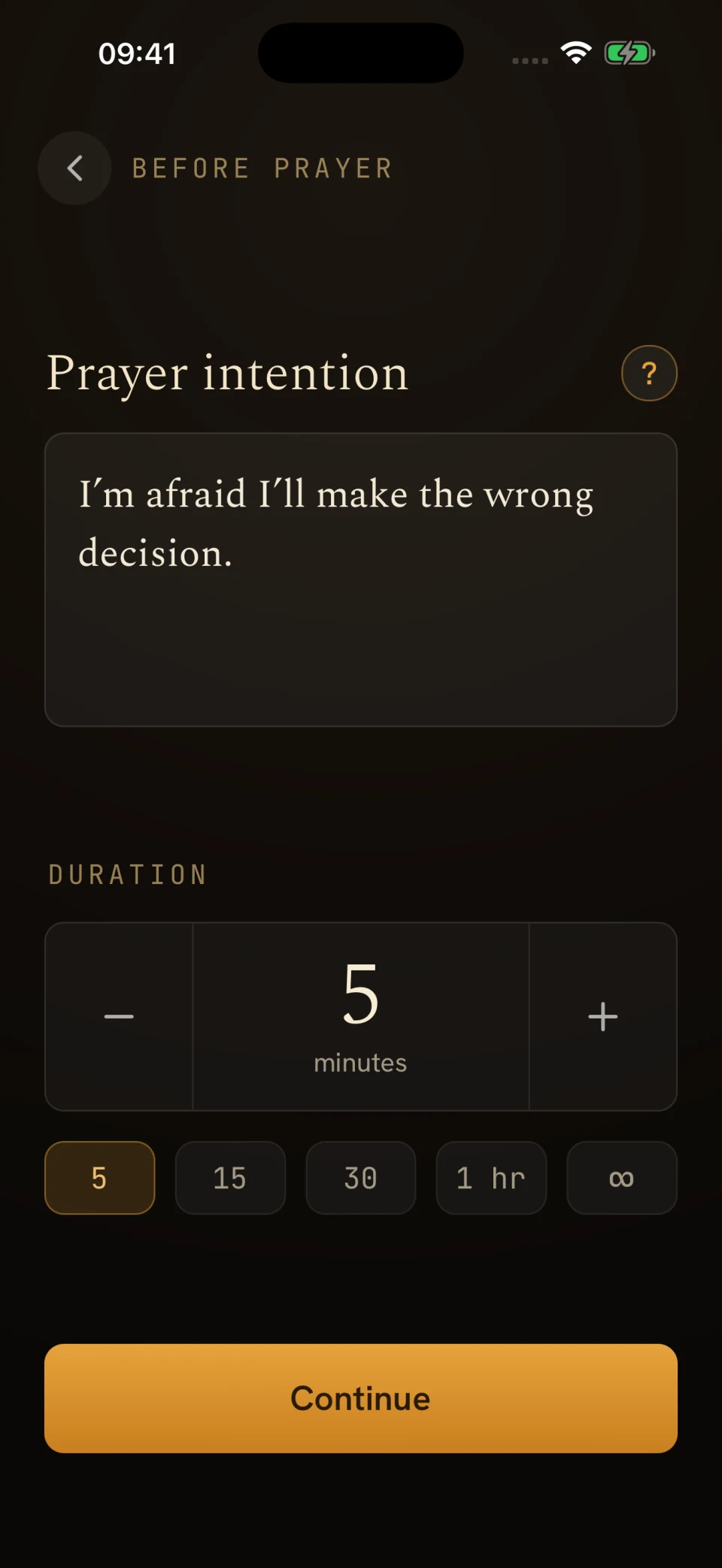
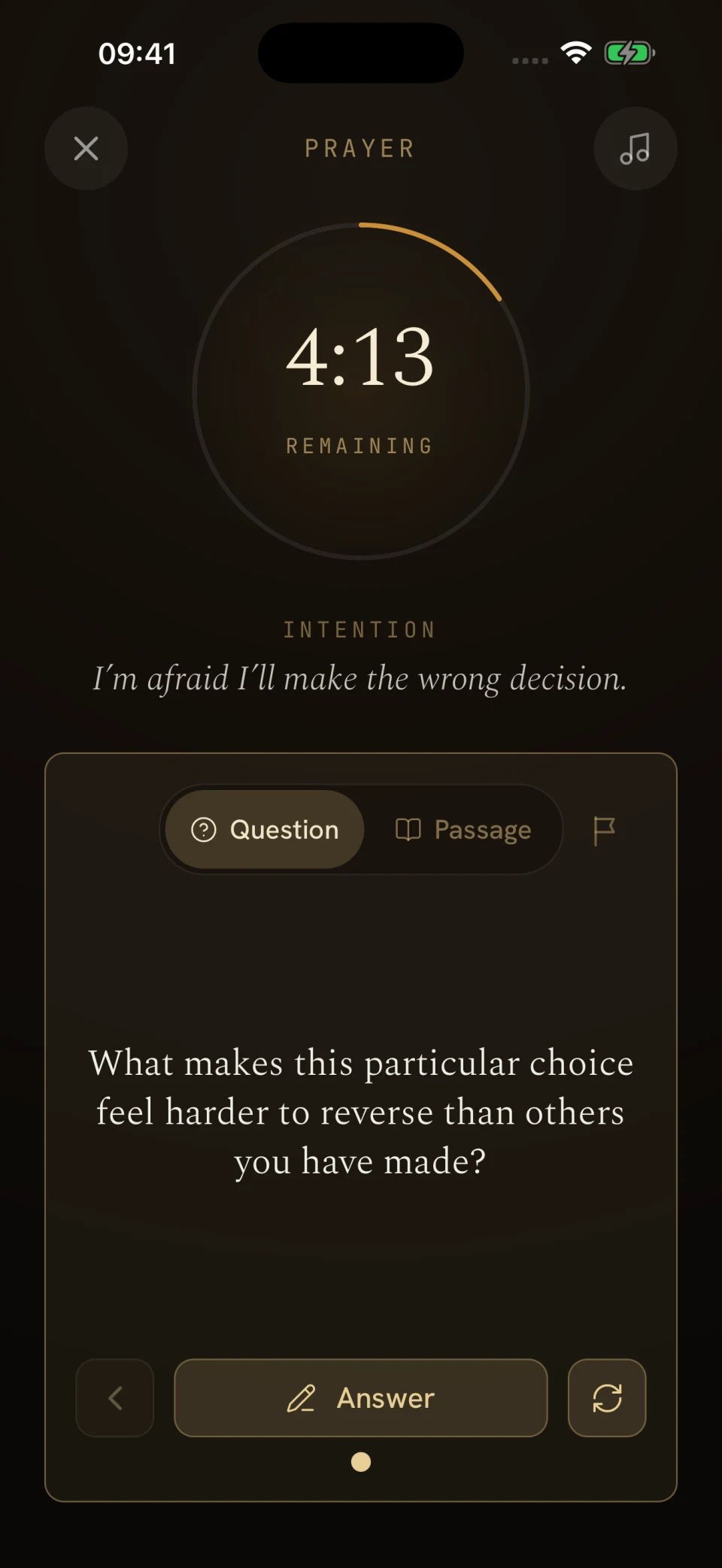
When you are afraid and the words won’t come, Lampada can help. Before you pray, you write your prayer intention in one sentence, the way Taylor named his fear; one of the examples is “Clear my mind.” You can choose how long to pray or turn the timer off.
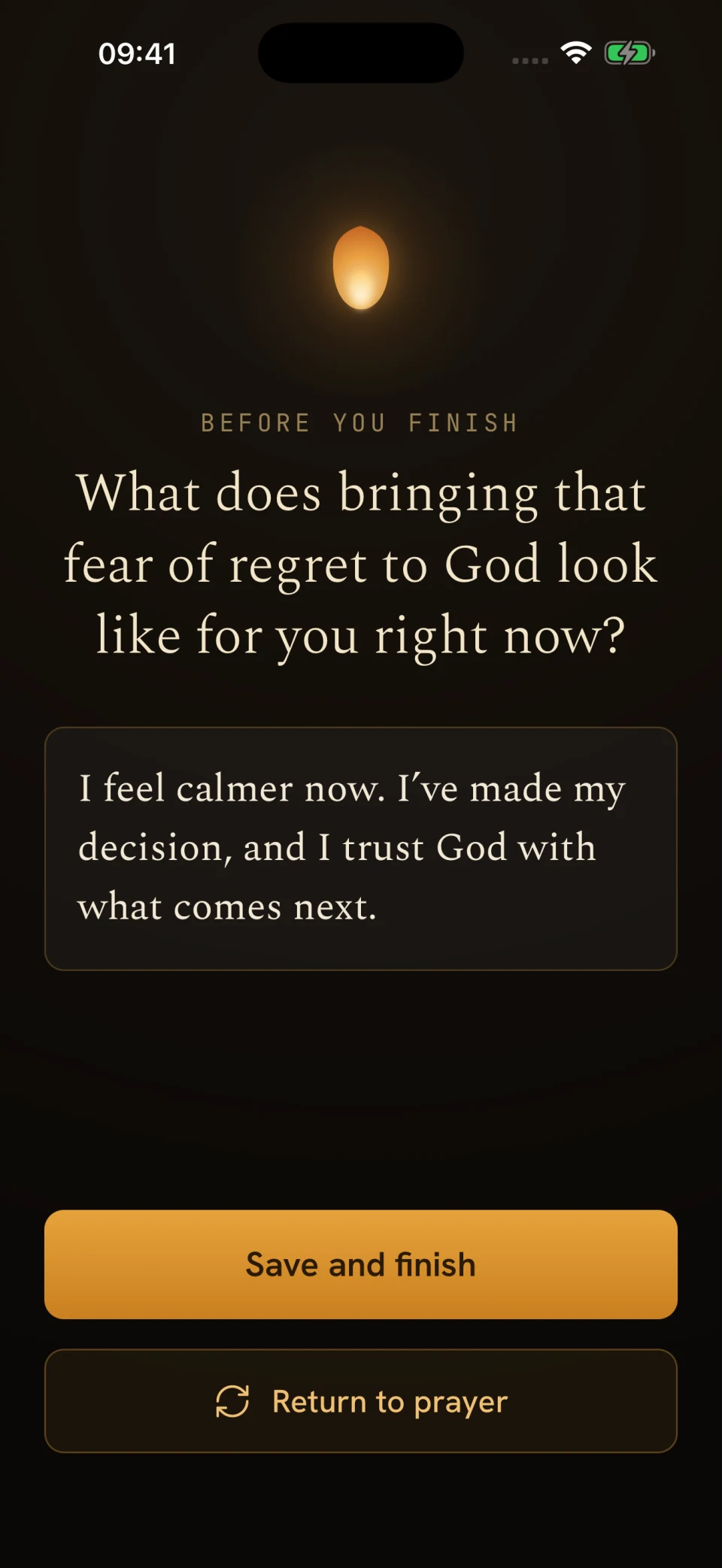
The guiding questions help you name what is going on rather than argue yourself out of it, as Thaddeus tried to do. AI chooses them, and they are only prompts: questions like “What is truly worrying you most right now?” or “What would change within you if you entrusted this to God?” You can answer by typing or by voice. If you have allowed the app in Settings to send your topic to the server, the Passage tab will show a passage of Scripture that fits its meaning, and you can listen to it read by a narrator. Quiet music plays if you want it. A takeaway of a line or two stays in your journal next to your answers, so later you can go back and see what happened next.
What Lampada doesn’t have: prayer texts, or psalms you can open by number. Read Psalms 23 and 91 in your own Bible, on paper or in the Bible Garden app. There is no emergency mode, no breathing exercises and no medical help either, and the AI doesn’t write prayers for you.
And in that 1831 letter, a little below his advice about the psalm, Anthony shares a piece of news he has saved for his correspondent’s children: with the spring the birds are coming back to the monastery and building their nests in safe places25, and they sing so that “I don’t even want to sit in my cell — I would just keep listening”10. The fear has been named, the psalm has been read to the end, and life goes on.
Frequently asked questions
What is a good prayer for anxiety?
A short one you can repeat: “Lord, have mercy,” the Jesus Prayer or a line from a psalm. Anthony of Optina advised reading Psalm 26 in full before God at every anxious thought25; in English Bibles it is Psalm 27. Many people pray Psalm 239 and Psalm 9111.
Can I pray in my own words when I’m anxious?
Yes. Paul writes: “in everything, by prayer and petition, with thanksgiving, present your requests to God” (Philippians 4:6)8. At the height of his fear, Hudson Taylor simply told God that the outcome was His to carry, and his own part was to obey and go where God led17.
Is anxiety a sin or a lack of faith?
Sudden fear is not a sin in itself. Julian of Norwich did not count it as sin when fright takes a person by surprise out of weakness; she likened it to an illness of the body15.
Can prayer help with panic attacks?
It can support you, but it does not replace treatment: if the attacks keep coming, see a doctor or a mental health professional. Ambrose of Optina wrote that seeking treatment is no sin, since both medicines and doctors come from God23. If you are having thoughts of ending your life, reach out right away to someone close and to your local emergency number.
What Bible verse helps with anxiety?
The best known is Philippians 4:6–7: “Be anxious for nothing, but in everything, by prayer and petition, with thanksgiving, present your requests to God. And the peace of God, which surpasses all understanding, will guard your hearts and your minds in Christ Jesus”26. Many also turn to Psalms 23 and 91 (see above) and to the verse Anthony read: “The Lord is my light and my salvation — whom shall I fear?” (Psalm 27:1)7
-
прп. Антоний Оптинский (Путилов). Письма к разным лицам. 73. Ответ на вопрос – Псалом 26-й (azbyka.ru) a b
-
прп. Антоний Оптинский (Путилов). Письма к разным лицам. 73. Ответ на вопрос – Псалом 26-й, our translation (azbyka.ru) a b c d
-
Psalms: Numbering on Wikipedia: the numbering of the psalms differs, mostly by one, between the Hebrew text and the Greek Septuagint; Protestant translations follow the Hebrew numbering, and Eastern Orthodox translations follow the Greek. Anthony’s Psalm 26 is Psalm 27 in the Berean Standard Bible we quote. ↩
-
Антоний Оптинский on Wikipedia (in Russian): Alexander Putilov, 1795–1865; head of the Optina skete from 1825; hegumen of the St. Nicholas Monastery in Maloyaroslavets from 1839 to 1853; illness repeatedly made him ask to be relieved of his post; glorified as a saint in the Synaxis of the Optina Elders in 1996 and for veneration throughout the Russian Church in 2000. ↩
-
прп. Антоний Оптинский (Путилов). Письма к разным лицам. 110. Душеполезные книги бывают ценнее лекарств, our translation (azbyka.ru) a b
-
прп. Антоний Оптинский (Путилов). Письма к разным лицам. 110. Душеполезные книги бывают ценнее лекарств (azbyka.ru)
-
Philippians 4:6. Berean Standard Bible (BSB), public domain. a b
-
Psalm 23 (Psalm 22 in Orthodox Bibles). Berean Standard Bible (BSB), public domain. a b
-
прп. Антоний Оптинский (Путилов). Письма к разным лицам. 103. Еще поздравления к дню тезоименитства. О возвращении птиц, our translation (azbyka.ru) a b c
-
Psalm 91:1–2 (Psalm 90 in Orthodox Bibles). Berean Standard Bible (BSB), public domain. a b
-
Julian of Norwich. Revelations of Divine Love / A Revelation of Love. REVELATIONS OF DIVINE LOVE — CHAPTER III, translated by G. Warrack (ccel.org) a b c d e
-
Julian of Norwich on Wikipedia: c. 1343 – after 1416; in 1373, aged 30, she fell gravely ill and, while a priest held a crucifix before her, received a series of visions; she lived as an anchoress in a cell attached to St Julian’s Church in Norwich; her writings are the earliest surviving works in English known to have been written by a woman. ↩
-
Julian of Norwich. Revelations of Divine Love / A Revelation of Love. THE THIRTEENTH REVELATION — CHAPTER XXVII, translated by G. Warrack (ccel.org) a b c
-
Julian of Norwich. Revelations of Divine Love / A Revelation of Love. THE SIXTEENTH REVELATION — CHAPTER LXXIV, translated by G. Warrack (ccel.org) a b c d
-
Hudson Taylor on Wikipedia: 1832–1905; a missionary in China from 1854; returned to England because of ill health in 1860 and qualified as a surgeon in 1862; founded the China Inland Mission in Brighton on June 25, 1865; by 1910 the mission had more than 800 missionaries. a b
-
J. Hudson Taylor. A Retrospect. CHAPTER XVIII — A NEW AGENCY NEEDED (www.gutenberg.org) a b c d e f g h i j k l
-
Thaddeus of Vitovnica on Wikipedia: born Tomislav Štrbulović, 1914–2003; Serbian Orthodox archimandrite and elder; hegumen of several monasteries, most notably Vitovnica; highly esteemed by Orthodox Christians, though not canonized; buried at Vitovnica Monastery. Фаддей (Штрбулович) on Wikipedia (in Russian): one of the most revered elders of the Serbian Orthodox Church in the late 20th and early 21st centuries; many pilgrims came to see him. ↩
-
старец Фаддей Витовницкий. Какве су ти мисли, такав ти је живот. О молитве, translated by Александр Логинов, our translation (predanie.ru) a b c
-
старец Фаддей Витовницкий. Какве су ти мисли, такав ти је живот. О молитве, translated by Александр Логинов (predanie.ru) a b c d e
-
старец Фаддей Витовницкий. Какве су ти мисли, такав ти је живот. Внутренняя молитва, translated by Александр Логинов, our translation (predanie.ru) a b c d e f
-
старец Фаддей Витовницкий. Какве су ти мисли, такав ти је живот. Внутренняя молитва, translated by Александр Логинов (predanie.ru) a b c d
-
прп. Амвросий Оптинский. Письма к мирским особам. 168. ЛЕЧИТЬСЯ – НЕ ГРЕХ. ОТ СКОРБЕЙ НИКУДА НЕ УЙДЕШЬ (azbyka.ru) a b
-
прп. Амвросий Оптинский. Письма к мирским особам. 168. ЛЕЧИТЬСЯ – НЕ ГРЕХ. ОТ СКОРБЕЙ НИКУДА НЕ УЙДЕШЬ, our translation (azbyka.ru)
-
прп. Антоний Оптинский (Путилов). Письма к разным лицам. 103. Еще поздравления к дню тезоименитства. О возвращении птиц (azbyka.ru) a b
-
Philippians 4:6–7. Berean Standard Bible (BSB), public domain. ↩