
A prayer for healing can be as short as the message Lazarus’s sisters sent to Jesus when their brother fell ill: “Lord, the one You love is sick” (John 11:3)1. They didn’t tell Him what to do. They simply told Him about someone they loved. You can begin the same way and go on in your own words: say the person’s name, what is happening to them right now, what you are asking for (that they get well, that the doctors see clearly, that they and the people caring for them have strength) and what you are afraid of. Prayer goes alongside medical treatment, not instead of it, and it does not promise how things will turn out. And if someone does not recover, it doesn’t mean that anyone’s faith was too small.
Short prayers for healing
- “Lord, the one You love is sick,” followed by the person’s name.
- “Lord, have mercy”: an ancient prayer you can keep repeating when nothing else will come.
- Words that Elder John of Valaam, an Orthodox monk, offered a woman after a serious operation: “You, O Lord, who see into our hearts, know our human weakness, our sorrows and our needs”2, and further on: “and we believe that not a hair falls from our head without Your will. Be pleased to let us live our life according to Your will, for we sinners do not know what is good for us”2.
- In your own words, for example: “Lord, You know Anna. She has surgery tomorrow, and I’m scared. Give the doctors clear minds and steady hands, and give her strength and peace. Make her well again. And be with us, whatever happens.”
Many churches also pray for the sick by name at their services. You can ask your pastor or priest to include the person you are praying for.
When there are no words
An anonymous story in The Wonders of Prayer begins with a small child in convulsions3. Cold on the head, warmth on the feet, rubbing of the arms and legs: the doctor tried everything doctors then knew, and none of it helped. The child stayed stiff as a board and seemed about to die. In the end the doctor walked away from the bed and sat looking out of the window4. “He seemed, to the agonized mother, to have abandoned her darling.”4 “For herself, she could do nothing but pray; and even her prayer was but an inarticulate and unvoiced cry for help.”4
Then the doctor jumped up and told them to check whether jimson weed was growing in the yard. They found the poisonous plant there, and he switched to different remedies at once4. The new medicine flushed out of the child so many seeds of the poisonous plant that they could have killed an adult4. Later the doctor said that in those five minutes by the window, every similar case from his twenty-five years of practice had come back to him4, and one of them pointed to the real cause of the convulsions, which until then had been hidden4. “And the child was saved.”4 It doesn’t always turn out this way. But a prayer without words is a real prayer too.
A sick man writes to a sick woman
In February 1953 the Orthodox elder John of Valaam answers a letter from a woman who has had a serious operation. He is nearly eighty, he has lived in a monastery since he was sixteen, and he is spending his last years at New Valaam, in Finland5. His replies will later be collected in the book Letters of a Valaam Elder. He begins with the good news: thank God, she has come through the surgery safely, even though she is still in a bad way6. What is she to do? His answer is patience: to bear it and give herself over to the will of God6. Then he suggests that they pray together in the words quoted above: the Lord knows our weakness, sorrows and needs, and we ourselves don’t know what is good for us6.
In the same letter he writes about himself: “my legs have given out, both of them ache”2. “You should see how I get up in the morning, like an infant just learning to walk; then I get going and walk about”2. These days he spends more and more of each service sitting down, but he still goes to every one, although celebrating the services himself has become hard6. And he passes on to her what the holy fathers taught: even when need makes you pray sitting down, the Lord accepts an attentive prayer, while a distracted one He does not heed, even if you stand6. Perhaps, he writes, she will come to see them in the summer, and they can talk about what matters most; and if he has died by then, she should visit his grave and pray for him6. This is not a healthy man writing to a sick woman, but one sick person writing to another.
In January 1954 she is ill again and losing heart. The big operation has worn her body down, and the doctors here on earth, she tells him, have not helped her7. The elder asks her not to despair: if the Lord takes care even of the birds7, “then have you really been forgotten by Him?”8 And he goes on: “I advise you now to turn to the heavenly Physician of our souls and bodies, to the Lord.”8 He tells her to ask her spiritual father to give her the anointing of the sick and Holy Communion7. This is what the apostle James advises: “Is any one of you sick? He should call the elders of the church to pray over him and anoint him with oil in the name of the Lord” (James 5:14)9. The elder promises no recovery. His letter ends with a blessing: “May the Lord be the protector of your soul and body.”8 We don’t know how her illness ended.
A year later, in January 1955, the elder himself was the patient. He wrote: “I lay in the hospital for 11 days; they helped me very much, for the Lord heals through doctors; and the Lord created the physician, says Holy Scripture”10. A monk who had spent his whole life in prayer did not see the doctor as God’s rival.
When the doctors tell the truth
David Brainerd, a missionary to Native Americans in New Jersey, was gravely ill by the age of twenty-nine11. At the end of March he was seized by pain so violent that it seemed only a miracle could keep him alive another day12, “but it pleased God to bless means for the abatement of my distress”12. He saw whatever eased his pain as the way God helped him. When he reached Northampton, Massachusetts, at the end of May, he seemed to have rallied: he could manage twenty-five miles on horseback in a day, and his spirits were good, yet his tuberculosis had already gone too far to be cured12. Dr. Mather was blunt with him: the signs pointed to advanced tuberculosis, and he could offer no hope of recovery12. Brainerd took the verdict without the slightest alarm; his good humor, his calm and his easy, pleasant talk stayed exactly as they had been12. The doctors’ advice was to keep riding his horse, because in their view nothing would do more to lengthen his life12.
The preacher Jonathan Edwards, in whose house Brainerd spent his last months, later published his diary as The Life of David Brainerd and described how he prayed: “not with florid expressions, or a studied eloquence”12; his words seemed to come “from the fulness of his heart”12. And one petition was nearly always part of his prayer: “that we might not outlive our usefulness”12.
Toward the end of September12 everyone, Brainerd included, thought he was dying, and he seemed glad that death was near. He could hardly speak, only move his lips, and someone sitting close by heard him calling on Christ to come quickly12: “O why is his chariot so long in coming?”12 When he rallied, he reproached himself for having been in such a hurry to die12. Asked whether he had heard the prayer he had requested12, he said, Edwards records, that “he heard every word, and had an uncommon sense of the things that were uttered in that prayer, and that every word reached his heart”12. In his last days he wrote that God had allowed him “to labor much for him in things both of a public and private nature, and perhaps to do more good than I should have done if I had been well”12.
One day Edwards’s daughter Jerusha11, who did most of the nursing, came into the room, and Brainerd gave her a warm look and said12: “Dear Jerusha, are you willing to part with me?”12 Then he said he was ready to let all his friends go, even his brother John, whom he loved more than anyone alive, because he had placed them all in God’s hands12. “Though, if I thought I should not see you, and be happy with you in another world, I could not bear to part with you. But we shall spend an happy eternity together!”12
On his last evening the pain in his chest kept growing, until even one more minute of it seemed more than he could bear. What he feared most was dishonoring God by losing patience, so he asked the people around him to keep praying for him: that God would hold him up and grant him patience12. Brainerd died on October 9, 1747, and a few months later Jerusha died too11.
Brainerd’s joy at approaching death was his own path, not a measure for someone who is praying for the life of a person they love. But he left two things for everyone: simple words from the heart, and asking others to pray for you when your own strength is gone. And at that point he asked them to pray not for his recovery but for patience. The apostle James says the same: “Therefore confess your sins to each other and pray for each other so that you may be healed. The prayer of a righteous man has great power to prevail” (James 5:16)9.
Getting well and being healed
Metropolitan Anthony of Sourozh, the Russian Orthodox bishop in London, worked as a doctor for fifteen years before he became a priest13. At one of his talks on prayer, someone asked him point-blank: “I don’t understand how to pray for the sick. If illness is given by God, then how can we pray for Him to take it away?”14 He answered with a story.
The warden of his church went into the hospital with jaundice; he did not yet know that he had cancer13. He complained to Anthony that it was all terribly boring13: there was still so much he wanted to do, yet he was confined to bed13. Anthony reminded him how often he had said he wished he could stop time and simply be, instead of always doing; now that had happened to him13. The warden admitted that he did not know what it meant to “be”13.
Anthony told him that people fall ill and die not only from physical causes but from moral ones too. The body was for the doctors to look after, but anger, bitterness and everything else that eats away at the soul were his own to deal with, because feelings like these can kill as well13. And the man had lived a hard life, including four years on Solovki13, a Soviet prison camp on islands in the White Sea. For months the two of them talked about how he related to himself and to other people, starting with those closest to him, until one day the weight of his past simply fell away13. At the end he lay in bed, so thin he seemed transparent, his eyes shining, and he marveled that his body was nearly dead and yet he had never felt so alive13. Anthony could not take the cancer away, but he watched the man open up inwardly and become free13.
Often, Anthony observes, a sick person wants only to recover and go back to the life they had before, but healing is wider than that: it is a wholeness from which a completely new life can begin13. This does not mean that sick people are to blame for their illness or that God is punishing them. Nor is it a reason to stop asking for recovery. But prayer for someone who is ill can reach beyond their test results.
Not “a lack of faith”
The London Baptist preacher Charles Spurgeon describes one such moment in his book Only a Prayer Meeting! A prayer meeting was interrupted by a cry of pain from someone in the congregation15. Spurgeon did not pretend that nothing had happened. “POSSESS your souls in quietness, beloved friends,”15 he began, and then he admitted: “I seemed to hear a voice in that sorrowful cry of our friend, and it bade me have pity upon the many whose life is one long agony”15. Then he told them about a woman in his congregation who had frequent attacks but loved the meetings so much that all he asked was that she sit by the door, since an attack could come on at any moment15. “Have sympathy with all the sick, but especially with those who might be spoken of in the words applied to Lazarus”15, he said, and quoted the sisters’ message: “Lord, he whom Thou lovest is sick.”15 Spurgeon echoes John 11:3 in the language of the King James Version. Loved, and sick.
The apostle James writes that “the prayer offered in faith will restore the one who is sick” (James 5:15)9. But these words must never be turned into an accusation against the sick person or the people praying for them: if recovery doesn’t come, that does not prove a lack of faith. Even the apostle Paul writes of one of his companions: “Trophimus I left sick in Miletus” (2 Timothy 4:20)16. Illness is not a verdict on anyone’s faith or a grade for your prayer.
How to pray for healing in your own words
- Start with the words of Lazarus’s sisters and the person’s name. Then speak simply, without trying to sound eloquent, the way Brainerd prayed.
- Be specific: ask for recovery, for an accurate diagnosis and clear thinking for the doctors, for strength for the person who is ill and for those who care for them.
- If you have no words, a cry without words is enough, like that mother’s, or “Lord, have mercy.”
- You can pray sitting or lying down. Elder John prayed sitting.
- If you can’t pray on your own, ask someone to pray with you or for you. You can also ask your pastor or priest. We wrote about how to pray for another person in our article on praying for others, and if fear for someone you love won’t let go, see our article on prayer for anxiety.
- When things get better, give thanks. Our article on thanksgiving prayer is about exactly that.
Prayer is no substitute for medical treatment, and it does not guarantee recovery. Don’t delay or stop treatment in the hope of a miracle, and don’t stop taking medication without talking to a doctor. If someone is seriously unwell right now, call your local emergency number first; you can pray while help is on the way. And illness is not a punishment for anyone’s lack of faith.
Praying for healing with Lampada
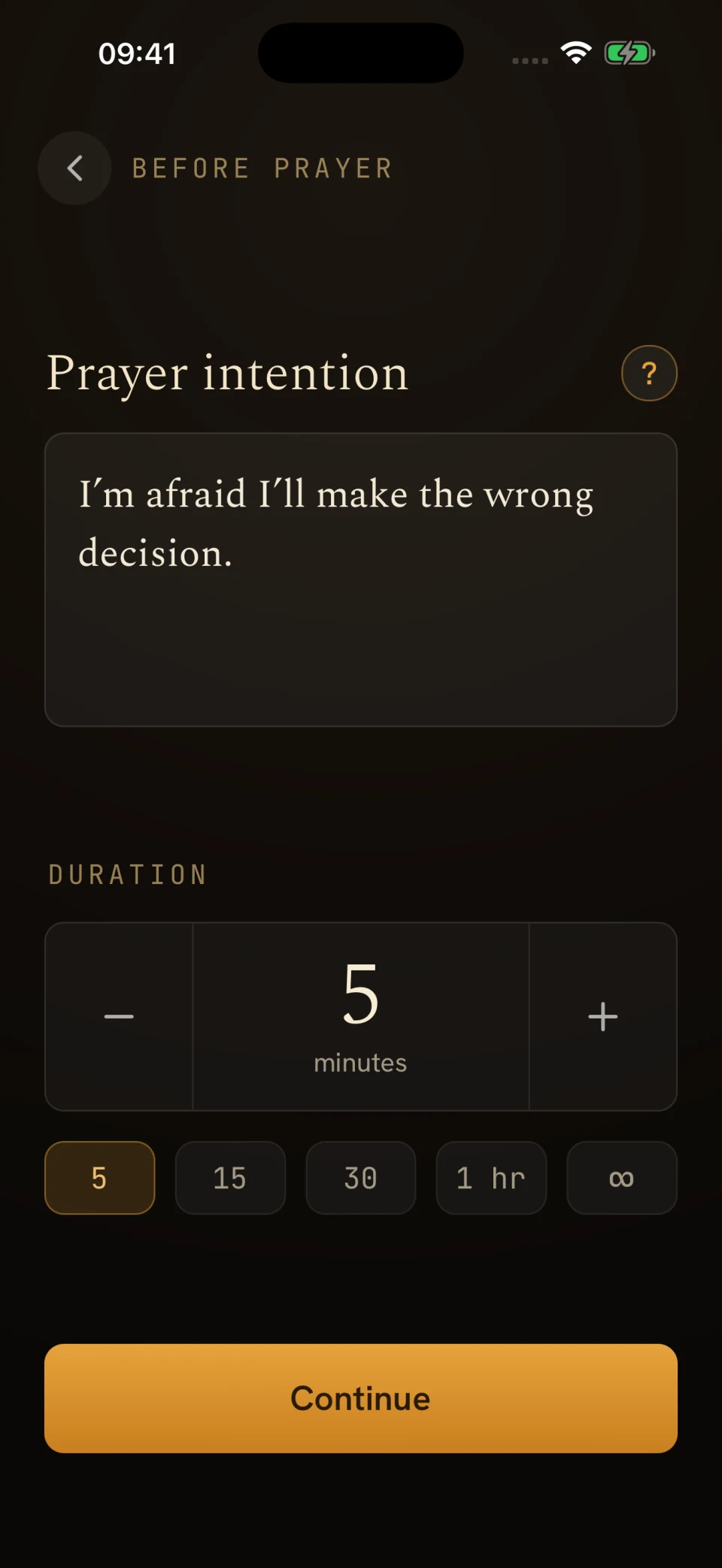
In Lampada, before you pray, you write your prayer intention in one sentence, such as “For Mom before her surgery.” You can choose how long to pray or turn the timer off.
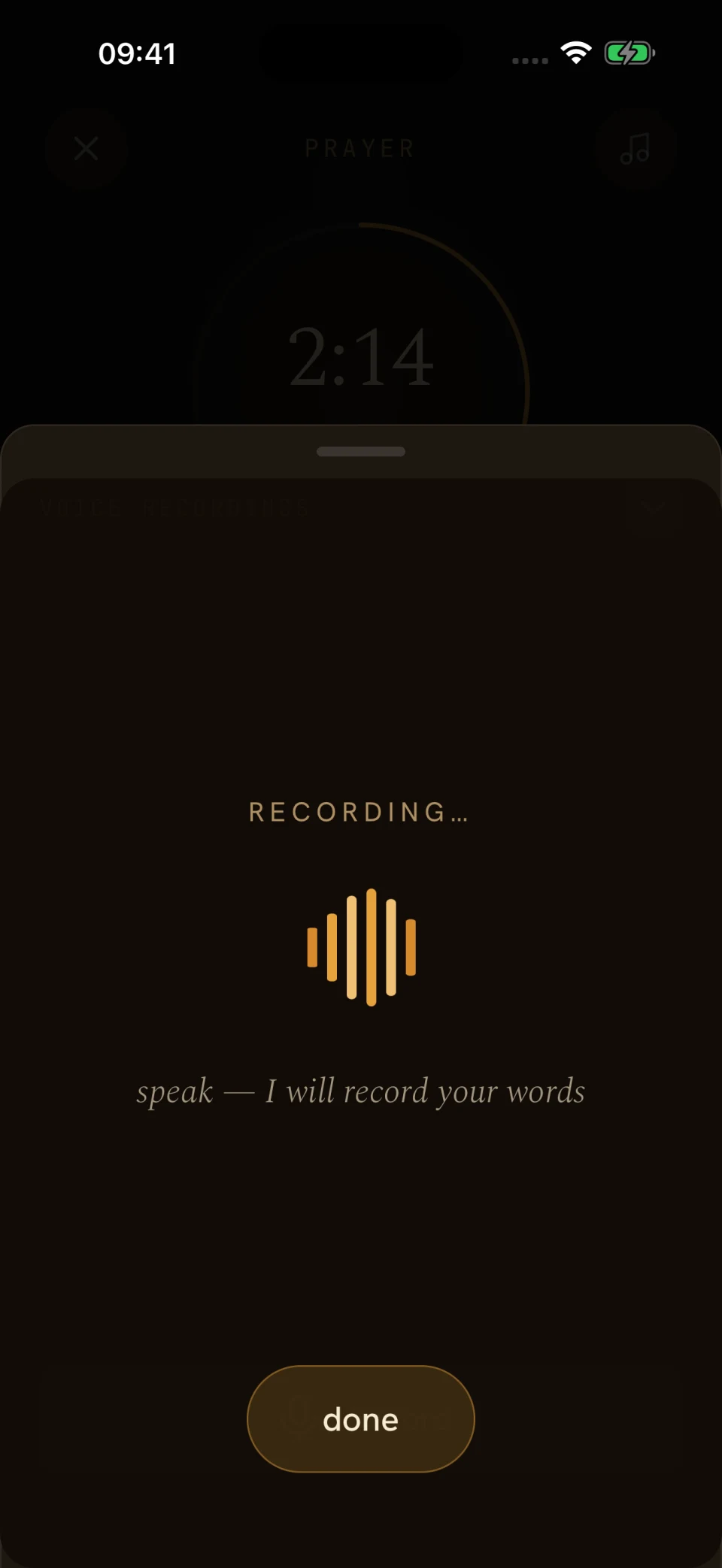
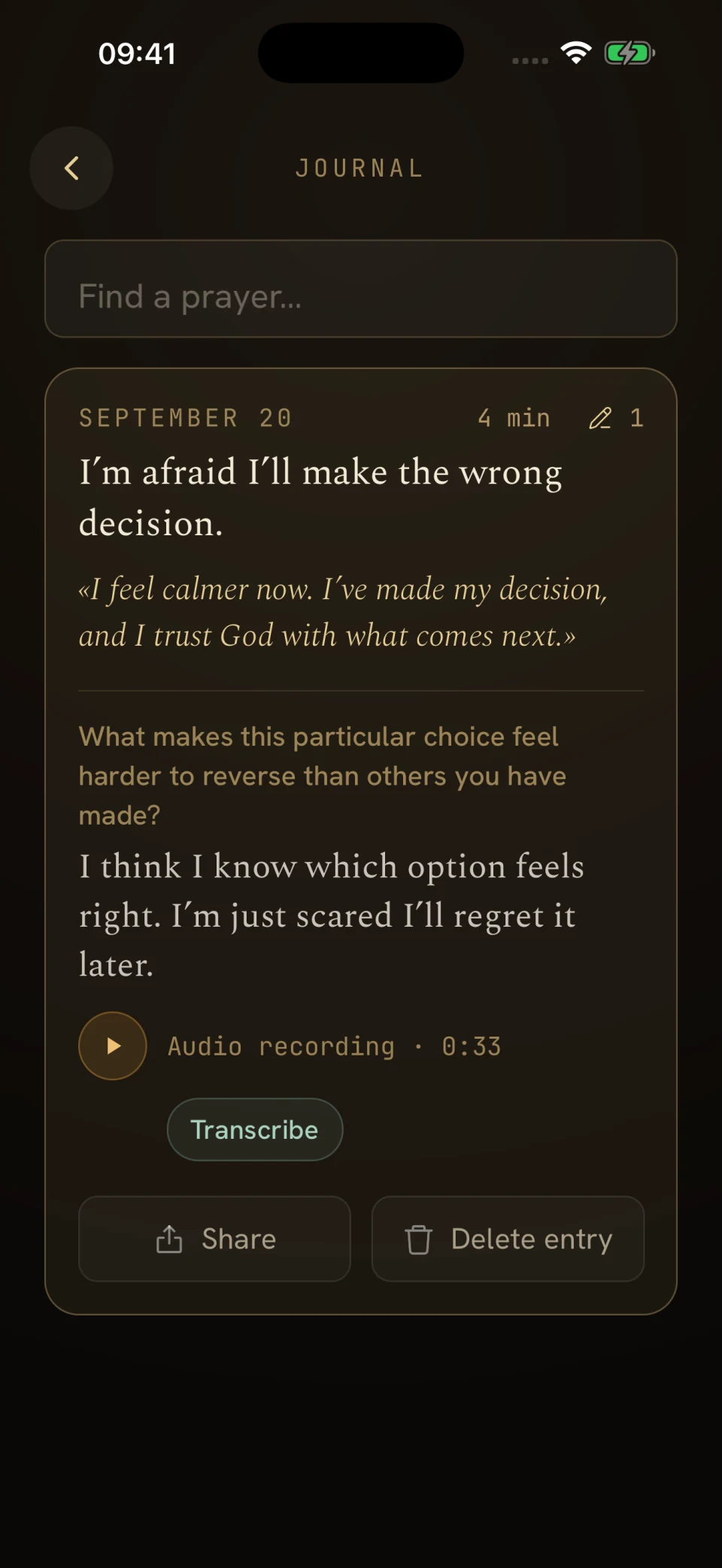
The guiding questions on your topic are chosen by AI. They are only prompts, and you can skip them: for example, “What are you afraid of losing?” or “If God were beside you listening right now, what would you tell Him?” You can answer by typing or, if typing is hard, by voice. If you have allowed the app to send your topic, the Passage tab will show a passage of Scripture that fits its meaning, and you can listen to it. A takeaway of a line or two stays in your journal on your phone. Search for a name, and you will see every prayer for that person, so you can come back later and give thanks. You can also share an entry with someone you have asked to pray with you.
What Lampada doesn’t have: ready-made prayers for healing, a prayer list of names, shared prayer requests and, of course, medical help. The AI doesn’t write prayers for you, and the app promises nothing.
Everything else begins with the same sentence that Lazarus’s sisters sent: “Lord, the one You love is sick.” Then the name. He knows the rest.
Frequently asked questions
What is a good prayer for healing?
A short, honest one. Begin with the words from the Gospel, “Lord, the one You love is sick” (John 11:3)1, then say the person’s name, what is wrong and what you are asking for: recovery, help for the doctors, strength. You don’t need eloquence: Brainerd, Edwards writes, prayed without fancy phrases or polished speech12.
Is it right to ask for healing if the illness comes from God?
Yes. Metropolitan Anthony of Sourozh was asked this very question13. A former doctor, he answered with a story: he left the treatment of the body to the doctors and helped the sick man deal with his heavy feelings as well13. Illness in itself is not a sign of God’s punishment. The apostle James plainly tells believers to pray for each other so that they may be healed (James 5:16)9.
If someone isn’t healed, does that mean we didn’t have enough faith?
No. Brainerd asked others to pray with him12, yet he died of tuberculosis at twenty-nine11. The apostle Paul left Trophimus sick in Miletus (2 Timothy 4:20)16. Prayer is not measured by how an illness ends.
What Bible verse can I pray for someone who is sick?
The shortest is “Lord, the one You love is sick” (John 11:3)1. For praying together with others, there is James 5:14–16: call the elders of the church and pray for each other9.
-
John 11:3. Berean Standard Bible (BSB), public domain. a b c
-
прп. Иоанн Валаамский (Алексеев). Письма валаамского старца. Письмо 70, our translation (predanie.ru) a b c d
-
The collection was published in 1885; the story was told by a correspondent of The Illustrated Christian Weekly who knew the mother. ↩
-
D. W. Whittle (ред.). The Wonders of Prayer. Answers To Prayer — Prayer Found The Remedy For The Disease. (www.gutenberg.org) a b c d e f g h
-
Преподобный старец Иоанн Валаамский (Алексеев) on Azbuka Very (in Russian): Ivan Alekseevich Alekseev, 1873–1958; at Valaam from 1889; abbot of the Trifon-Pechenga Monastery in 1921–1931; in 1933 took the great schema with the name John; in 1940 the monks were evacuated to Finland, to New Valaam; glorified as a saint by the Patriarchate of Constantinople in 2018. See also John of Valamo on Wikipedia. ↩
-
прп. Иоанн Валаамский (Алексеев). Письма валаамского старца. Письмо 70 (predanie.ru) a b c d e f
-
прп. Иоанн Валаамский (Алексеев). Письма валаамского старца. Письмо 73 (predanie.ru) a b c
-
прп. Иоанн Валаамский (Алексеев). Письма валаамского старца. Письмо 73, our translation (predanie.ru) a b c
-
James 5:14–16. Berean Standard Bible (BSB), public domain. a b c d e
-
прп. Иоанн Валаамский (Алексеев). Письма валаамского старца. Письмо 96, our translation (predanie.ru)
-
David Brainerd on Wikipedia: 1718–1747; expelled from Yale College in 1742 for a sharp remark about a tutor; a missionary to Native Americans in New Jersey; in 1747, ill with tuberculosis, came to Jonathan Edwards in Northampton and died in his house on October 9, 1747; Edwards’s daughter Jerusha, who had nursed him, died in February 1748. Edwards published his diary in 1749. a b c d
-
David Brainerd. The Life of David Brainerd, chiefly extracted from his Diary. CHAPTER IX. (www.gutenberg.org) a b c d e f g h i j k l m n o p q r s t u v w
-
митр. Антоний Сурожский. Может ли еще молиться современный человек. Митрополит Сурожский Антоний. ОТВЕТЫ НА ВОПРОСЫ (www.mitras.ru) a b c d e f g h i j k l m n
-
митр. Антоний Сурожский. Может ли еще молиться современный человек. Митрополит Сурожский Антоний. ОТВЕТЫ НА ВОПРОСЫ, our translation (www.mitras.ru)
-
C. H. Spurgeon. Only a Prayer Meeting!. An Interruption Improved (www.monergism.com) a b c d e f
-
2 Timothy 4:20. Berean Standard Bible (BSB), public domain. a b