
Autumn 1982, New York. Father Alexander Schmemann, an Orthodox priest who for thirty years had spoken about faith on Radio Liberty and for twenty had led St. Vladimir’s Seminary1, is lying in a hospital bed and writing in his diary: “Two tumors, hundreds of ‘tests’.”2 And straight after: “Writing about it is boring and long-winded.”2 Other things he writes about gladly: “Letters, flowers, a sense of something undeserved…”2 A week later: “Outside the window, an amazing view of New York.”2 “Water, skyscrapers. And the sun, sun every day. Love and worry all around.”2 The next day: “I sit in a sunlit hospital room, waiting for something to happen – for a decision about treatment…”2 In the same entry he notes the phone calls of the day before and the loved ones at his side3, and he writes two words: “Almost happiness.”2
That “almost” is where the honesty lies. Schmemann doesn’t pretend his illness is a joy. But he notices the letters, the sun in the window, the people around him, and he names them.
That is what a thanksgiving prayer in your own words looks like. You don’t need special language or a festive mood: just name for God something specific you have been given. “Thank you for my sister’s call. Thank you that it hurt less today.” You can thank God in hard times too, not for the trouble but in the middle of it, and you can also tell Him honestly that you don’t feel thankful right now. Here are four people whose lives could hardly have been more different, and how each of them gave thanks.
Seeing what was there all along
In 1677 the Scottish Presbyterian preacher James Fraser of Brea was sent to the Bass Rock, a crag out at sea where prisoners were held, for preaching at banned gatherings. He spent about two and a half years there and later saw the inside of two more prisons4. The Scottish pastor David MacIntyre, in The Hidden Life of Prayer, remembers him as a man once jailed on the Bass Rock for Christ’s sake5 and tells how Fraser resolved to “search out and record the loving-kindnesses of God”5. MacIntyre doesn’t say exactly when.
Fraser himself described what came of it: “The calling to mind and seriously meditating on the Lord’s dealings with me as to soul and body, His manifold mercies, has done me very much good”5. It made him sure of God’s love and moved him to love God in return5. “Oh…what wells of water have mine eyes been opened to see, which before were hid”5. “Scarce anything hath done me more good than this”5.
Those wells had been in his life all along; he just hadn’t seen them. Here gratitude begins not with a feeling but with attention. And attention can be practiced: stop and ask yourself what good there was today.
Thanking God for people
Francis Asbury was twenty-six when he sailed from England to America in 1771 to preach. He went on to become one of the first Methodist bishops there and spent the rest of his life on horseback, averaging some six thousand miles a year6. In the spring of 1774, in Maryland, he was so ill and weak that he no longer expected to live long, nor did he wish to7: “But, come life or come death, let the will of the Lord be done!”7 For several days he had hardly preached at all. One day he felt a little better. Captain Webb, who was due to preach, was kept away, and Asbury went in his place so that the people wouldn’t go home empty-handed. After the sermon he felt so ill that he had to go straight to bed7.
On Sunday, April 3, still far from well, he tried to preach7: “How difficult it is for a man who longs for the salvation of souls to be silent!”7 And in the same entry: “Gratitude urges me to acknowledge the providence of God, and the kindness of my friends”7. The people who had borne the brunt of looking after him had shown, in his words, “remarkable care, tenderness, and concern”7. And then came a prayer in a single sentence: “May the Lord reward their work and labour of love!”7 Three days later he writes that severe chills and fevers are tormenting him day and night7. His thanks didn’t wait until he was well.
This may be the simplest prayer of thanks there is: name the people who were kind to you and ask God to bless them. And then thank them, too.
When you don’t feel thankful
As a young man John Newton was a captain of slave ships; after his conversion he became an Anglican clergyman and wrote the hymn “Amazing Grace”8. His collection of letters, Cardiphonia, includes one dated October 10, 1777. Newton wrote it just after coming back from a hospital where he had been to see a sick woman he knew9. “My spirits always sink when I am within these mournful walls,”9 he confides to a friend who was suffering with his eyes and his back9. Newton recalls that exactly a year before, he had been under the surgeon’s knife, and he thanks God that he agreed to the operation and came through it safely9. “In short, I have so many reasons for thankfulness, that I cannot count them.”9 He adds that they outnumber the hairs on his head9. And in the next breath he admits that he doesn’t feel thankful at all: “And, yet, alas! how cold, insensible, and ungrateful!”9
Newton doesn’t pretend his heart is full of gratitude. He makes another confession, too: “I could make as many complaints as you; but I find no good by complaining, except to Him who is able to help me.”9 Complaining to God is no enemy of gratitude; it is part of the same conversation.
Near the end of the letter Newton, the old sailor, speaks of the Saviour, who is able to help and to save completely9, and adds: “there I desire to cast anchor, and wish you to do so likewise”9. The last line of the letter is from a psalm: “Hope in God, for you shall yet praise Him.”9 In the Berean Standard Bible the whole verse reads: “Why are you downcast, O my soul? Why the unease within me? Put your hope in God, for I will yet praise Him for the salvation of His presence” (Psalm 42:5)10. The psalmist doesn’t say the gloom has lifted. He speaks to his own soul and promises that he will yet praise God. You can pray like that too.
The gifts of an ordinary day
Long before his illness, in February 1977, in the first days of Lent, Schmemann wrote in his diary: “How passionately I long for silence, for recollection, for inner peace.”11 Yet within three hours of their getting home, the phone had already rung about ten times12. The next day he looks back on where they had been: a day and a half with his daughter Anya13, “in the coziness and light of her family, her home”11, and how “after Forgiveness Vespers we walked home through the snowdrifts”11 (Forgiveness Vespers is the evening service with the rite of forgiveness before Lent): “All of it together: the snow lit by the scattered streetlamps, the lit windows of the house, little Alexandra like a little ball on that snow.”11 “All these are God’s gifts,”11 he writes. And he adds: “None of this is God; all of it is from Him and therefore about Him.”11
A prayer of thanks doesn’t need anything grand. Snow, light in the windows, a child nearby: that is already reason enough to speak to the One they come from.
How to thank God in your own words
- Name something specific, not just “thanks for everything.” A few questions can help: Who was kind to me today? What ordinary thing turned out to be a gift: sunlight, a phone call, a warm cup of tea? What did I take for granted only yesterday?
- Start with people, as Asbury did: “Thank you for N. Reward them for their kindness.” The person you prayed for might like to hear your thanks, too.
- If it hurts, talk about the pain first. You don’t have to thank God for the trouble itself. You may find something to be thankful for even in the middle of it, or today you may only bring your complaint to the One who can help.
- If you don’t feel grateful, say that too. Newton had more reasons than he could count, and his heart still felt cold. And if right now there is more anxiety than gratitude, read our article on prayer for anxiety.
- Now and then, write down the good you notice, as Fraser did, and later try coming back to those notes. We explain how to keep them in our article on the prayer journal. If thanksgiving is just one of the things you pray about, see what to pray about.
For example: “Lord, thank you for Mom’s call today and that my back hurt less. Work was hard, You know that; please help me. And thank you for being with me.”
Being grateful doesn’t mean you have to seem cheerful. Gratitude shouldn’t drown out pain, your own or anyone else’s: “others have it worse” is poor comfort. And it is no substitute for help, a doctor or rest.
A prayer of thanks with Lampada
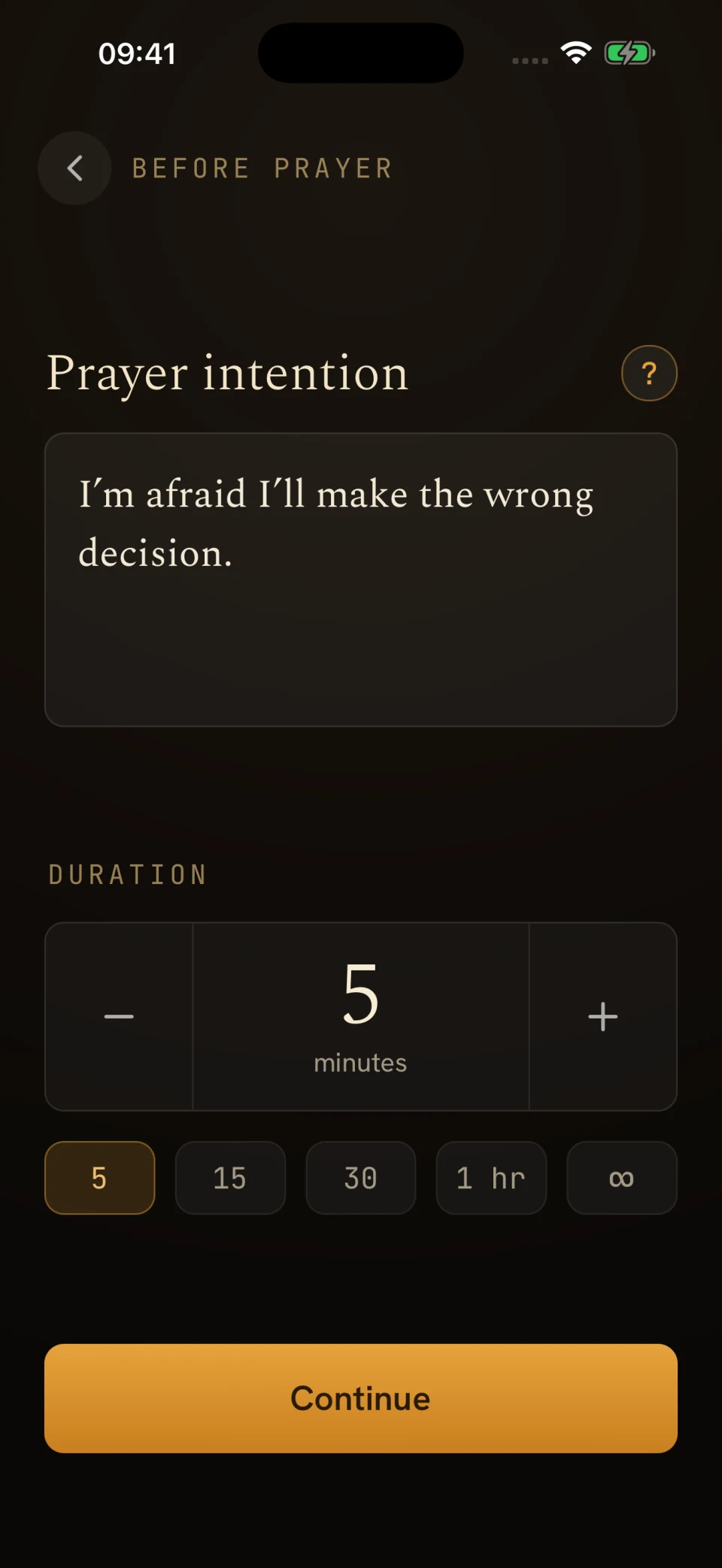
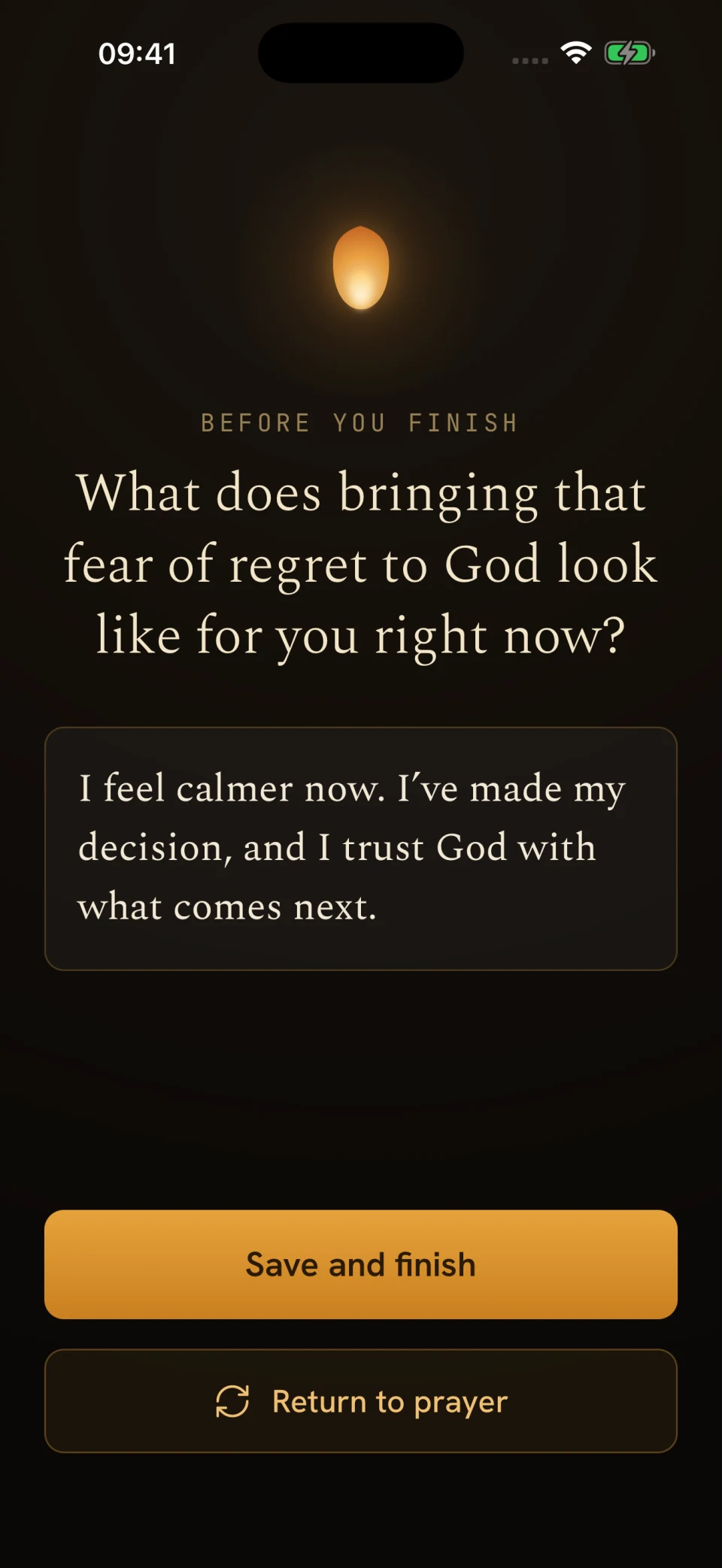
You can try this today in Lampada. Before you pray, you name your prayer’s topic in one sentence: one of the examples is “Thank God,” or you can write your own, such as “Thank you for this day” or “Thanks for my mom.” You can turn the timer off. The guiding questions are only prompts: you can skip them, and you can answer by typing or by voice. If you have allowed the app to send your topic, the Passage tab will show a passage of Scripture that fits its meaning.
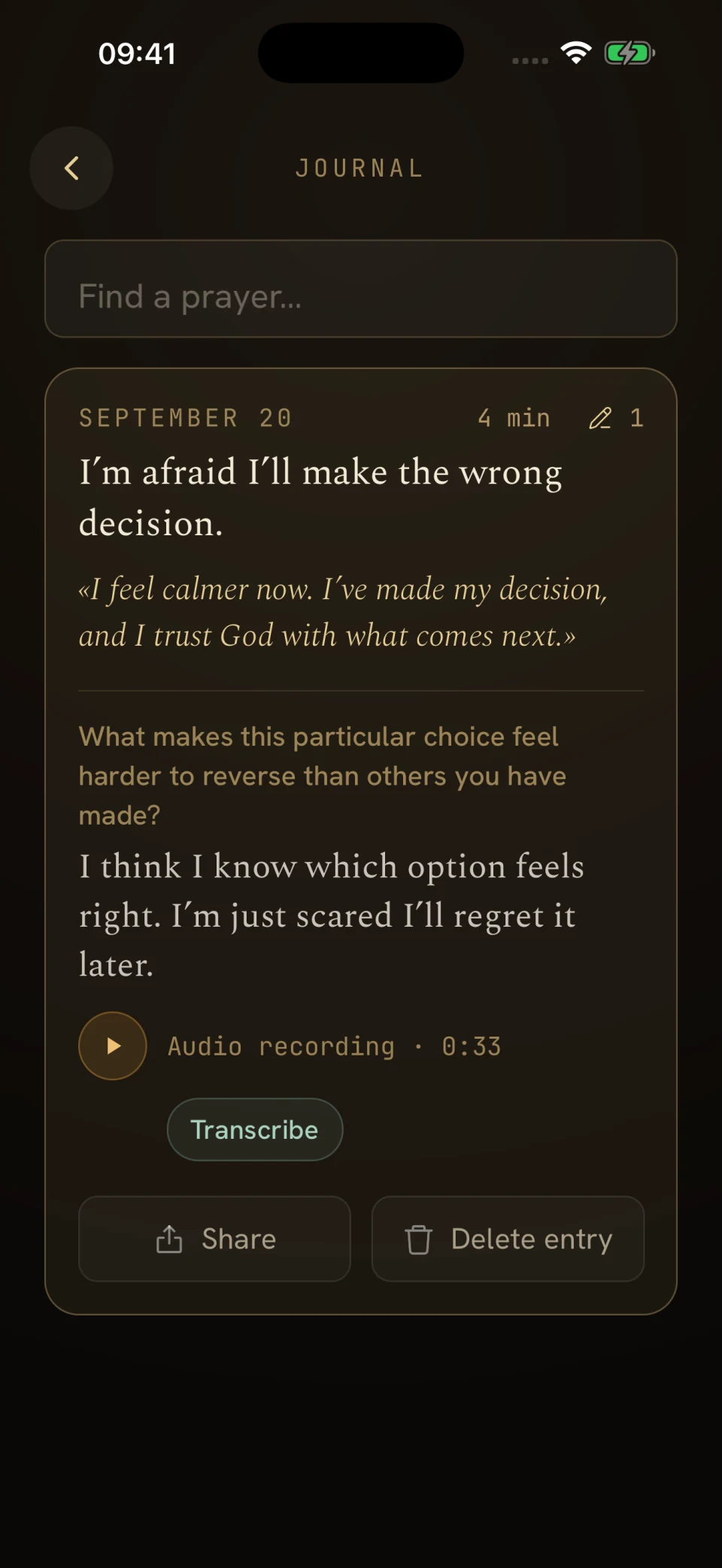
At the end you can write a takeaway of a line or two. The prayer is saved in the journal on your phone, and keyword search will help you later find the prayers where you gave thanks and remember what you thanked God for. You can set a prayer reminder for the days and time you choose. There is no gratitude list or counter in the app and no ready-made prayers: the words stay yours.
Schmemann made his last diary entry on June 1, 1983: “Eight months – I haven’t written a word here. And not because there was nothing to say: never, perhaps, have there been so many thoughts, and questions, and impressions.”2 He had kept silent because “I kept being afraid of the height to which my illness had lifted me, afraid of ‘falling out’ of it”2. Then he writes about the person closest to him: “An active presence – L. I think that if she had not been with me, there would not have been these – mostly peaceful and deep – eight months.”2 Lyana was his name in the diary for his wife, Ulyana Sergeevna13. And he ended the entry with a list: “Three visits from Andrei. Three visits from Serge. Visits from the Tkachuks… What happiness all of this was!”2 Andrei was his brother, and Serge his son13. In the preface to the diaries Serge would write that six months later, on December 13, 1983, Father Alexander died at home, surrounded by those closest to him13. Listing who came and marveling at it: that, too, is thanking God in your own words.
Frequently asked questions
Should I thank God for illness or hardship?
Not necessarily for the hardship itself. You can give thanks in the middle of it. When he was ill, Asbury gave thanks for the friends who looked after him7, and Schmemann, in the hospital, noticed the letters, the flowers and the sun3. If you can’t give thanks right now, tell God honestly about the pain.
What if I don’t feel thankful?
Tell God so. John Newton listed his reasons for thankfulness and in the same breath admitted that he felt cold and insensible9. Gratitude is also a matter of attention: Fraser deliberately resolved to “search out and record the loving-kindnesses of God”5.
What is a short prayer of thanks to God?
Name one specific thing: “Thank you for…” Francis Asbury fit his prayer for his friends into a single sentence: “May the Lord reward their work and labour of love!”7
How is a thanksgiving prayer different from a gratitude journal?
A journal is written for yourself; a prayer is addressed to God. But each can help the other: Fraser wrote that calling God’s mercies to mind and meditating on them did him a great deal of good5.
-
Alexander Schmemann on Wikipedia: 1921–1983; born in Tallinn, Estonia; emigrated with his family to the United States in 1951; dean of St. Vladimir’s Seminary from 1962 until his death; for some 30 years his Russian-language sermons were broadcast into the Soviet Union on Radio Liberty; died of cancer in Crestwood, New York, on December 13, 1983. ↩
-
прот. Александр Шмеман. Дневники 1973–1983. Тетрадь VIII ИЮНЬ 1982 – ИЮНЬ 1983, our translation (predanie.ru) a b c d e f g h i j k
-
прот. Александр Шмеман. Дневники 1973–1983. Тетрадь VIII ИЮНЬ 1982 – ИЮНЬ 1983 (predanie.ru) a b
-
James Fraser of Brea on Wikipedia: 1639–1699; Scottish Presbyterian minister; for preaching at banned conventicles he was sent to the Bass Rock in January 1677 and held there for two and a half years, until July 1679; later imprisoned in Blackness Castle (1681) and in Newgate Prison in London (1683). ↩
-
David M’Intyre (David MacIntyre). The Hidden Life of Prayer. 4. The Engagement: Worship — (a) Acknowledge Daily Mercies (www.chapellibrary.org) a b c d e f g h
-
Francis Asbury on Wikipedia: 1745–1816; sailed for British North America in 1771; became a Methodist bishop in December 1784; traveled on average about 6,000 miles a year. ↩
-
Francis Asbury. The Journal and Letters of Francis Asbury, Vols. I–II. Chapter 3 (wesley.nnu.edu) a b c d e f g h i j k
-
John Newton on Wikipedia: 1725–1807; a captain of slave ships, he was ordained in the Church of England in 1764 and served 16 years as curate of Olney; the hymn known as “Amazing Grace” was published in Olney Hymns (1779). ↩
-
John Newton. Cardiphonia: or, The Utterance of the Heart, in the course of a real correspondence (archive.org) a b c d e f g h i j k l
-
Psalm 42:5 (Psalm 41:6 in Orthodox Bibles). Berean Standard Bible (BSB), public domain. ↩
-
прот. Александр Шмеман. Дневники 1973–1983. Тетрадь IV МАЙ 1976 – МАЙ 1977, our translation (predanie.ru) a b c d e f
-
прот. Александр Шмеман. Дневники 1973–1983. Тетрадь IV МАЙ 1976 – МАЙ 1977 (predanie.ru)
-
прот. Александр Шмеман. Дневники 1973–1983. ПРЕДИСЛОВИЕ (predanie.ru) a b c d