
Not long after his ordination, a young priest was sent to serve in a home for the elderly. After his very first service, a woman of a hundred and one came up to him and asked for advice1: “For many, many years I have been saying the Jesus Prayer constantly, and I have never once felt the presence of God.”2 He answered readily: “Find someone who is experienced in prayer, and he will tell you everything.”2 But all through her long life she had already gone to everyone who knew anything about it, and heard nothing worth having1. “When I saw you, I thought: he probably knows nothing, so perhaps he’ll blurt out something by chance, if you’ll pardon the expression, that will do me good.”2 The priest remembered Balaam’s donkey: if a donkey could speak, he might as well try to say something too1.
So he said to her: “What do you think: when is God supposed to get a word in, or make His presence felt, if you are talking all the time?”2 The advice that followed was strange: in the morning, tidy her room, light the lamp and settle where she could see the icons, the window thrown open for summer and the photographs of people dear to her1. Then take up her needles and wool: “knit in silence before the face of God, and don’t you dare say a single prayer; just sit quietly and knit.”2 The old woman looked at him, as he recalls, “more with distrust than with hope”2 and went away.
That priest was the future Metropolitan Anthony of Sourozh, a doctor who later spent many years as a bishop in London3. He tells the story himself in one of his books, in a chapter on prayer. We’ll come back to how it ended.
Quiet time with God is time alone with Him in which you don’t only talk but also fall silent. It usually includes a little Scripture, prayer in your own words and some silence. In that silence, “hearing God” most often doesn’t mean hearing a voice. It means noticing that He is near, remembering a word of Scripture, seeing the truth about yourself. Christians test anything that seems to come “from God” against Scripture, with people they trust and over time. And if nothing happens in the silence, you haven’t failed.
A voice that said what was already written
England, the 1640s. George Fox, a former shoemaker’s apprentice, left home at nineteen to look for God4. Sitting in a hollow tree with his Bible until nightfall was nothing unusual for him, any more than fasting or long, lonely wandering5. Neither clergy nor dissenting preachers nor experienced believers could help him, so he turned away from them all5. When there was nothing left to hope for from people, he heard a voice: “There is one, even Christ Jesus, that can speak to thy condition”5; “and when I heard it, my heart did leap for joy.”5
Later, when Fox was already preaching, he was sitting by the fire one morning when a heavy cloud of temptation came over him6. It struck at the very existence of the Creator:
It was said, “All things come by nature”; and the elements and stars came over me, so that I was in a manner quite clouded with it.6
He sat quiet, and no one in the house noticed a thing6. Then came the turn he describes:
And as I sat still under it and let it alone, a living hope and a true voice arose in me, which said, “There is a living God who made all things.”6
At once, he writes, “the cloud and temptation vanished away, and life rose over it all; my heart was glad, and I praised the living God.”6
Notice what came to him in the silence. Not a secret revelation, but the first line of the Bible and the heart of the gospel.
And yet Fox himself, one of the founders of the Quakers, set the inner light above Scripture. One Sunday morning he was walking with friends to a meeting in Nottingham when, from the top of a hill, he caught sight of the town’s huge church tower. The Lord, as he tells it, told him to go and denounce that “great idol” and the people who worshipped there. He kept this to himself, and after the meeting had begun he left his friends there and went to the church7. The preacher was expounding Peter’s words about a lamp shining in a dark place7: that lamp, he told the people, was Scripture, the measure for testing every doctrine. The power of the Lord took hold of Fox so strongly that he could not keep quiet and shouted7: “Oh, no; it is not the Scriptures!”7 The test, he explained, is the Holy Spirit, through whom holy men of God gave us the Scriptures in the first place7. At that the officers seized him and put him in a “nasty, stinking prison”7, his first ever4. People argued with him then, and they still do. But even for Fox, silence led back to the first line of the Bible, not off to the side.
Ten years of getting it wrong
Valentin Sventsitsky, a writer who later became a priest, published a book in 1915 about his journey to the hermits of the Caucasus mountains; its title translates as Citizens of Heaven8. One of its episodes is an evening in a forest clearing where Sventsitsky sat up late with Father Nikifor9. With them was Sventsitsky’s companion, Father Ivan: this young hermit from the Bramba mountains had met him at the monastery guesthouse10. “The forest stood all around like a black wall. Its jagged tops stood out against the bright, starry sky. All over the clearing, like wax candles, fireflies flared up and went out.”11 Somewhere far off an eagle owl was hooting9. This is how Sventsitsky describes Nikifor himself: “The wind blew his white beard to one side, and he looked every inch a fairy-tale grandfather of the forest.”11 He had once been a clerk in a haberdasher’s shop, then owned one himself and lived well off but, by his own account, badly. He lost his wife early; he gave up his money, spent many years at New Athos and at last went off to live as a hermit9.
And there, he said, he nearly lost his mind. Then he fell silent for a long time and turned his gaze to the darkness9. Sventsitsky asked how it had happened, but Nikifor said nothing, and Father Ivan answered quietly for him: “He prayed the wrong way…”9 At last Nikifor spoke himself: “I prayed the wrong way. For ten years I lived like that, and all of it wrong.”11 He would see Christ in the sky and bow down before the image, and only later did he realize he had been bowing to a demon. As soon as his mind grew tired of looking, the demon would open up a new picture, a whole host of angels, and curiosity kept him watching9. He had been warned: “The brethren told me: you mustn’t pray like that. Those words pierced my heart like a spear; I’d get angry and walk away. And again I’d pray my own way.”11 In the end he told one of the monks: “Today or tomorrow I’ll go out of my mind.”11 The monk objected: “Come now, father, there’s nothing to show it.”11 “It doesn’t show, because it is a mystery. But I can see it myself,”11 Nikifor replied.
He had no strength left to fight. One night he got up to read an akathist9, a long hymn of praise, and suddenly felt “grace itself entering into me. I cannot read. I stand without moving.”11 “And such stillness and peace that I cannot put it into words. And I hear: ‘Seek in the heart!’ Then I understood everything.”11
In silence, God is not the only one who speaks. Our imagination speaks too, and so do our wishes and fears. Nikifor himself put his visions down to a demon; that is his explanation, not a diagnosis. He looked for God in pictures before his eyes, and found peace when he heard in the silence: seek in the heart. His trouble wasn’t that he made mistakes: everyone does. It was that for ten years he wouldn’t let anyone correct him.
How to test what seems to be “from God”
The apostle John writes: “Beloved, do not believe every spirit, but test the spirits to see whether they are from God. For many false prophets have gone out into the world” (1 John 4:1)12. Both stories show how to do it. The first test is Scripture. What Fox heard agrees with the first line of the Bible. If a “voice” contradicts the gospel, it isn’t from God. The second test is the people around you. Nikifor’s brothers tried to correct him, and he should have listened.
The third test is time. F. B. Meyer, an English Baptist pastor and a friend of the evangelist D. L. Moody13, wrote in The Secret of Guidance: “God's impressions within and His word without are always corroborated by His Providence around, and we should quietly wait until these three focus into one point.”14 His everyday advice is even shorter: “If you do not know what you ought to do, stand still until you do.”14 Of himself he writes: “after months of waiting and prayer, I have become absolutely sure of the Guidance of my heavenly Father.”14
Be wary if a “voice” rushes you, flatters you, frightens you, tells you to keep it secret from everyone or argues with Scripture. And if intrusive voices or images won’t leave you alone, there is nothing shameful about seeing a doctor.
Contemplative, centering and breath prayer
A week later Anthony was serving in the same home again and, he admits, kept looking around in the hope that the old woman wasn’t there, or he would be in for it1. She came: “Father Anthony, you know what — it works!”2 She had done everything he told her: “I sat down to knit in silence, it was quiet all around; then I began to hear the clicking of the needles, and that sound somehow deepened the sense of silence around me.”2 Then she sensed that the silence was “not simply an absence of noise, but that there was something else in it, that at the very heart of this silence there was some kind of presence.”2 And she understood: “I can pray with words or not pray, it’s all the same: I am with Him. He looks at me, I look at Him, and it is so good for us to be together.”2
Anthony remarked: “Here her experience coincided with that of the simple peasant from a little French village.”2 The priest of that village often noticed that in his church “an old man is sitting there, just sitting, looking ahead of him and saying nothing.”2 “Your lips don’t move, your fingers don’t run over your prayer beads: what are you doing?”2 the priest asked. The old man answered: “I look at Him, He looks at me, and we are so happy with each other.”2
This is contemplative prayer: not thinking about God, but simply being in His presence. Even so, Anthony added a caveat: we cannot live like this all the time, and prayers in words are necessary, because we don’t reach that silence all at once on our own1.
Centering prayer is a method put forward in the 1970s by American Trappist monks15. Its root is The Cloud of Unknowing, an English book from the fourteenth century by an unknown author16. He advises picking a short word of one syllable, such as “God” or “love,” and holding it fast in the heart17. “This word shall be thy shield and thy spear”17: it is how you beat back every thought that pulls you away17.
Breath prayer is a short prayer said in the rhythm of your breathing. In the Orthodox tradition, the Jesus Prayer is sometimes joined to the breath. The hero of The Way of a Pilgrim, a book first published in Kazan in 188418, heard the reading “Pray without ceasing” during the liturgy, and the words would not leave him: how could anyone pray without stopping and still work for a living?19 At last he found an elder who went through the Philokalia with him and explained how to join the Jesus Prayer to the breath19. But breathing is not a key that unlocks God. A hermit on Mount Athos, in a conversation recorded by Metropolitan Hierotheos (Vlachos), allows breathing techniques as an aid to attention but warns that without an elder’s supervision they are forbidden and require his special blessing20. Remember the old woman: she had repeated the Jesus Prayer for years, and she sensed God when she fell silent.
What sets all this apart from secular meditation is the goal. The point is not to empty your head or to relax, though peace may come. We are silent before Someone.
How to try it today
Start the way the old woman did: clear away distractions, put your phone aside and sit somewhere quiet. Read a few verses of Scripture; for reading slowly, see our article on lectio divina, and for turning verses into your own prayer, Praying Scripture. Tell God in your own words what you have come with. Then fall silent without demanding anything, neither feelings nor an answer. When thoughts crowd in, bring your attention back to God with a short word or the Jesus Prayer, and let your breathing stay calm, without exercises. Close with words: thanks, a request, the Lord’s Prayer. Take whatever time you have.
If a thought comes in the silence that seems to be “from God,” don’t rush. Check it against Scripture, tell someone you trust and wait.
Silence in Lampada
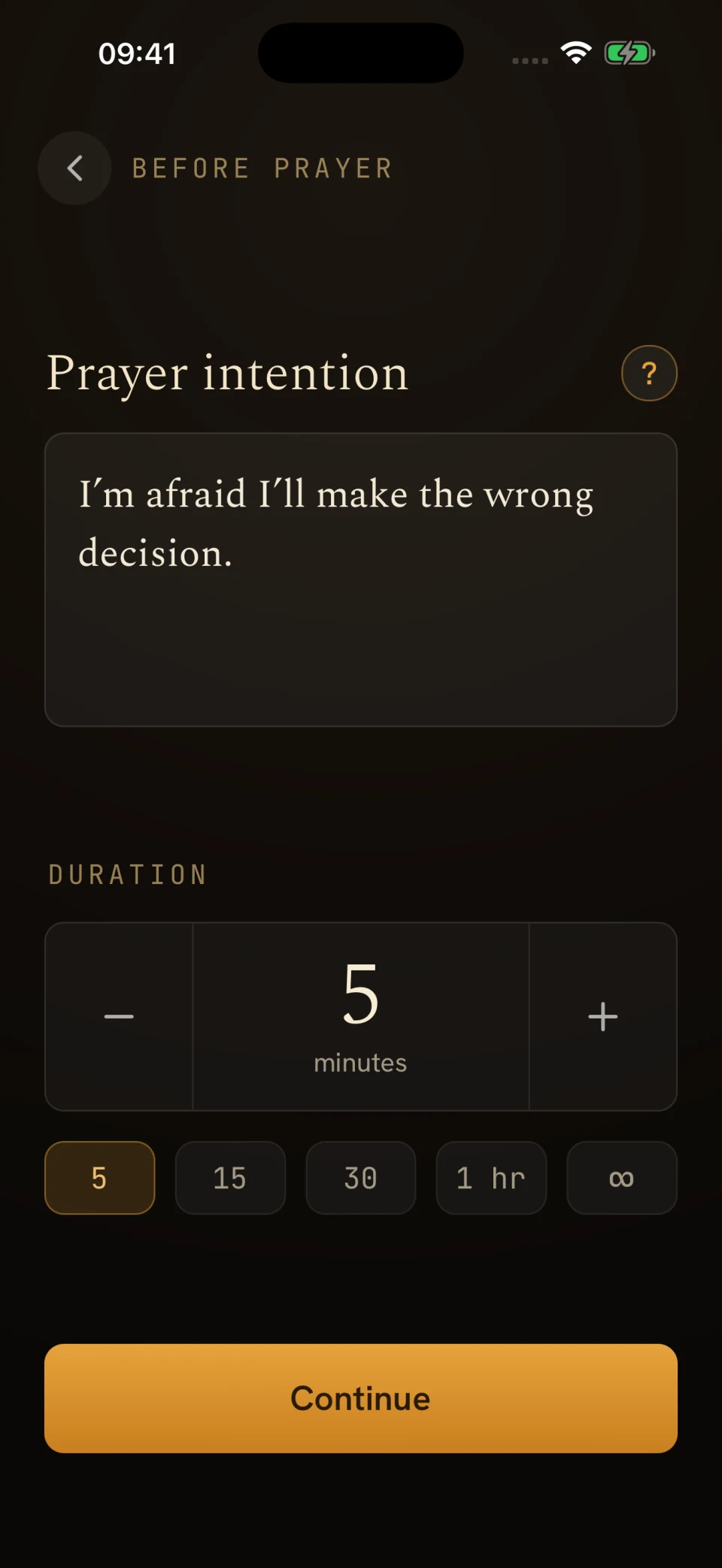
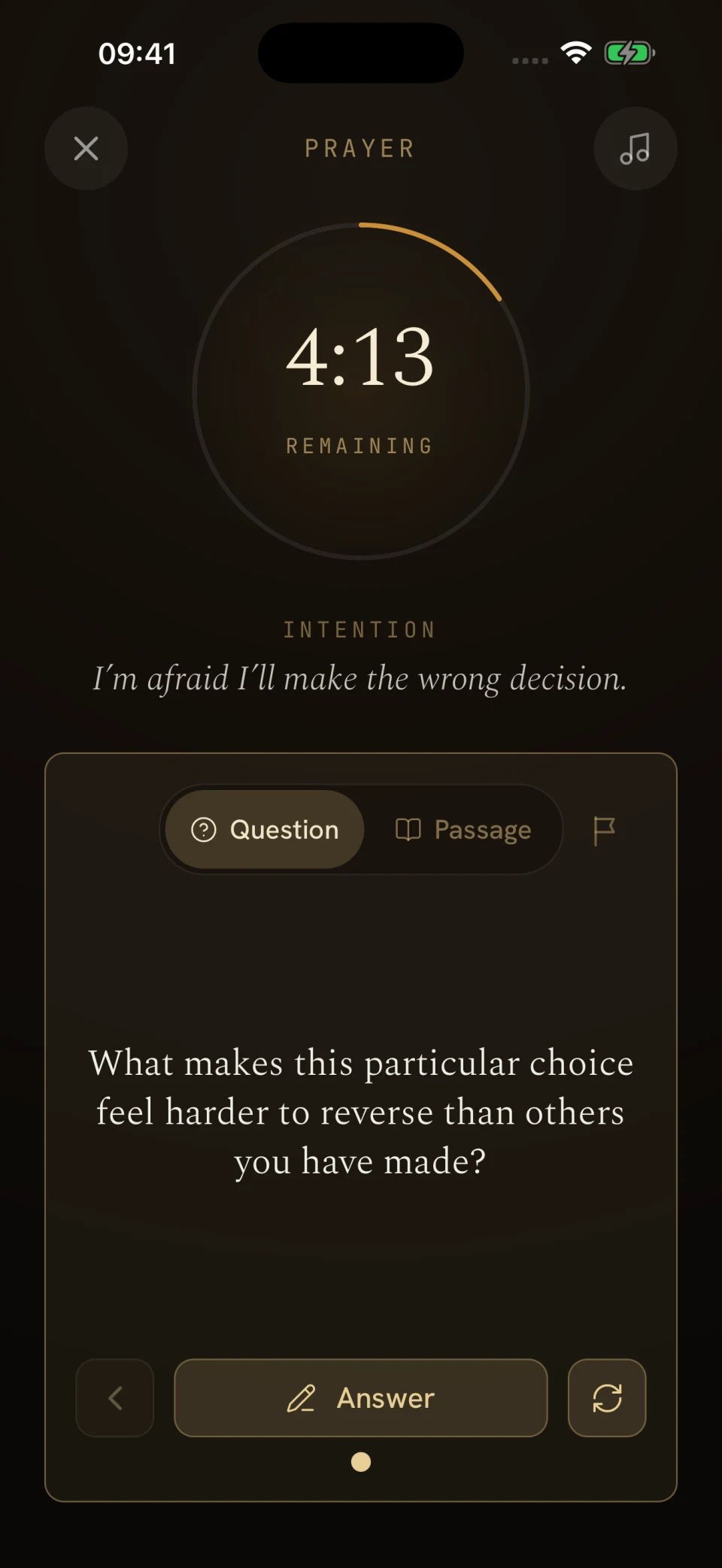
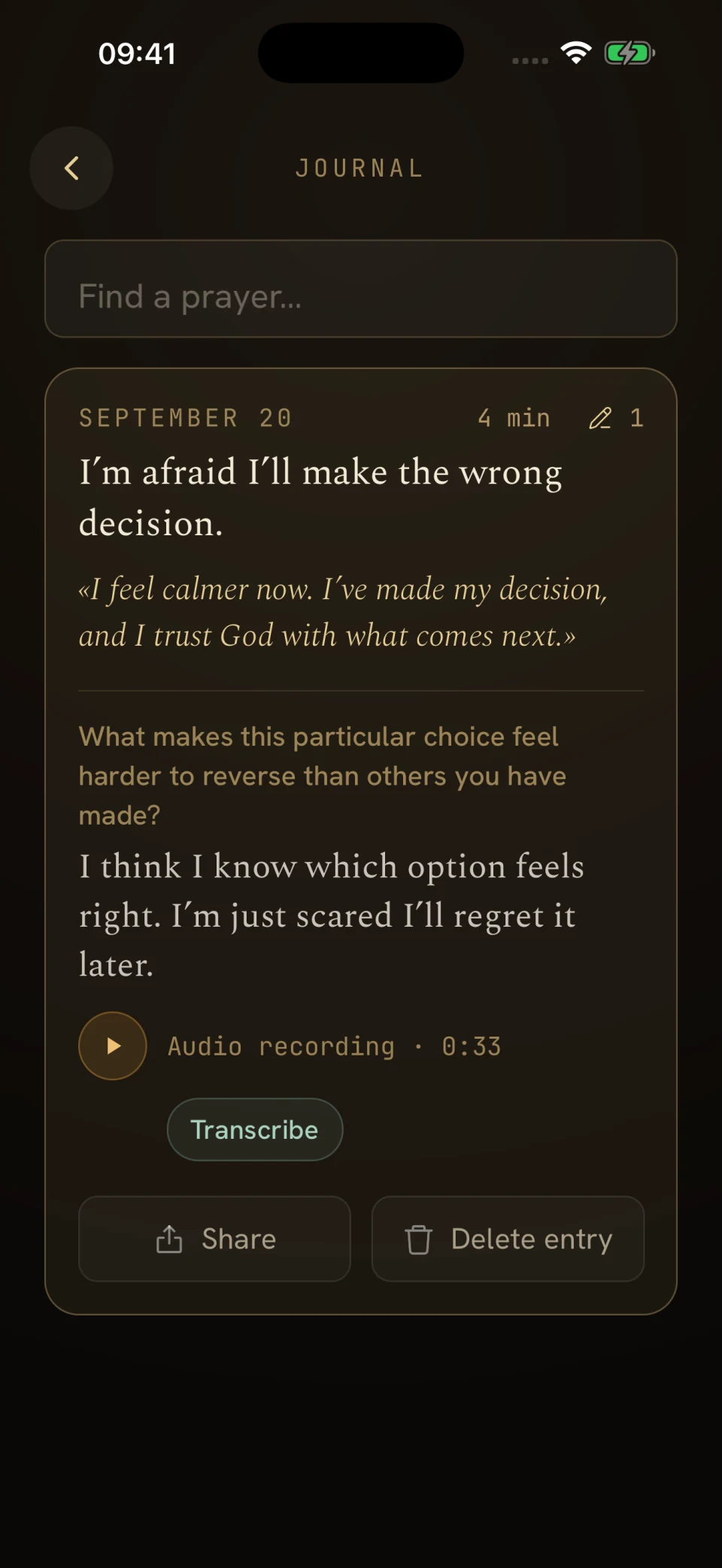
In Lampada you can choose how long to pray, 5, 15 or 30 minutes or an hour, or pray with no timer and no rush. You can add or take away time, and when it runs out, you can keep going. You don’t have to name a topic: there is open prayer, with no specific intention. Prayer begins in silence; quiet music plays only if you turn it on.
The guiding questions are only prompts: you can skip them or talk about what matters to you, or not answer at all and simply be with God. If you allow it, the app finds verses that fit the meaning of your topic. You don’t have to write a one- or two-line takeaway, and a prayer without words still stays in your journal.
To be honest: Lampada has no silence mode and no centering or breath prayer. The questions and the choice of verses come from AI. They are prompts, not the voice of God and not spiritual direction. The app can’t test what you “hear”; that is what Scripture and living people are for. Lampada gives you a place and a time to fall silent. The listening is yours.
Anthony’s advice began with lighting the lamp and sitting down. The silence did the rest. In the psalm God says: “Be still and know that I am God; I will be exalted among the nations, I will be exalted over the earth” (Psalm 46:10)21.
Frequently asked questions
How can I “hear” God?
Most often not as a voice, but as His presence, a word of Scripture or the truth about yourself. Whatever seems to come “from God” is tested by Scripture, other people and time: “do not believe every spirit, but test the spirits to see whether they are from God” (1 John 4:1)22.
What are centering prayer and breath prayer?
Centering prayer is silence with one short “sacred word” that you return to when your attention wanders; in its present form it was put forward in the 1970s by American Trappist monks drawing on the medieval Cloud of Unknowing15. Breath prayer is a short prayer in the rhythm of your breathing: this is how, for example, the Jesus Prayer is joined to the breath19.
What if nothing happens in the silence?
A lack of special feelings doesn’t make your prayer a failure. You can close it with words and go back to your day: even Metropolitan Anthony of Sourozh cautioned that we cannot live in silent prayer all the time and that we need prayers in words1.
-
митр. Антоний Сурожский. Быть христианином. О МОЛИТВЕ (www.mitras.ru) a b c d e f g
-
митр. Антоний Сурожский. Быть христианином. О МОЛИТВЕ, our translation (www.mitras.ru) a b c d e f g h i j k l m n
-
Anthony of Sourozh on Wikipedia: 1914–2003; worked as a doctor; sent to Britain in 1948; from 1962 head of the Russian Orthodox Diocese of Sourozh for Great Britain and Ireland. More about him in our article on lectio divina. ↩
-
George Fox on Wikipedia: 1624–1691; apprenticed to a shoemaker and grazier; in September 1643, at about 19, left his relatives; one of the founders of the Religious Society of Friends (Quakers); first imprisoned in Nottingham in 1649. a b
-
George Fox (избранное в ред.). Journal / Autobiography of George Fox. I. Boyhood - A Seeker (ccel.org) a b c d
-
George Fox (избранное в ред.). Journal / Autobiography of George Fox. II. The First Years of Ministry (ccel.org) a b c d e
-
George Fox (избранное в ред.). Journal / Autobiography of George Fox. III. The Challenge and the First Taste of Prison (ccel.org) a b c d e f
-
Свенцицкий, Валентин Павлович on Wikipedia (in Russian): 1881–1931; ordained a priest in 1917; arrested in 1928 and exiled; died in Kansk; Grazhdane neba (Граждане неба; ‘Citizens of Heaven’), Petrograd, 1915. ↩
-
прот. Валентин Свенцицкий. Граждане неба. Мое путешествие к пустынникам Кавказских гор. VII. О. НИКИФОР (predanie.ru) a b c d e f g
-
прот. Валентин Свенцицкий. Граждане неба. Мое путешествие к пустынникам Кавказских гор. I. КАК Я ИСКАЛ ПУСТЫННИКОВ. — ЕХАТЬ ИЛИ НЕ ЕХАТЬ? — «СТРОИТЕЛЬ МОНАСТЫРЯ». — «ЧЛЕН ГОСУДАРСТВЕННОЙ ДУМЫ» (predanie.ru)
-
прот. Валентин Свенцицкий. Граждане неба. Мое путешествие к пустынникам Кавказских гор. VII. О. НИКИФОР, our translation (predanie.ru) a b c d e f g h i
-
1 John 4:1. Berean Standard Bible (BSB), public domain. ↩
-
F. B. Meyer on Wikipedia: 1847–1929; English Baptist pastor and evangelist who served in London; a friend of D. L. Moody. ↩
-
F. B. Meyer. The Secret of Guidance. I. The Secret of Guidance (ccel.org) a b c
-
Centering prayer on Wikipedia: developed in the 1970s by the Trappist monks William Meninger, Basil Pennington and Thomas Keating at St. Joseph’s Abbey in Spencer, Massachusetts, drawing on the fourteenth-century Cloud of Unknowing; the “sacred word” can be “God,” “Jesus,” “Love,” “Peace” and the like, and you return to it when your attention wanders. a b
-
The Cloud of Unknowing on Wikipedia: written in Middle English in the latter half of the 14th century by an unknown author; addressed to a disciple; its practical advice is the main basis of the contemporary centering prayer developed by Trappist monks in the 1970s. ↩
-
Anonymous. The Cloud of Unknowing. Chapter 7: How a man shall have him in this work against all thoughts, and specially against all those that arise of his own curiosity, of cunning, and of natural wit (ccel.org) a b c
-
The Way of a Pilgrim on Wikipedia: an anonymous book first published in Kazan in 1884; it is unclear whether it is the account of a real pilgrim or a literary form for teaching unceasing prayer; the best-known English translation is by R. M. French (1930). ↩
-
Аноним. Откровенные рассказы странника духовному своему отцу, translated by R. M. French (ccel.org) a b c
-
митр. Иерофей (Влахос). Одна ночь в пустыне Святой Горы. Беседа с пустынником об Иисусовой молитве (predanie.ru)
-
Psalm 46:10 (Psalm 45:11 in Orthodox Bibles). Berean Standard Bible (BSB), public domain. ↩
-
1 John 4:1. Berean Standard Bible (BSB), public domain. ↩