
Praying for someone means naming them before God and asking Him to help them. Sometimes that is easier said than done.
The Alps, the Monte Rosa massif. The London preacher Newman Hall1 recalls that he was once climbing one of its peaks with his brother2. Near the summit a thick fog came down on them. In it there was no telling that what lay ahead was no longer the slope but a snow cornice hanging over a precipice several thousand feet deep. The guides stopped, but his brother, thinking the slope went on, rushed ahead2. The guides cried out. As the snow gave way beneath him, one of them, risking his own life, ran after him, grabbed him by the coat and pulled him back to safety2.
Afterwards something remarkable came to light. A sick woman from the brother’s congregation had been praying all along that nothing would happen to him, and on one particular day she had prayed with special urgency, as if pleading for his rescue from some great danger. She told him so herself when he got home. They compared the times, and they matched2. Hall tells this story in The Wonders of Prayer, a collection compiled by D. W. Whittle, and he had no doubt what had saved his brother: it was her prayer that rescued him2.
Prayer did not replace human help: a sick woman prayed far from the mountains, while a guide grabbed his coat. But you can pray for someone from far away, even when the hand that reaches them belongs to someone else.
What is intercessory prayer?
Praying for others, which Christians call intercessory prayer, means bringing to God not yourself but another person: their name, their situation and your worry for them. Starting is simple. Say the person’s name. Tell God honestly how things are for them right now and what worries you. Ask God to give them what they need, whether health, peace, reconciliation, protection or faith, and don’t dictate to Him how it should happen.
For other things to bring to God, see our article on what to pray about.
Others pray for us too
England, the middle of the nineteenth century. His mother was away from home, and her son had a free day. By his own later account he was about fifteen; that afternoon he went through his father’s books, looking for something to fill the empty hours34. In a basket he found a small gospel tract. He took it for the story at the start and meant to skip the moral at the end3.
Meanwhile his mother was seventy or eighty miles away from him, and he had no idea what was happening in her heart3. That afternoon she got up from the table longing to pray for her son to come to faith3. “She went to her room and turned the key in the door, resolved not to leave that spot until her prayers were answered.”3 She prayed for hours, until she could ask no longer and began to thank God instead: His Spirit, she believed, had shown her that her son was already converted3.
Her son, meanwhile, was reading the tract, and one phrase caught him: “the finished work of Christ.” Why did the author say “finished”? Then Jesus’ words on the cross came to his mind: “It is finished.”3 The answer came at once: Christ had died for the sins of the whole world, and the debt for them was already paid3. Then came another question: “If the whole work was finished and the whole debt paid, what is there left for me to do?”3 Suddenly he understood that he had nothing left to do but accept the Saviour and, on his knees, praise Him for ever. He describes that moment as light from the Holy Spirit breaking into his soul, and it filled him with joy3. “Thus while my dear mother was praising God on her knees in her chamber, I was praising Him in the old warehouse to which I had gone alone to read at my leisure this little book.”3 Only after several days did he dare to share his joy with his sister, and even then only after she had promised to tell no one3.
When his mother returned two weeks later, her son was first at the door to meet her: he could hardly wait to tell her his good news3. She held him close: “I know, my boy; I have been rejoicing for a fortnight in the glad tidings you have to tell me.”3 He was taken aback: “Why,” he asked, “has Amelia broken her promise? She said she would tell no one.”3 But his mother assured him that no human being had told her3.
And that was not all. Some time later he opened a little notebook by mistake, taking it for his own, since the two looked exactly alike3. It was his sister’s diary. She had written that “she would give herself daily to prayer until God should answer in the conversion of her brother”3. Exactly one month after that entry, he came to faith3.
The boy’s name was Hudson Taylor. He grew up to be an evangelical missionary, founded the China Inland Mission and gave half a century of his life to China5. Before he ever prayed for others, he found out that others had been praying for him, and he had never suspected a thing.
The man who turned away
Shortly before he left for China, Taylor had to dress, every day, the foot of an old man who was dying of senile gangrene. The Christian family the man lived with told Taylor that he openly called himself an atheist and was hostile to anything to do with faith6. When they brought in a Scripture reader without asking him, he flew into a rage and drove the man out, and when the local vicar called, he spat in his face6.
Taylor prayed a great deal for him, but for the first two or three days said nothing about faith and simply looked after him, taking care to ease his pain. When the patient began to thank him, Taylor, his heart trembling, spoke to him of his need for God’s mercy6. “He turned over in bed with his back to me, and uttered no word.”6 It went on like that day after day: many times a day Taylor begged God to save the man, after each dressing he said a few words about faith, and every time the man turned his back on him6. Over time Taylor lost heart. He began to fear that his words were no help at all, and that he might even be making the old man more stubborn6. One day, after dressing the wound and washing his hands, he did not go back to the bed but stopped at the door. Running through his mind were the prophet Hosea’s words about stubborn Israel: “Ephraim is joined to his idols; let him alone.”6
The patient watched him go in surprise: until then Taylor had always come over to the bed before he left. Taylor could not bear it. In tears, he crossed the room and pleaded with the man to let him pray with him6. The old man did not turn away: “If it will be a relief to you, do.”6 Within days, Taylor tells us, the man accepted Christ6.
Taylor’s conclusion is not about the patient but about himself. “Sometimes it may be that while we are complaining of the hardness of the hearts of those we are seeking to benefit, the hardness of our own hearts, and our own feeble apprehension of the solemn reality of eternal things, may be the true cause of our want of success.”6 Notice something else, too. The prayer went along with the bandages, not instead of them. And Taylor prayed with the man only once the man agreed.
When you’d rather not pray for them
All of Russia knew John of Kronstadt, an Orthodox priest: crowds of thousands came out to meet him, and people revered him as a man of prayer7. Yet the diary he kept for himself shows an ordinary man whose feelings had been hurt: “I hear that the elder of the Gethsemane Skete near the Sergius Lavra, Father Barnabas, has spoken unkindly of me. What have I done to him? I must pray that the Lord will reconcile our hearts”89.
He does not ask God to set Barnabas straight. He asks Him to reconcile their hearts, both of them, his own included.
Right after that comes another entry. The wife of a man who had once been his secretary came to see him and was rude to him, after all the help he had given their family10. “I confess I could not stand it and sharply asked her to leave my house”8.
The diary does not say how things ended with Barnabas or with that woman. But the neighboring pages show what John did with his own heart. A little earlier he thanks God for freeing him from a painful temptation: on learning how much a fellow traveler had been paid to accompany him, he had cooled toward the man10, but then he reckoned up how much he himself receives from others for nothing10, and “turned dislike into liking for him”8. In the very next entry, on his way into church, he feels “an involuntary dislike for the people I met on the road and in the church”8 and, without showing it to anyone, asks God to change his own heart10, and notes that the Lord “wondrously changed the state of my spirit”8.
Jesus said, “love your enemies and pray for those who persecute you” (Matthew 5:44)11. John’s diary shows what that looks like in a real person’s life: praying for someone who hurt you starts with being honest about the hurt and asking God to change your own heart.
When the person is far away
People traveled to Optina Monastery to ask Elder Ambrose for advice, and those who could not come wrote to him; Dostoevsky took him as a model for the elder Zosima12. One day a letter came to him from a mother whose son had abandoned his faith. Once she had given alms to a beggar and asked him to pray for her son’s health, but the beggar prayed for the repose of his soul instead, and the mother was shaken13. She blamed herself for not bringing him up as she should have, and she admitted that in her grief she had sometimes thought he would be better off dead than living as he was13. She asked whether she should write to him in Moscow on the off chance it would reach him, and how to word the letter so that it would touch his heart13.
His reply is dated November 22, 186913. The elder apologizes for his long silence: her letter had arrived back at the end of August, and he had sat down to answer it more than once, but first visitors kept him from it, and then he was ill for over a month and is still very weak13. Even so, he promises: “with God’s help I will write as much as I can and as best I know how”14. There is no need to be troubled by the beggar’s mistake, he tells her: no harm to her son can come of it13. Nor does Ambrose want her to take all the blame on herself: “every person is endowed with free will and will have to answer before God above all for himself”14. She may write to her son. “But first, I repeat, you need to find out where he is at present and what his circumstances are”14. And then: “you should now be concerned not so much with bringing him to his senses as with praying for him, so that the Lord Himself, by ways known to Him, may bring him to his senses”14. “Great is the power of a mother’s prayer. Remember from what depths of evil the prayer of his devout mother drew blessed Augustine.”14 And one more thing: “And while you pray for your son, pray for yourself as well”14.
We don’t know how the story ended. What remains is the advice: less of your own script, more trust.
That is how Jesus prayed for Peter on the eve of his denial: “But I have prayed for you, Simon, that your faith will not fail. And when you have turned back, strengthen your brothers” (Luke 22:32)15. Knowing that Peter would deny Him, Jesus prays for Peter’s faith and for his return.
Prayer and action
Elizabeth Wheaton was known as “Mother Wheaton”; for more than twenty years she traveled from prison to prison with the gospel16. In 1898 she came to a city jail where four people were waiting to be executed. She held a service and talked with each of the condemned, and one young man in particular stayed with her17. Then she moved on to other states, but she could not get the boy out of her mind. When she looked into his case, she learned that he had not even been charged with murder and did not deserve to die17. “I plead to God if there was nothing the law could find in him worthy of death, that his sentence might be commuted, and the poor boy might live.”17 She did not stop at prayer. Back from her travels, she went to see the governor in the state capital and asked him to change the boy’s sentence to life in prison17. She got what she asked for, and the boy was allowed to live17. “Yet the Deputy Sheriff was very angry at the Governor for granting the commutation!”17 she adds.
In 1899 she visited two condemned men the day before their execution. She talked with them and sang their favorite hymns with them, and then, as she remembered it:
we three kneeled together in prayer in the little “condemned cell.”18 Kneeling between my boys, clasping each by the hand, we gave ourselves to the blessed Savior…18 A solemn hush filled the little cell…18
“They sang hymns and prayed all night before the execution. They refused to eat, preferring to sing and pray till the last,”18 and they “went to the scaffold singing and praising God”18. This time her story has no governor and no reprieve.
For her, prayer and action went together. But prayer is not a lever that can move any decision you like. Sometimes the whole answer is that on their last night a person is not alone.
How to pray for someone
If you don’t know how the person is doing, find out first; that is where Ambrose began. Ask for what is good for them, not for your own plan. And if you have no idea what to ask for, remember the American preacher S. D. Gordon: in Quiet Talks on Prayer he confesses that he often can’t tell what to ask for, because his picture of the situation may be incomplete19, and then he prays like this: “Blessed Spirit, pray in me the prayer Thou art praying for this man”19.
Put yourself into the prayer too: “reconcile our hearts.” For someone who hurt you, start with one honest sentence. If you lose your temper with them again tomorrow, so did John of Kronstadt. But praying for someone who hurt you does not cancel out boundaries, protection or your right to ask for help: from the people close to you, a pastor or priest, a professional, and, if you are being threatened, the police.
If you can help in practical ways, help. Offer to pray together, and wait until the person says yes.
Coming back to the person
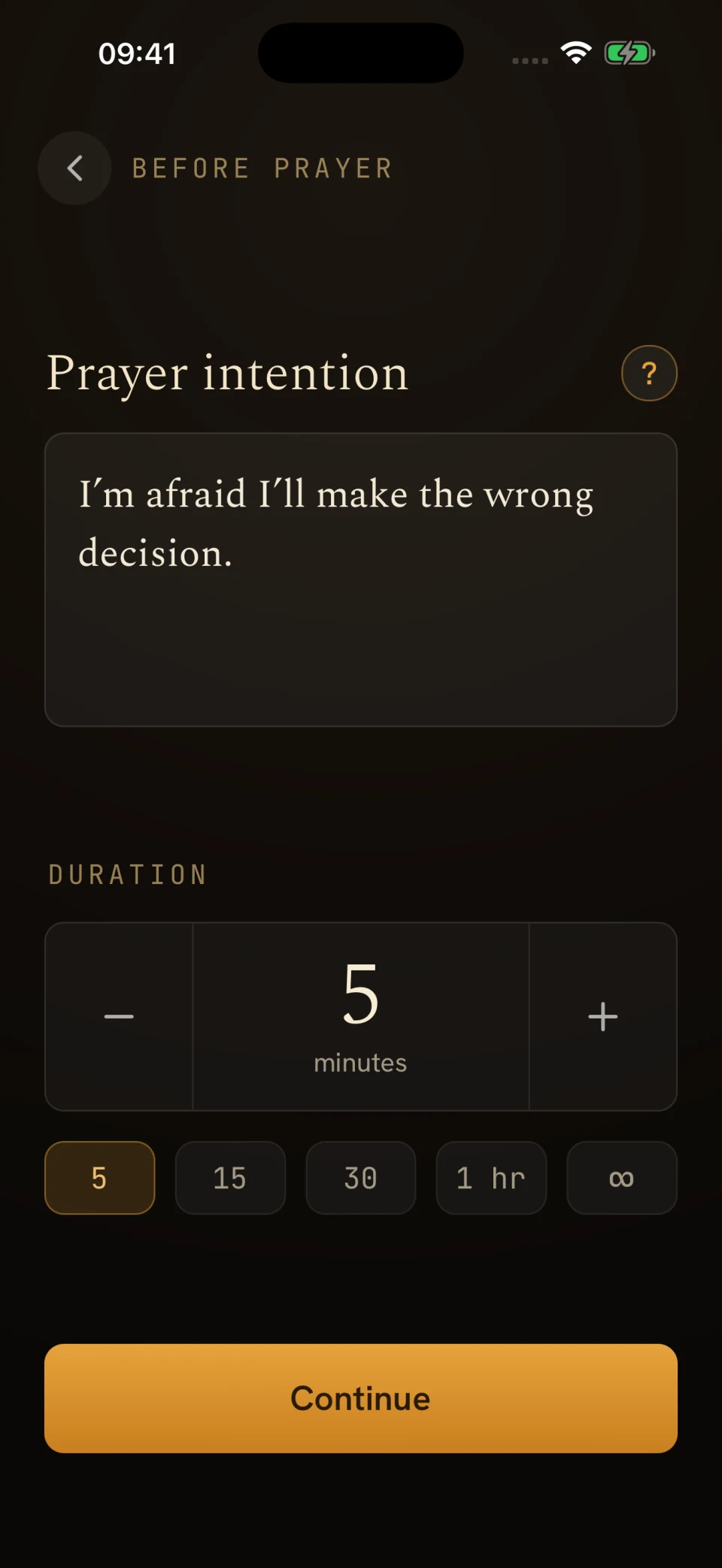
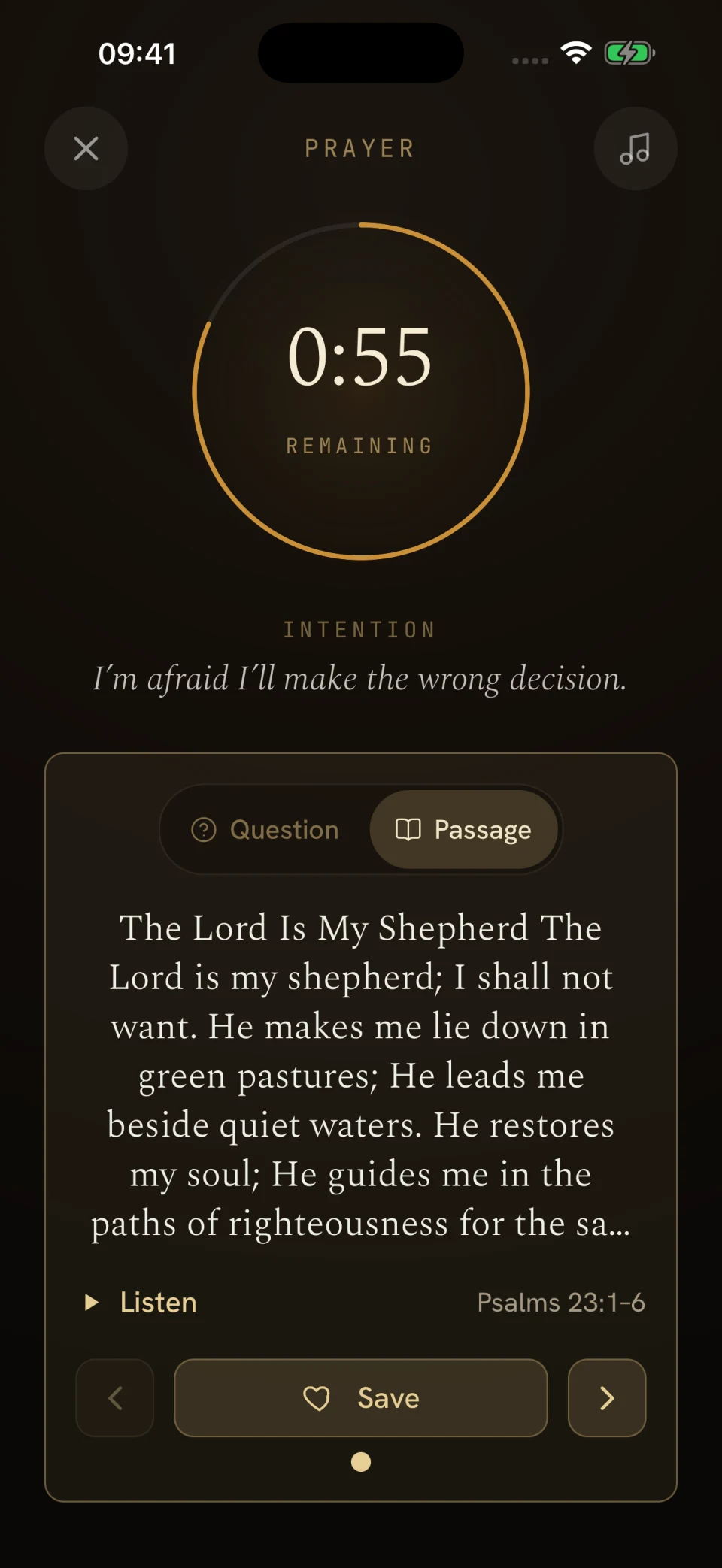
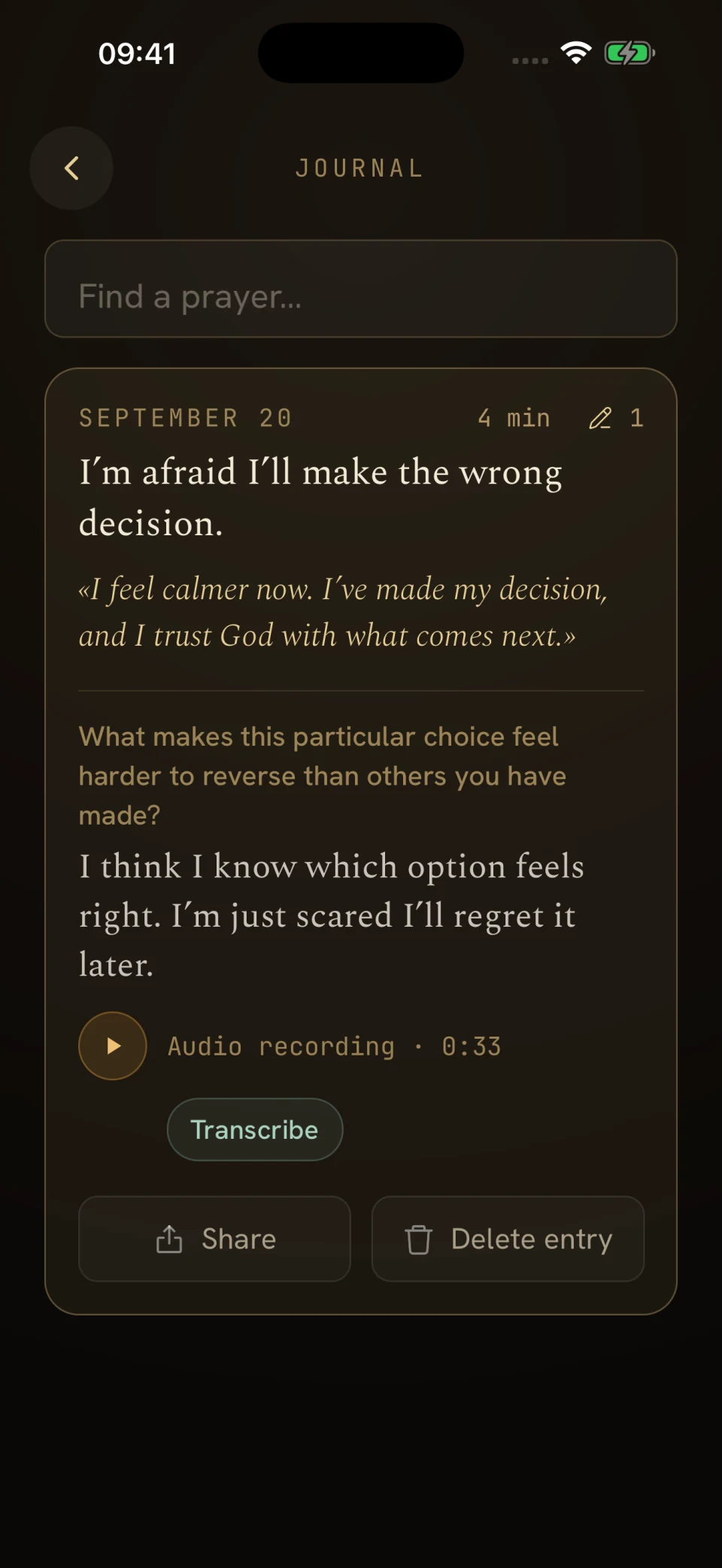
In Lampada, your prayer intention is one sentence in your own words, and it can be a person: “For Mom before her surgery,” “For Andrew, after our fight.” You can answer the guiding questions by typing or by voice, and you don’t have to turn on the AI at all. If you have allowed the app to send your intention, Lampada will find Scripture passages that fit its meaning and will try to find ones about God’s care for the person you are praying for. You can listen to them read by a narrator and tap Save to keep them.
At the end you write a takeaway of a line or two. The journal is stored only on your phone. To see when you prayed for someone and what you asked for, type their name the way you wrote it: search will find it in your intentions, answers and takeaways. That makes the journal your own version of Taylor’s sister’s notebook. You can send an entry with the Share button, but whether to tell the person you are praying for them is up to you.
What Lampada doesn’t have: a separate list of the people you pray for, a way to mark a prayer as answered, shared prayer requests, or a community where you can ask others to pray. A standing list of names is easier to keep in a notebook.
Taylor found his sister’s notebook by accident. Perhaps someone is praying for you the same way, and you have no idea. Taylor himself would later write that from the very start of his Christian life he came to feel that “prayer was in sober matter of fact transacting business with God, whether on one's own behalf or on behalf of those for whom one sought His blessing”3.
Frequently asked questions
What is intercessory prayer?
It is prayer for another person: you ask God not for yourself but for them. The Gospels give an example: Jesus prayed for Peter that his faith would not fail (Luke 22:32)15.
Can I pray for someone who hurt me?
Yes. Jesus tells us plainly to pray for those who persecute us (Matthew 5:44)11. When he was hurt, John of Kronstadt prayed “that the Lord will reconcile our hearts”8. But prayer does not cancel out boundaries or protection.
Should I tell someone I’m praying for them?
You don’t have to. Taylor learned of his sister’s prayers by chance: he opened someone else’s notebook by mistake, thinking it was his own3. But when Taylor wanted to pray with the sick man, he asked his permission, and the man agreed6.
-
Newman Hall on Wikipedia: 1816–1902; an English Nonconformist preacher; from 1854 the minister of the well-known Surrey Chapel in London; by his own account, his tract Come to Jesus (1848) sold more than four million copies. ↩
-
D. W. Whittle (ред.). The Wonders of Prayer. Answers To Prayer — Rescued In Peril. (www.gutenberg.org) a b c d e
-
J. Hudson Taylor. A Retrospect. CHAPTER I — THE POWER OF PRAYER (www.gutenberg.org) a b c d e f g h i j k l m n o p q r s t u
-
Taylor himself writes “about fifteen.” Biographers date his conversion to June 1849, when he was seventeen: Hudson Taylor on Wikipedia. ↩
-
Hudson Taylor on Wikipedia: 1832–1905; born in Barnsley, England; first arrived in China in 1854 and founded the China Inland Mission in 1865; lived in or visited China over a span of 51 years. ↩
-
J. Hudson Taylor. A Retrospect. CHAPTER VII — MIGHTY TO SAVE (www.gutenberg.org) a b c d e f g h i j k l
-
John of Kronstadt on Wikipedia (in Russian): 1829–1908; for many years the rector of St. Andrew’s Cathedral in Kronstadt; revered as a man of prayer in his own lifetime; crowds of thousands met him on his travels around Russia. ↩
-
св. прав. Иоанн Кронштадтский. Дневники (полное издание, т. I–XXVI). Часть 3. 1904–1907 годы (azbyka.ru) a b c d
-
Matthew 5:44. Berean Standard Bible (BSB), public domain. a b
-
Ambrose of Optina on Wikipedia (in Russian): 1812–1891; a hieroschemamonk of Optina Monastery, revered as an elder in his own lifetime; a model for the elder Zosima in Dostoevsky’s The Brothers Karamazov. ↩
-
прп. Амвросий Оптинский. Письма к мирским особам. 191. МАТЕРИ, СКОРБЯЩЕЙ О НЕВЕРИИ СЫНА. О ГОВЕНИИ (azbyka.ru) a b c d e f
-
прп. Амвросий Оптинский. Письма к мирским особам. 191. МАТЕРИ, СКОРБЯЩЕЙ О НЕВЕРИИ СЫНА. О ГОВЕНИИ, our translation (azbyka.ru) a b c d e f
-
The title page of her book Prisons and Prayer; Or, a Labor of Love (1906): “Mother Wheaton,” “Prison Evangelist,” “nearly Twenty-two Years of Gospel Work… in Prisons”: Project Gutenberg. ↩
-
Elizabeth Ryder Wheaton. Prisons and Prayer; Or, a Labor of Love. CHAPTER XIV. — Gone Home from the Scaffold. — INTERCEDED FOR THE LIFE OF A BOY. (www.gutenberg.org) a b c d e f
-
Elizabeth Ryder Wheaton. Prisons and Prayer; Or, a Labor of Love. CHAPTER XIV. — Gone Home from the Scaffold. — WENT TO THE SCAFFOLD SINGING. (www.gutenberg.org) a b c d e
-
S. D. Gordon. Quiet Talks on Prayer. III. How to Pray — The "How" of Method (ccel.org) a b