
Egypt, the fourth century. In the hills of Pherme, on the edge of the desert of Scetis, some five hundred ascetics live1. One of them, Paul, is given over to unceasing prayer alone: he does no work, and he accepts only as much in alms as he needs to eat1. “He had three hundred set prayers; every day he gathered exactly that many pebbles, kept them in his belt and threw one away at each prayer”2. One day he goes to see the elder Macarius, known as the City-Dweller, and confesses: “Father, I am in great distress”2.
Only after much persuading does Paul say what is troubling him1: in a certain village, a virgin has been living as an ascetic for thirty years1. He has been told that she eats only on Saturdays and Sundays and says seven hundred prayers a day1. “That is why I have been reproaching myself, because I can’t manage more than three hundred”2.
Palladius, who had lived among the Egyptian monks himself, wrote this story down in his Lausiac History around 4203. We’ll come back to Macarius’s answer at the end.
A rule of prayer is “the prayers a person says regularly, every day”4. Its length varies widely, from a few minutes to several hours. How much to pray depends on a person’s spiritual make-up, how deeply they are rooted in prayer and how much time they have5. Orthodox Christians call it a prayer rule. Anglicans keep the Daily Office, Morning and Evening Prayer from the Book of Common Prayer, and Catholics pray the Liturgy of the Hours6. In Orthodox practice, there is a short rule of morning and evening prayers meant for everyone, found in any prayer book. And for days of extreme fatigue or too little time there is the shortest of all, the rule of St. Seraphim of Sarov: the Lord’s Prayer three times, “Rejoice, O Virgin Theotokos” three times and the Creed once7. What matters in a rule is not its size but a measure that fits your strength. People whose rule fell apart learned this the hard way.
St. Seraphim’s short rule
The Lord’s Prayer is the prayer Christ Himself taught His disciples (Matthew 6:9–13)8:
Our Father in heaven, hallowed be Your name. Your kingdom come, Your will be done, on earth as it is in heaven. Give us this day our daily bread. And forgive us our debts, as we also have forgiven our debtors. And lead us not into temptation, but deliver us from the evil one.
“Rejoice, O Virgin Theotokos” is built on the words with which the archangel Gabriel and Elizabeth greeted Mary (Luke 1:28, 42). In the West, a close relative of this prayer is known as the Hail Mary9:
Rejoice, O Virgin Theotokos, Mary full of grace, the Lord is with you. Blessed are you among women, and blessed is the fruit of your womb, for you have given birth to the Saviour of our souls.
The Creed is longer; you will find it in any prayer book.
Praying morning and evening is an ancient rhythm. The psalmist wrote: “Morning, noon, and night, I cry out in distress, and He hears my voice” (Psalm 55:17)10. Notice that he doesn’t say “I recite flawlessly,” but “I cry out in distress.” A rule has room for a tired, uneven voice too.
The rule that didn’t fit
In his book On Prayer, Hilarion Alfeyev recalls that after taking monastic vows at the age of twenty, he asked an experienced spiritual father what his rule of prayer should be5, and was told: “You must read the morning and evening prayers, three canons and one akathist every day”4. Canons and akathists are types of devotional hymns used in Orthodox worship. The spiritual father continued: “Whatever happens, even if you are very tired, you must read them. And even if you read them hastily and without attention, it doesn’t matter”4.
“I tried. It didn’t work”4, he writes. He describes how quickly the daily repetition of a fixed set of prayers can become tiresome5. Besides, he spent hours at church services, which, he says, “fed me spiritually, filled me and gave me wings”4. Next to them, the three canons and the akathist came to feel like a needless extra load5.
Then Hilarion found different advice from Theophan the Recluse, whom we wrote about in our article on praying in your own words: to measure a rule “not by the number of prayers but by the time we are ready to give to God”4. For example, half an hour in the morning and in the evening, but given wholly to God5. What you fill that time with matters less: you can read all the prayers or just one, or give a whole evening to the Gospel, the Psalms or prayer in your own words5. “This advice suited me”4, Hilarion writes.
He doesn’t present his way as the only one: “I don’t rule out, however, that others will find the advice my spiritual father gave me more suitable”4. About lay people he writes with care: in his view, even five minutes in the morning and evening may be enough for them, as long as they pray with attention and their life matches their prayer5.
A measure that fits your strength
Long before that, the same question, how much to pray, was put to Macarius, an elder of the Optina Monastery in Russia. He spent a quarter of a century there, guiding the monks and thousands of visitors together with the elder Leo, and with Ivan Kireyevsky he published translations of the Church Fathers11.
Once a married couple visited him at the monastery, and after returning home the wife wrote the elder a letter12. At Optina she had found peace and comfort12. But at home troubles were waiting for her: she had defended her husband against accusations heatedly, and not without anger12, and at prayer she could not gather her scattering thoughts12. So she asked the elder to assign her prayers for every day12.
Macarius was so weak that he could not write himself and dictated his reply to a brother12. The peace she had found at the monastery, he answered, had been given to her by the Lord12, “but in the course of life and in dealings with people one cannot always remain in such a state of spirit”13. And about her wandering thoughts he wrote: “to pray without distraction is the work of the perfect”13. Only then did he turn to her request, with an honest caveat: “Not knowing your home situation, your occupations and your strength, I cannot say precisely”13. And then, “if it suits you,” he suggested: the morning and evening prayers and, when there was time, a kathisma, one of the sections of the Psalter, or at least part of one; the canons to the Mother of God and to the Guardian Angel; akathists on Saturdays and Sundays; and on Sundays also a chapter each from the Epistles and the Gospel12. All of this she was to do humbly, “not thinking, ‘I am doing right,’ as the Pharisee thought”13. That was the measure for one nineteenth-century woman, not a norm for everyone.
An Anglican bishop gave similar advice. Edward King, later Bishop of Lincoln14, wrote to a lady in 1874 that in a life in the world one can expect to bring under rule only the outward framework of the day: sleep, meals, work and prayer15, “so as to have an average of regularity”15.
The Russian Orthodox priest Alexander Men compiled his Practical Guide to Prayer almost entirely from the writings of Christian teachers of East and West16. One of their tips is very down-to-earth: say the morning prayers before you start on anything else, or, if that doesn’t work out, at least on your way out the door. Don’t put off the evening prayers until late at night, when fatigue no longer lets you focus: it is better to say them before supper or even earlier17.
When you want to do more
There is another trap: piling on more and more. Abbot Nikon (Vorobyov) knew real hardship: in 1933 he was arrested and sent to the Siberian camps18. In 1944 he became rector of the Church of the Annunciation in Kozelsk and lodged with some nuns, and those who knew him then remembered how incredibly emaciated he was19.
Later Nikon told how something else grew along with his zeal in serving: “And the better I thought I was serving, the more a high opinion of myself grew somewhere deep inside”20. After his evening prayers he began making a hundred prostrations with the Jesus Prayer, sometimes until two in the morning, and he got up around four to make another hundred before the service19. “From the outside the nuns saw it; they are a curious lot”20, he recalled. “But the Lord saw that I was doing the devil’s work, not God’s”20.
There was another pastor in Kozelsk, Father Raphael, a former Optina monk who had spent twenty-one years in the camps, a kind and prayerful man. The two of them fell out, and Nikon was suspended from serving for a time19. “And far from being rewarded somehow, I was thrown out of the priesthood”20, he said later. One might think he had suffered “for some good deed, for my ascetic feat”20. But in Nikon’s own words, “the Lord let me understand that this was the work of demons, that it was vanity, a high opinion of myself”20. That opinion went like this: “though I’m no longer young, nearly 55, I make a hundred prostrations in the evening, a hundred in the morning, and with attention!”20 Later the suspension was lifted. Nikon also made peace with Father Raphael, by letter, and in his letter he took the blame on himself and repented19.
The prostrations themselves are not the point: Nikon is talking about the vanity that grew along with his zeal. Years later he advised a spiritual daughter: “Set yourself a small rule, one within reach of your circumstances and strength”21.
Three centuries earlier, a similar letter reached Noël de Sillery, a Knight of Malta and former ambassador who renounced the world and became a priest in 163422. The Catholic nun Jane Frances de Chantal wrote to him that what she had always feared had happened: his great fervour had worn him down23. But what troubled him was something else: was he indulging himself, giving in to faintheartedness?23 Just like Paul with his three hundred prayers.
Chantal begged him, for God’s sake, to let go of such thoughts: all his worry that he was doing too little pleased God far less than a humble willingness to accept rest for body and soul23. God asks only for his heart, not for great feats that strain his strength23. There is no point in wringing from the body what even God does not demand: it was God who gave him his frail health, and He wants it looked after23. For now God expects from him not strenuous effort of mind and will but rest; it is enough now and then, without any strain, to turn to Him with love and acceptance of His will23. And of the four or five hours he spent on his knees each day, one would be enough: a quarter of an hour after getting up, a quarter before Mass, a quarter after it and a short quarter in the evening to look back over the day. She also told him to rest and eat well to get his strength back23.
When your rule isn’t working
To the woman who had come home from Optina, Macarius added at the end of his letter: “if you fail to do something because of some obstacle, or even out of laziness, do not be troubled in the least, do not despond and do not lose heart”13.
Another lay correspondent asked him something very practical: what if you start the rule but are too tired to finish it, or someone calls you away: may you mark the place and finish later?24 He replied: “You may do that, or you may leave it, making up for what is lacking with humility, without being troubled that you did not complete it for some reason”25. She also asked about a forty-day prayer, with its prayers and prostrations counted out: she had been told that after it you were sure to receive what you asked for24. Macarius admitted that he had “never happened to read of this anywhere in the rules and instructions of the Fathers”25, and he did not dare to claim anything on his own authority; to follow such advice without the support of Scripture or the Fathers was not safe24. The Lord told us to ask, “but He did not set a number of prayers for each matter”25.
Alexander Men warned against the other extreme: “To drop the ‘rule’ altogether is dangerous”26. Tiredness and distraction, though, are in his view no reason to be troubled7.
The seventeenth-century Anglican writer Jeremy Taylor27 took a stricter view: an hour a day was not too much to give God28. Yet he divided his prayers into short portions so that readers could choose which to use28.
If the words have worn thin, you can do what Hilarion did: sometimes give the time of your rule to the Psalms, the Gospel or your own words. Men had Church Slavonic in mind, but his advice works just as well for the old English of “thee” and “thou”: work out what the prayers mean before you pray, using a ready translation or putting them into your own words29.
A rule exists for the sake of the person. Christ said of the Sabbath: “The Sabbath was made for man, not man for the Sabbath” (Mark 2:27)30.
How to choose your rule
Start with what you can definitely do: a short rule from the prayer book, one office, or five minutes in the morning and evening. If counting weighs on you, measure by time. Fit your rule around your commute, your work, your children and your health. Before adding more, check whether you have the strength and whether you are driven by a wish to outdo yourself or others. Review your rule calmly, with a spiritual father or pastor if you have one. If it falls apart, start again without beating yourself up.
Your rule and Lampada
Lampada has no prayer book: no morning or evening prayers, no canons or akathists, no Daily Office and no St. Seraphim’s rule. Pray your rule from your own book, and let the app help with the rest.
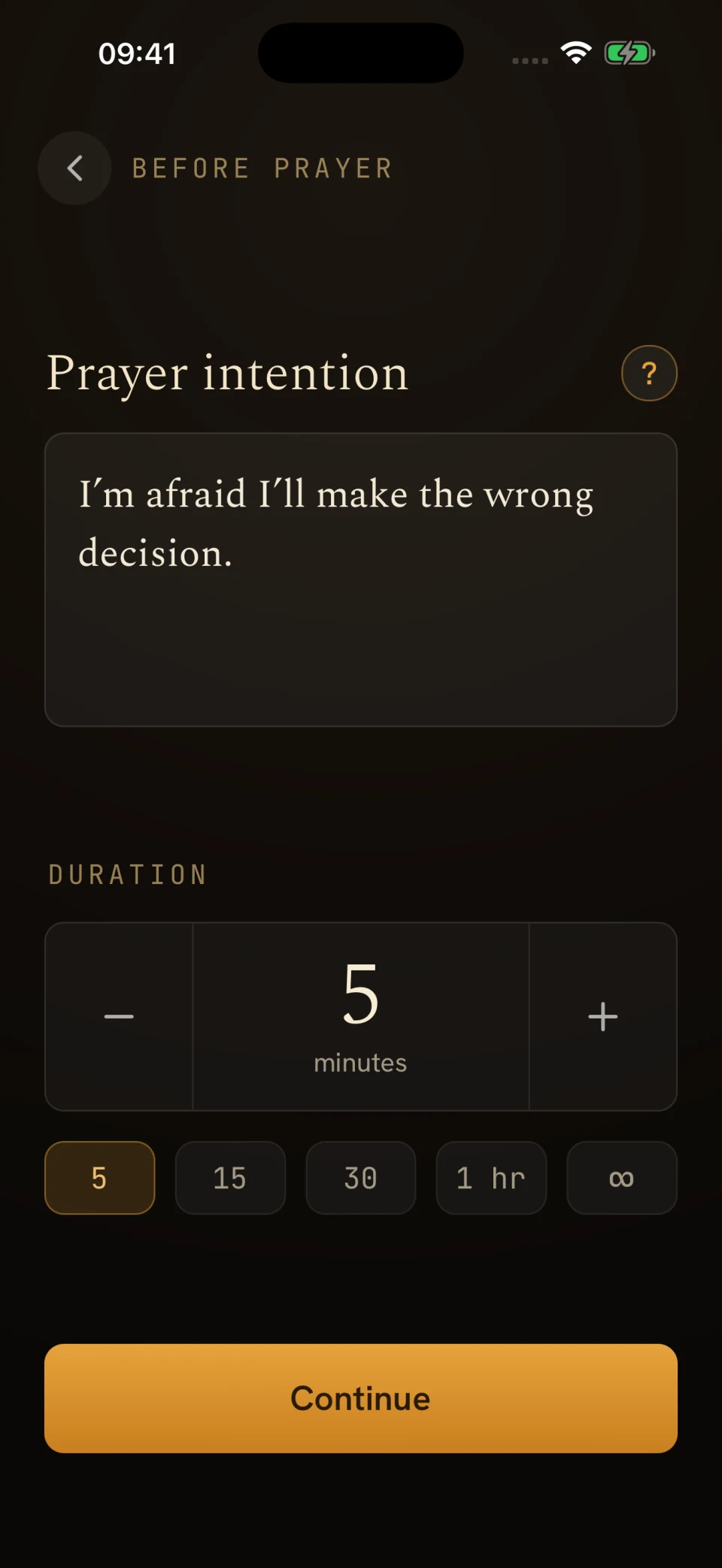
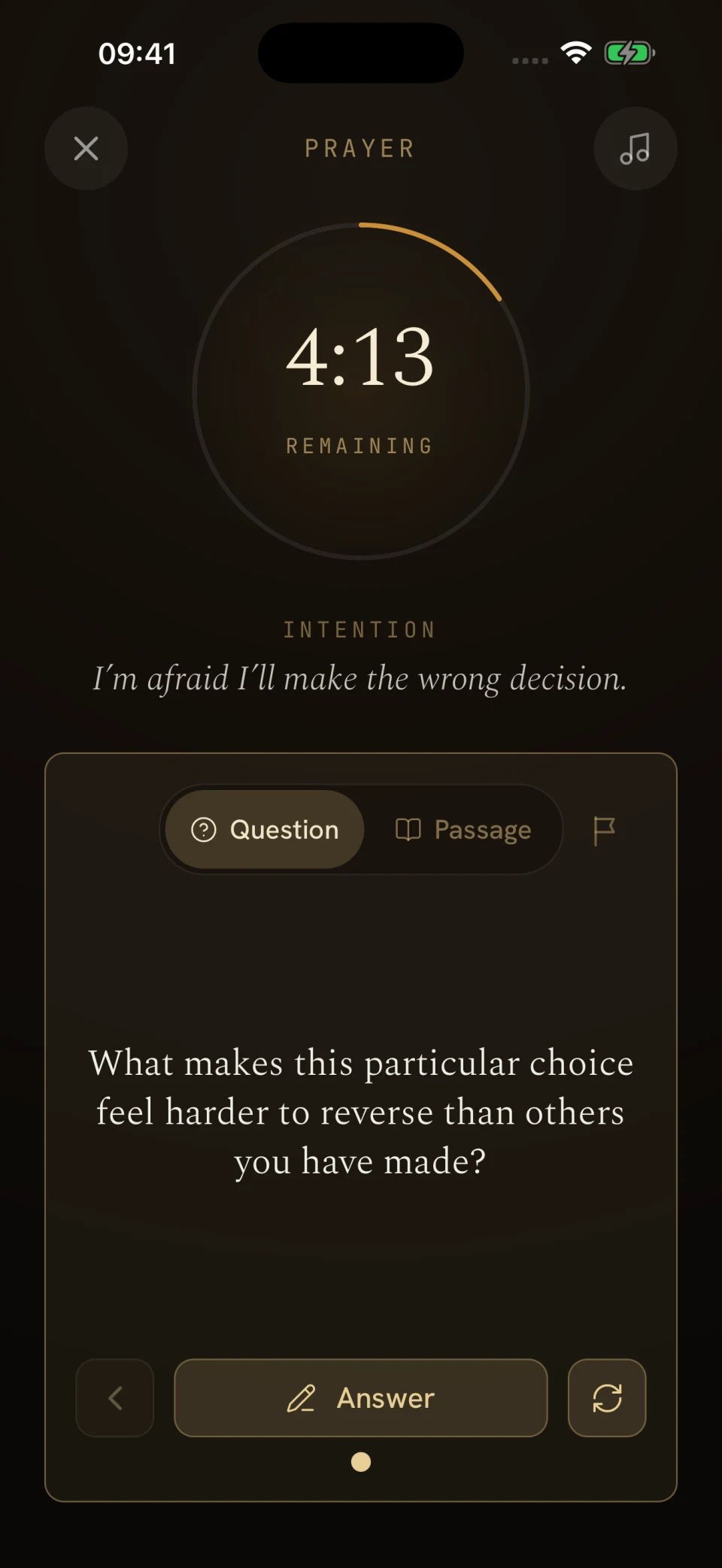
If, like Hilarion, you measure your rule by time, choose how long to pray, anywhere from 1 to 120 minutes, or pray with no timer. When the time is up, the screen says: “Time is up. You can continue.” After your rule you can add a few minutes in your own words: name your prayer intention in one sentence, answer the guiding questions and, if you allow your intention to be sent, receive a Scripture passage that fits its meaning. A short takeaway stays in your journal on your phone.
Reminders can be set by day of the week and by hour: several times a day, and differently on weekdays and weekends, like the psalmist’s “morning, noon, and night.”
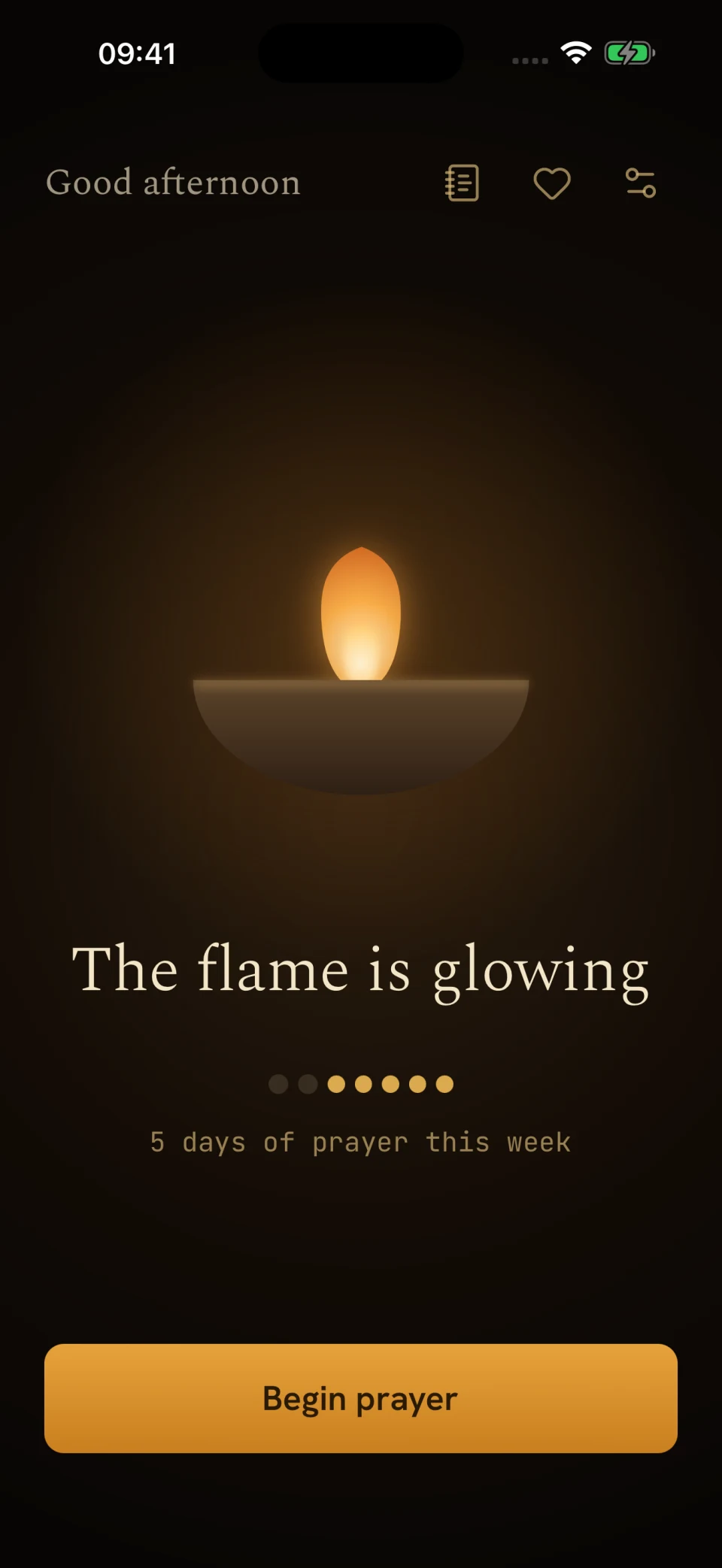
On the home screen you’ll see a small flame and seven dots for the past week, one for each day you prayed. There is no streak counter that resets after a missed day: a missed day is simply an empty dot. Keep in mind that the dots only count prayers in the app, so a rule you pray from your book won’t light them up. Lampada has no counter for prayers or prostrations either.
So what did the Egyptian elder Macarius say to Paul? “For sixty years I have said a hundred prayers every day; at the same time I earn my living with my own hands and give the brothers as much time as they need. And yet the thought that I am negligent never once occurs to me”2. And he added: “But if your conscience reproaches you even though you say three hundred prayers, it follows that you are not praying with devotion, or that you could pray more than you actually do”2. What matters is not how much someone else prays, but whether you pray with attention and whether your rule fits your strength.
Frequently asked questions
What is a good short rule of prayer for beginners?
In the Orthodox tradition, a short rule of morning and evening prayers can be found in any prayer book7. On days of extreme fatigue or too little time, you can pray the rule of St. Seraphim of Sarov: the Lord’s Prayer three times, “Rejoice, O Virgin Theotokos” three times and the Creed once7.
What rule of prayer suits lay people?
Hilarion Alfeyev believes that five minutes in the morning and evening may be enough for a lay person, as long as they pray with attention and feeling5. Abbot Nikon advised a small rule, “within reach of your circumstances and strength”21.
What is the Daily Office?
In Anglican churches, the Daily Office is the daily round of Morning and Evening Prayer, usually following the Book of Common Prayer. Clergy and lay people alike can lead it6.
-
Палладий Еленопольский. Historia Lausiaca. 20. Paulus von Pherme., translated by R. Storf (bkv.unifr.ch) a b c d e
-
Палладий Еленопольский. Historia Lausiaca. 20. Paulus von Pherme., translated by R. Storf, our translation (bkv.unifr.ch) a b c d e
-
Palladius of Galatia on Wikipedia: travelled to Egypt to meet the Desert Fathers; wrote the Lausiac History in 419–420. ↩
-
митр. Иларион (Алфеев). О молитве. 7. МОЛИТВЕННОЕ ПРАВИЛО, our translation (predanie.ru) a b c d e f g h
-
митр. Иларион (Алфеев). О молитве. 7. МОЛИТВЕННОЕ ПРАВИЛО (predanie.ru) a b c d e f g h
-
On Anglican Morning and Evening Prayer, see Daily Office (Anglican) on Wikipedia; on Catholic practice, see Liturgy of the Hours. a b
-
прот. Александр Мень. Практическое руководство к молитве. Практическое руководство к молитве — I. Молитва и молитвословие — 1. Молитвословие (predanie.ru) a b c d
-
Matthew 6:9–13. Berean Standard Bible (BSB), public domain. ↩
-
Our translation of the traditional Church Slavonic prayer; the source text is public domain. On its Gospel sources and its relation to the Latin Hail Mary, see Hail Mary on Wikipedia. ↩
-
Psalm 55:17 (Psalm 54:18 in the Greek and Slavonic numbering used in Orthodox prayer books). Berean Standard Bible (BSB), public domain. ↩
-
Макарий Оптинский on Wikipedia (in Russian): at Optina Monastery from 1834 until his death in 1860; with the elder Leo guided the monks and many thousands of people; with help from Ivan and Natalia Kireyevsky, published the translations of the Church Fathers made by Paisius Velichkovsky. ↩
-
прп. Макарий Оптинский. Собрание писем… к мирским особам. Письма 201–300 — 231 (azbyka.ru) a b c d e f g h
-
прп. Макарий Оптинский. Собрание писем… к мирским особам. Письма 201–300 — 231, our translation (azbyka.ru) a b c d e
-
Edward King (bishop of Lincoln) on Wikipedia: Bishop of Lincoln in the Church of England from 1885 to 1910. ↩
-
Edward King (епископ Линкольнский). Spiritual Letters (archive.org) a b
-
прот. Александр Мень. Практическое руководство к молитве. Практическое руководство к молитве — Введение (predanie.ru)
-
прот. Александр Мень. Практическое руководство к молитве. Практическое руководство к молитве — I. Молитва и молитвословие — 3. Время и место (predanie.ru)
-
Никон (Воробьёв) on Wikipedia (in Russian): arrested in 1933 and sentenced to five years in the Siberian camps; rector of the Church of the Annunciation in Kozelsk from 1944. ↩
-
игум. Никон (Воробьёв). Нам оставлено покаяние. Я искренне всегда стремился к Богу. Биография игумена Никона (Воробьева) (predanie.ru) a b c d
-
игум. Никон (Воробьёв). Нам оставлено покаяние. Я искренне всегда стремился к Богу. Биография игумена Никона (Воробьева), our translation (predanie.ru) a b c d e f g
-
игум. Никон (Воробьёв). Нам оставлено покаяние. Письма игумена Никона (Воробьева) к духовным чадам — Письмо 268, our translation (predanie.ru) a b
-
Noël Brûlart de Sillery on Wikipedia: Knight of Malta; ambassador to Spain in 1614 and to Rome in 1622; renounced the world and became a priest in 1634. ↩
-
св. Иоанна Франциска де Шанталь. Lettres (избранное). XCV. To M. Noël Brulart, the Commander de Sillery.[A] (www.gutenberg.org) a b c d e f g
-
прп. Макарий Оптинский. Собрание писем… к мирским особам. Письма 201–300 — 243 (azbyka.ru) a b c
-
прп. Макарий Оптинский. Собрание писем… к мирским особам. Письма 201–300 — 243, our translation (azbyka.ru) a b c
-
прот. Александр Мень. Практическое руководство к молитве. Практическое руководство к молитве — I. Молитва и молитвословие — 1. Молитвословие, our translation (predanie.ru)
-
Jeremy Taylor on Wikipedia: 1613–1667; cleric of the Church of England; author of The Rule and Exercises of Holy Living (1650). ↩
-
Jeremy Taylor. The Rule and Exercises of Holy Living. Chapter 1. Consideration of the General Instruments and Means Serving a Holy LIfe, by Way of Introduction. — Prayers and Devotions. — Ejaculations and short Meditations to be used in the night, when we awake. (ccel.org) a b
-
прот. Александр Мень. Практическое руководство к молитве. Практическое руководство к молитве — I. Молитва и молитвословие — 2. Подготовка к молитвословию (predanie.ru)
-
Mark 2:27. Berean Standard Bible (BSB), public domain. ↩